The exact weight of the mild steel (MS) structural sections is important for estimating the structural steel required, calculating the dead loads or shipping freight for fabrication projects. A MS angle weight chart that is accurate, will help the structural engineer, steel fabricators, quantity surveyor and procurement teams, to be able to check on the standard weight per meter in a flash, thus enabling them to cost, design structures and manage materials. Mild steel angles, commonly known as L-angles or structural angle iron, are hot-rolled pieces of steel that have an L-shape and are right angled, that is, 90 degrees. This guide contains a verified reference table for standard equal angle sizes ranging from 20×20mm to 200×200mm along with the standard mathematical formula for weight calculation as prescribed in Indian Standard IS 808:1989, worked examples from the engineering practice and imperial conversion factors.
What Is an MS Angle?
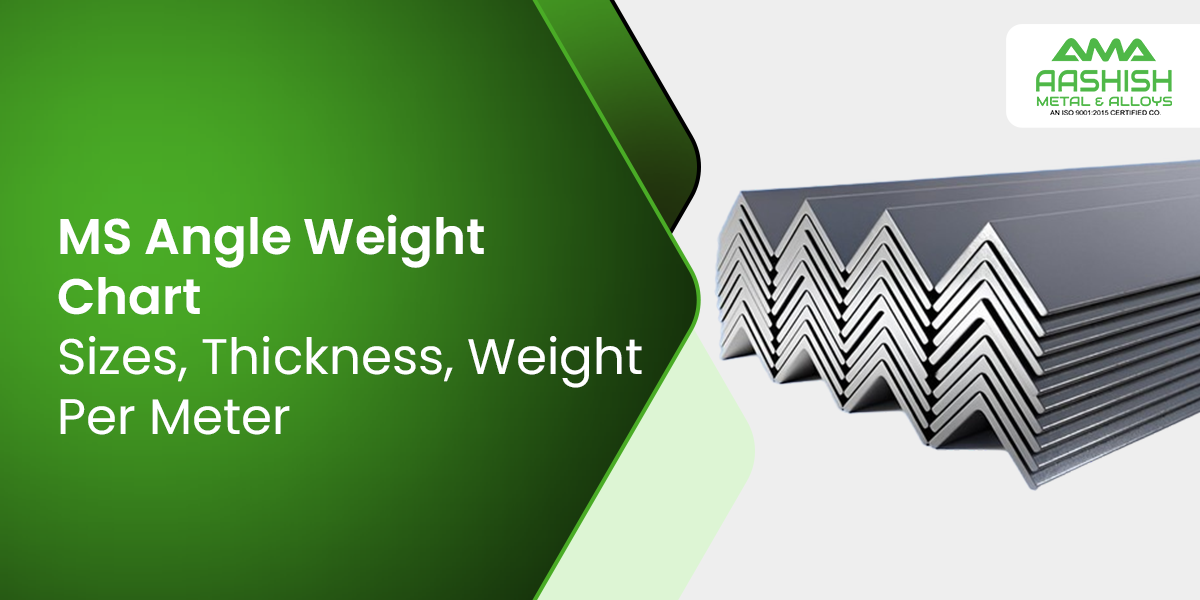
An MS angle is a hot-rolled mild steel section shaped with two legs forming a right angle (90). These structural shapes are widely utilized in steel building frameworks, industrial trusses, transmission towers, machinery bases, and general metal fabrication due to their high structural stiffness relative to weight. In structural engineering, mild steel angles are rolled according to standardized dimensional specifications such as IS 808:1989.
MS Angle Weight Chart — Sizes, Thickness & Weight Per Meter
Angle Size (mm) | Thickness (mm) | Nominal Mill Weight (kg/m) | Theoretical Precision Weight (kg/m) |
20 × 20 | 3 mm | 0.90 | — |
25 × 25 | 3 mm | 1.10 | 1.114 |
25 × 25 | 5 mm | 1.80 | 1.770 |
30 × 30 | 2.5 mm | — | 1.171 |
30 × 30 | 3 mm | 1.36 | 1.363 |
30 × 30 | 5 mm | 2.20 | 2.180 |
35 × 35 | 4 mm | 2.10 | — |
35 × 35 | 5 mm | 2.60 | — |
40 × 40 | 2.5 mm | — | 1.582 |
40 × 40 | 3 mm | — | 1.874 |
40 × 40 | 5 mm | 3.00 | 2.974 |
40 × 40 | 6 mm | 3.50 | 3.516 |
45 × 45 | 4 mm | — | 2.131 |
45 × 45 | 5 mm | 3.40 | 3.378 |
45 × 45 | 6 mm | 4.00 | 3.998 |
50 × 50 | 4 mm | — | 2.367 |
50 × 50 | 5 mm | 3.80 | 3.770 |
50 × 50 | 6 mm | 4.50 | 4.469 |
50 × 50 | 8 mm | — | 5.819 |
50 × 50 | 10 mm | — | 7.056 |
55 × 55 | 6 mm | 4.90 | — |
60 × 60 | 5 mm | — | 4.568 |
60 × 60 | 6 mm | 5.40 | 5.423 |
60 × 60 | 8 mm | 7.00 | 7.088 |
60 × 60 | 10 mm | — | 8.689 |
65 × 65 | 6 mm | 5.80 | — |
65 × 65 | 8 mm | 7.70 | — |
65 × 65 | 10 mm | 9.40 | — |
70 × 70 | 6 mm | 6.30 | — |
75 × 75 | 6 mm | 6.80 | — |
75 × 75 | 8 mm | 8.90 | — |
75 × 75 | 10 mm | 11.00 | — |
80 × 80 | 6 mm | 7.30 | — |
80 × 80 | 8 mm | 9.60 | — |
80 × 80 | 10 mm | 11.80 | — |
90 × 90 | 8 mm | 10.80 | — |
90 × 90 | 10 mm | 13.40 | — |
100 × 100 | 8 mm | 12.10 | — |
100 × 100 | 10 mm | 14.90 | — |
100 × 100 | 12 mm | 17.70 | — |
110 × 110 | 10 mm | 16.60 | — |
110 × 110 | 12 mm | 19.70 | — |
130 × 130 | 10 mm | 19.70 | — |
130 × 130 | 12 mm | 23.50 | — |
150 × 150 | 10 mm | 22.80 | — |
150 × 150 | 12 mm | 27.20 | — |
150 × 150 | 16 mm | 35.80 | — |
150 × 150 | 20 mm | 44.10 | — |
200 × 200 | 16 mm | 48.50 | — |
200 × 200 | 20 mm | 60.00 | — |
How to Calculate MS Angle Weight (Formula)
When looking up specified or non-standard angle sizes, you can manually calculate the theoretical weight per meter using the standard geometric cross-sectional area formula for equal angles.
Mathematical Formula for MS Equal Angle Weight
Weight per Meter (kg/m) = (2 × A − t) × t × 0.00785
Where:
- A = Leg length of the equal angle (in millimeters, mm)
- t = Thickness of the angle leg (millimeters, mm)
- 0.00785 = Density constant derived from mild steel density (7,850 kg/m³ divided by 1,000,000 mm²/m²)
Worked Calculation Example
Problem: Calculate the weight per meter of an 50 × 50 × 6 mm MS angle.
- Identify the variables:
- Leg length (A) = 50 mm
- Thickness (t) = 6 mm
- Apply the values to the formula:
Weight = (2 × 50 − 6) × 6 × 0.00785
Weight = (100 − 6) × 6 × 0.00785
Weight = 94 × 6 × 0.00785
Weight = 564 × 0.00785 = 4.4274 kg/m
- Rounding & Comparison:
The calculated theoretical weight is approximately 4.43 kg/m. Published mill charts (like the standard table above) list this section at 4.50 kg/m. The slight difference (~0.07 kg/m) accounts for the internal root radius (r₁) and toe fillets added during rolling to eliminate stress concentrations in structural steel sections.
Common Unit Conversions MS Angle Weight Chart
Angle Size (mm) | Thickness (mm) | Weight (kg/m) | Weight (lb/ft) |
25×25 | 3 | 1.10 | 0.74 |
50×50 | 6 | 4.50 | 3.02 |
75×75 | 8 | 8.90 | 5.98 |
100×100 | 10 | 14.90 | 10.01 |
MS Angle vs MS Channel: What Is the Difference?
Parameter | MS Angle (L-Shape) | MS Channel (C-Shape) |
Cross-Sectional Shape | Single 90 elbow with 2 legs | C-shaped profile with 1 web and 2 flanges |
Primary Structural Role | Bracing, trusses, corner joins, frames | Load-bearing beams, columns, purlins, joists |
Bending Axis Symmetry | Asymmetrical or single-axis symmetry | Symmetrical along the major web axis |
Weight per Meter | Lighter per meter for equivalent depth | Higher per meter due to additional flange width |
Frequently Asked Questions
MS angle is a general term for mild steel angles, while ISMA refers to standardized Indian Standard Medium Angle sections manufactured according to IS 808.
The theoretical formula is:
Weight (kg/m) = 0.00785 × t × (2A − t)
Here, A is the leg length and t is the thickness, both in millimeters.
Equal MS angles have two legs of the same length, while unequal MS angles have legs of different lengths for specific structural requirements.
Yes, minor weight variations may occur due to manufacturing tolerances and differences in profile dimensions.
MS angle bars are commonly supplied in 6-meter and 12-meter lengths. Custom lengths may also be available.
An MS angle has an L-shaped profile, while an MS channel has a C-shaped profile with a web and two flanges for structural support.