Refractory Anchors
Home > Refractory Anchors
V, Y, UV, L and custom refractory anchors in SS 304, 310, 316, 330 and Inconel 601. Made to drawing, bulk supply across India.
✔ Made to your drawing ✔ Material test certificates ✔ Bulk & shutdown orders ✔ Pan-India & export supply
Refractory Anchors Manufacturer & Supplier in India
Refractory anchors are metal or ceramic holders welded to the steel shell of a furnace, boiler or kiln. They lock the refractory lining – castable, gunning mix or ceramic fibre – firmly to the wall, so it stays in place despite high heat, vibration and thermal expansion. Without the right anchors, linings crack, sag and fall off, causing costly shutdowns. Refractory anchors come in many shapes, such as V, Y, UV, L and custom designs, and are usually made from heat-resistant stainless steels like SS 304, SS 310, SS 316 and SS 330, or nickel alloys like Inconel 601 for extreme heat. They are widely used in steel plants, cement kilns, power plant boilers, petrochemical heaters, refineries, glass furnaces, aluminium smelters and incinerators. Aashish Metal is a trusted refractory anchors manufacturer and supplier in India, offering V type anchors, UV type anchors and L type anchors in standard and custom sizes, at competitive prices. Explore our stainless steel products or share your drawing on our contact page for a quick quote.
What Are Refractory Anchors?
Refractory anchors are fixing elements that hold a heat-resistant lining to the inside of high-temperature equipment. One end is welded to the steel shell; the other end (the tines or legs) is buried in the refractory. When the lining is cast or sprayed, it sets around the anchor and is locked in place.
A good anchor does three jobs:
- Holds the lining against gravity, vibration and gas flow.
- Allows thermal expansion – the shape and plastic end caps let the metal grow without cracking the refractory.
- Survives the heat – the material must resist oxidation at the temperature inside the lining.
Quick facts (snippet box):
- Types: V, Y, UV, L, wavy, ceramic, stud and custom
- Materials: SS 304, SS 310/310S, SS 316, SS 330, Inconel 601, carbon steel
- Wire / bar diameter: 4 mm – 10 mm (typical)
- Length: 25 mm – 300 mm (typical)
- Fixing: stud welding or manual welding
Types of Refractory Anchors
The anchor shape is chosen based on lining thickness, refractory type and how the lining is installed.
| Anchor Type | Shape | Best For |
|---|---|---|
| V Anchor | Two legs in a V shape | Most castable linings; general furnaces and boilers |
| Y Anchor | V top with a straight stem | Thick castable linings; cement kilns, cyclones |
| UV Anchor | U-shaped base with V legs | Better hold in high-vibration areas |
| L Anchor | Single bent leg | Thin linings, roofs and corners |
| Wavy / Corrugated V | V with waved legs | Extra grip in castable and gunning mixes |
| Ceramic Anchors | Ceramic block with metal holder | Very hot face zones above metal limits |
| Stud / Pin Anchors | Straight pin, often with clip | Ceramic fibre blankets and modules |
| Hexmesh / Mesh | Honeycomb steel mesh | Thin erosion-resistant linings in refineries |
| Custom Anchors | As per drawing | Special equipment and OEM designs |
See our dedicated pages for V type refractory anchors, UV type refractory anchors and L type refractory anchors.
How to Choose the Right Anchor Type
- Lining thickness – the anchor is usually 60–80% of the lining thickness.
- Lining material – castable, gunning or ceramic fibre.
- Location – wall, roof, floor, door or nose ring.
- Temperature at the anchor tip – decides the material grade.
- Spacing – commonly 150–300 mm, closer on roofs.
Technical Data
Stainless Steel Refractory Anchors – Material Grades
Stainless steel is the most common choice because it resists oxidation and keeps strength at high temperatures. Pick the grade by the temperature the anchor tip will see.
| Material | Approx. Max Tip Temperature | Best For |
|---|---|---|
| Carbon steel | ~430 °C | Low-temperature backup linings |
| SS 304 | ~760 °C | General boilers and ducts |
| SS 316 | ~800 °C | Areas with mild corrosion |
| SS 309 | ~1,000 °C | Medium-to-high temperature linings |
| SS 310 / 310S | ~1,100 °C | Furnaces, kilns, high-heat zones |
| SS 330 | ~1,150 °C | Very high heat and carburizing atmospheres |
| Inconel 601 | ~1,200 °C | Extreme heat and oxidation |
Temperatures are general guide values; actual limits depend on atmosphere, sulphur and design.
We also supply the raw material for anchors, including SS 310/310S stud bolts, Inconel 601 round bars and Incoloy 800/800H round bars.
Refractory Anchor Specifications
| Parameter | Details |
|---|---|
| Types | V, Y, UV, L, wavy V, stud, custom |
| Materials | SS 304, 309, 310/310S, 316, 330, Inconel 601, carbon steel |
| Diameter | 4 mm, 5 mm, 6 mm, 8 mm, 10 mm (wire / round bar) |
| Flat section | 2 × 10 mm to 3 × 20 mm (strip anchors) |
| Length | 25 mm – 300 mm |
| Footprint | Flat or round base for welding |
| End caps | Plastic caps for thermal expansion (on request) |
| Finish | Bright / as-formed |
| Packing | Boxes or bags, quantity per type |
| Documents | Material test certificate (EN 10204 3.1) |
Common V Anchor Sizes
| Wire Dia. (mm) | Height (mm) | Typical Lining Thickness (mm) |
|---|---|---|
| 4 | 50 – 75 | 75 – 100 |
| 5 | 75 – 100 | 100 – 150 |
| 6 | 100 – 150 | 150 – 200 |
| 8 | 150 – 200 | 200 – 250 |
| 10 | 200 – 300 | 250 – 400 |
Refractory Anchors Price in India
Refractory anchor price depends on the material grade, wire diameter, length, shape, quantity and whether end caps are needed. Nickel-rich grades like SS 310, SS 330 and Inconel 601 cost much more than SS 304.
| Anchor Type & Material | Price |
|---|---|
| SS 304 V Anchor | ₹___ per piece / per kg |
| SS 310 V Anchor | ₹___ per piece / per kg |
| SS 310 Y Anchor | ₹___ per piece / per kg |
| SS 316 UV Anchor | ₹___ per piece / per kg |
| SS 330 Anchor | ₹___ per piece / per kg |
| Inconel 601 Anchor | Price on Request |
| Custom Anchor (as per drawing) | Price on Request |
What Affects the Price
| Factor | Effect |
|---|---|
| Material grade | Biggest factor – linked to nickel price |
| Diameter & length | More weight = higher price per piece |
| Shape | Complex shapes (Y, UV, wavy) cost more to form |
| Quantity | Bulk orders get lower per-piece rates |
| Extras | End caps, special testing and packing add cost |
Applications of Refractory Anchors
| Industry | Where Anchors Are Used |
|---|---|
| Steel plants | Reheating furnaces, ladles, tundishes, blast furnace parts |
| Cement | Kilns, preheater cyclones, coolers, tertiary air ducts |
| Power plants | Boilers, burners, ducts, cyclones |
| Petrochemical & refineries | Process heaters, reformers, FCC units, flue ducts |
| Glass | Melting furnaces, regenerators |
| Aluminium & non-ferrous | Melting and holding furnaces |
| Incinerators & waste-to-energy | Combustion chambers |
| Ceramics & heat treatment | Kilns, heat-treatment furnaces |
Benefits of Quality Refractory Anchors
| Feature | Benefit |
|---|---|
| Correct heat-resistant grade | No oxidation or burn-off inside the lining |
| Accurate shape & size | Even hold across the whole wall |
| Clean weld footprint | Strong, reliable weld to the shell |
| Expansion-friendly design | Less cracking of the lining |
| Consistent batches | Faster installation, fewer rejects |
| Longer lining life | Fewer shutdowns and lower repair costs |
Standards & Documents
| Item | Details |
|---|---|
| Material standards | ASTM A240, ASTM A276, ASTM A580 (wire), ASTM B166 (Inconel) |
| Test certificate | EN 10204 3.1 MTC |
| Testing | PMI, dimensional check, weld test on request |
| Quality | ISO 9001 quality system |
| Inspection | Third-party inspection on request |
Types of Refractory Anchors We supply
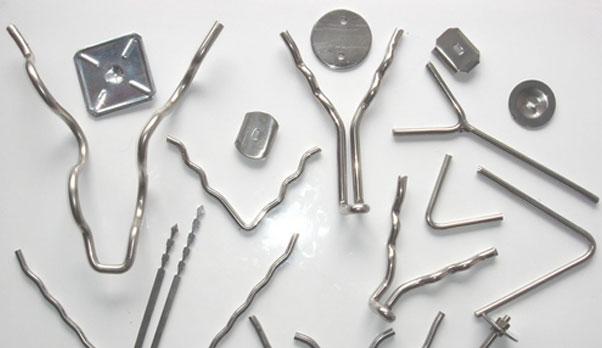
Aashish Metals manufactures all major refractory anchor types in multiple grades and custom dimensions. Each anchor type is designed to address specific mechanical and thermal challenges within high-temperature linings.
How We Make Refractory Anchors
- Material selection – wire, round bar or strip in the right grade, checked against the mill certificate.
- Cutting – cut to exact length on automatic machines.
- Forming – bent into V, Y, UV, L or custom shapes using dies and CNC wire benders.
- Footprint forming – base flattened or shaped for easy welding.
- Tine ends – ends finished or fitted with plastic caps if required.
- Inspection – shape, size and angle checked against the drawing; PMI on request.
- Packing & marking – packed by type and grade with clear labels.
Why Choose Aashish Metal as Your Refractory Anchors Manufacturer?
- All types in one place – V, Y, UV, L, wavy and custom anchors.
- Right grade advice – we help you pick SS 304, 310, 330 or Inconel 601 for your temperature.
- Made to drawing – for OEMs, refractory contractors and plant shutdowns.
- Bulk capacity – large quantities for shutdown schedules.
- Full traceability with MTCs.
- One-stop supply of stainless steel products, nickel alloys, fasteners and washers.
Learn more about Aashish Metal.
Need help choosing a grade? Our technical team can recommend the optimal alloy for your operating temperature, atmosphere, and lining system. Contact us with your process parameters for a free grade recommendation.
Refractory Anchors: Frequently Asked Questions
They are made by cutting heat-resistant stainless steel wire, bar or strip to length, then bending it into shapes like V, Y, UV or L using dies or CNC benders. The base is formed for welding, and the anchors are inspected for size and shape before packing.
Refractories are grouped by chemistry into three main types: acidic (such as silica), basic (such as magnesia and dolomite) and neutral (such as alumina, chromite and carbon). The type is chosen to match the slag and gases inside the furnace.
The word comes from the Latin refractarius, meaning “stubborn”. Refractory materials are “stubborn” because they resist heat – they keep their strength and shape at very high temperatures without melting or breaking down.
The common types are V, Y, UV, L, wavy V, stud and ceramic anchors, plus custom designs. V and Y anchors are the most widely used in castable linings.
It depends on the temperature at the anchor tip. SS 304 suits up to about 760 °C, SS 310 up to about 1,100 °C, and SS 330 or Inconel 601 for even higher heat.
Price depends on the grade, size, shape and quantity. SS 304 anchors are the most economical, while SS 310, SS 330 and Inconel 601 cost more. Contact us with your type and quantity for today’s price.
Products
Please feel free to contact us. We will get back to you with 2 business days. Or just call us now.