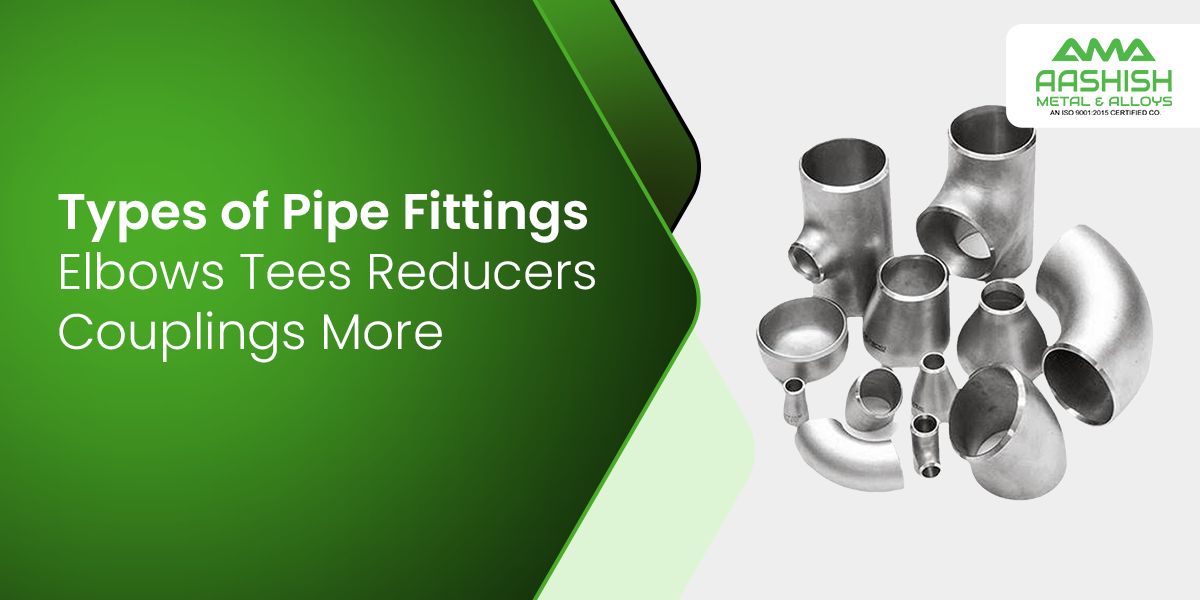
To design, fabricate, and maintain safe and efficient industrial piping systems, it is important to understand the different types of pipe fittings. Pipe fittings are important elements that are used to change the direction of flow, change line size, branch off into a number of directions, connect between straight pipe sections, or end a line all together. This all-in-one reference manual outlines the basics of process piping functionality, connection options, typical pressure ratings, and unique materials.The reference is for use by the piping engineer, fabricator and procurement buyer who need to specify the fittings used in high pressure, high temperature or highly corrosive applications. Note that mechanical tubing systems may need to use special types of instrumentation tube fittings depending on the design of the system, whereas process piping uses welded or forged components.
What are Pipe Fittings?
A pipe fitting is defined as a piping component used to join pipe sections together with other fluid control equipment like valves, pumps, and pressure vessels. Fittings are manufactured to precise dimensional standards and pressure ratings to ensure leak tight joints and structural stability under varying thermal and mechanical stresses. Fittings are not just used for joining functions, but they also have significant contributions to make in the field of system hydraulics. By choosing the correct geometry, radius and joint connection, the pressure drop will be minimal, the velocity of flow will be controlled, no turbulence caused erosion will be experienced and the mechanical integrity will be maintained under operating conditions.
Types of Pipe Fittings by Function
1. Elbows
Elbows are pipe fittings that are used to redirect flow in a pipe system. Common fittings include 45 degree elbows, 90 degree elbows and long, short and reducing elbows. They are extensively employed in industrial pipelines to circulate pipeline paths around equipment, structures, and other obstacles. Short radius elbows are typically made according to ASME B16.28, whereas butt weld elbows are in accordance with ASME B16.9.
2. Pipe Bends
Long radius pipe bends are fitted to pipelines to change direction without altering the flow path. Typical bends are 3D and 5D bends, which refer to the bend radius compared to the pipe’s outside diameter. They are especially useful when pressure loss and passage of pigs through the system is a concern on piggable pipelines and systems requiring a larger radius. MSS SP-75 is a widely used method of producing pipe bends.
3. Tees
Tees are branch fittings that are used to divide one flow up into two directions or merge flows from two branches into one pipeline. Equal or straight tees have the same diameter at all three outlets. Reducing tees have a branch outlet smaller than the run pipe.These are the same size at all 3 tee outlets and reducing tees are smaller branch outlets. A pigging system will use barred tees to keep the pigs from going into the branch line and lateral or wye fittings will be used to connect the branch line in a more gradual manner. Butt weld tees are covered by ASME B16.9.
4. Crosses
A cross fitting is a fitting that connects four lengths of pipe. They can be used to split flow between multiple pipelines or to merge flow from multiple pipelines. Straight crosses are those that are the same size at both outlets, reducing crosses have one or more outlets of different diameters. They are utilized in piping systems with several branch connections; they are often produced based on ASME B16.9.
5. Reducers
Reducers are fittings that join pipes of varying outside diameters, but allow for a gradual change in size. An eccentric reducer joins pipes of different diameters with one side of the wall kept flat rather than centered, so the top or bottom of the bore stays level. This is used to maintain proper drainage or avoid air pockets in horizontal lines. An eccentric reducer is used to join pipes horizontally when it is important to keep their centers aligned to ensure proper drainage or to avoid fluid buildup. ASME B16.9 applies to Butt weld Reducers.
6. Couplings
Reducing couplings are used to join pipes of varying diameters; full and half couplings join pipes of the same diameter and comes in various configurations to accommodate the pipe sizes and connections needed. Full couplings are used for joining two full pipe ends and half couplings are used for joining a pipe to a branch or equipment connection. Couplings are used to join pipes of varying diameters. The majority of forged socket weld and threaded couplings are produced in accordance with ASME B16.11.
7. Unions
A union is one of the mechanical fittings designed to have two pipes in continuous communication with each other, but with a simple method for separating them for maintenance, inspection or replacement. They are usually made up of a number of parts which can be tightened and loosened without turning the pipes to which they are attached. Smaller diameter piping systems usually use threaded or socket weld unions, which are addressed by ASME B16.11.
8. Pipe Caps
A pipe cap is a fitting for the end of a pipe, either permanently or temporarily sealing the end of a pipe so that the fluid does not flow out of the pipe. Process and industrial piping are often closed with butt weld caps, and threaded or socket weld caps are generally used on smaller diameter lines. The type is determined by the pipe size, the pressure, temperature, and the type of connection. ASME B16.9 covers butt weld caps and ASME B16.11 covers forged threaded/socket weld caps.
9. Stub Ends
Stub ends are short pipe fittings which are used with lap joint flanges. These are welded to the pipe and the loose lap joint flange allows it to freely rotate, which makes alignment more convenient during assembly. Stub ends come in short-pattern and long-pattern and are especially beneficial when frequent dismantling, inspection or maintenance is needed. The ASME B16.9 is used to manufacture butt weld stub ends.
10. Pipe Nipples
Pipe nipples are short lengths of pipe with external threads for use between two threaded fittings, valves, pipes or other parts. These can come in a variety of lengths, diameters, close nipples, hex nipples, reducing nipples and threaded nipples. In the field of pipe nipple, the main applications are for use in utility pipe, plumbing, instrumentation and process pipe. Threaded nipples are generally covered under ASME B16.11, while swage nipples follow MSS SP-95.
Types of Pipe Fittings by Connection and Material
Buttweld Pipe Fittings
Buttweld pipe fittings have bevelled ends that butt up against the pipe and are welded together with a full penetration weld. These are typically installed in process pipes that have high operating pressures, high temperatures, and large diameters. The welded connection not only ensures high structural strength and leakproofing, but also the continuous internal bore ensures smooth fluid flow, and minimizes turbulence, pressure loss and erosion.
Socket Weld Fittings
The socket weld pipe fittings feature a recessed socket in which the plain-end pipe is positioned and then a fillet weld is placed outside of the pipe fitting. Typically these are employed on small bore piping systems that run at high pressure and temperatures. Thermal expansion and stress on the connection are minimized during installation by leaving a small gap between the end of the pipe and bottom of the socket.
Threaded Pipe Fittings
Threaded pipe fittings are male and female pipe threads that are used to join pipes and other parts without welding. These fittings are typically made in the form of a common thread, and PTFE tape or an appropriate thread sealant is used to assist in preventing leaks. Typically they are used with low pressure utility lines, plumbing, fire protection and installations where welding is not feasible or allowed.
Stainless Steel Pipe Fittings
Stainless steel pipe fittings are chosen due to their corrosion, oxidation and chemical resistance. Common grades include 304 for general corrosion resistance, 304L for improved weldability in the same services, 316 for chloride-containing and marine environments, and 316L for welded equipment in those same chloride services Grade 904L has also been used for applications where increased resistance to aggressive chemical environments is desired.
Duplex Steel Pipe Fittings and Super Duplex Steel Pipe Fittings
Duplex and super duplex steel pipe fittings are a combination of austenitic and ferritic microstructures, they offer high mechanical strength with increased resistance to chloride stress corrosion cracking and pitting. The duplex grades are typically UNS S31803 and UNS S32205, with super duplex grades being UNS S32750 and UNS S32760. They are typically employed in offshore, marine, desalination, chemical processing and other harsh applications.
Carbon Steel Pipe Fittings
Carbon steel pipe fittings are commonplace and are used in various applications such as oil, gas, steam and water pipes or in general industrial pipes. ASTM A234 WPB is a wrought carbon steel commonly specified butt weld fitting. LTCS fittings, like ASTM A420 WPL6 & WPL3, are intended to have adequate toughness at sub zero temperatures and are used in situations where resistance to brittle fracture is of significance.
Alloy Steel Pipe Fittings
Alloy steel pipe fittings are made with alloying elements including chromium and molybdenum to enhance properties like at high temperatures, creep resistance, and strength. Common grades include ASTM A234 WP5, WP9, WP11, WP22, WP91, and WP92. They are common in the power generation, petroleum refining, boilers, superheaters and other high-temperature industrial pipe systems.
Nickel Alloy Pipe Fittings
Nickel alloy pipe fittings are applied in high demands environments where high corrosion resistance, high temperature resistance or anti-corrosive property to aggressive chemicals is required. Common alloys are Inconel alloys, Hastelloy alloys, Monel alloys and Incoloy alloys. Inconel 625 is chosen for high-temperature and severe corrosion applications, Hastelloy C276 for hostile chemical environments, Monel 400 for marine and seawater applications, and Incoloy 800/825 for elevated-temperature and chemical processing applications.
How to Choose the Right Pipe Fitting
When specifying fittings for your procurement package or engineering drawings, evaluate these four key criteria:
- System Pressure and Operating Temperature: Dictates the connection type and wall thickness (schedule) or pressure class (Class 3000, 6000). Refer to our pipe schedule chart to verify matching pipe wall dimensions.
- Fluid Media and Corrosion Environment: Determines material grade selection, such as carbon steel for basic steam vs. Hastelloy or Duplex for aggressive chemical services.
- Connection Method: Select buttweld for high strength large bore piping, socket weld for small bore high pressure lines, or threaded joints for lower pressure maintenance access.
- Flow Dynamics and Space Constraints: Choose long radius elbows for smooth flow, or short radius elbows and eccentric reducers where space and air elimination are critical.
Frequently Asked Questions
A coupling joins two pipes and is not designed for frequent disassembly. A union allows two pipes to be connected and easily disconnected for maintenance.
A concentric reducer has a common centerline, while an eccentric reducer has an offset centerline with one flat side. Eccentric reducers are often used for proper drainage or to avoid air pockets.
A long-radius elbow has a centerline radius of about 1.5 times the pipe diameter, while a short-radius elbow has a radius of about 1 times the pipe diameter. Long-radius elbows generally provide smoother flow.
Socket weld fittings are joined to pipes by welding, while threaded fittings are connected using mating threads. Socket weld fittings are generally used for higher-pressure applications, while threaded fittings suit lower-pressure services.
ASME B16.9 covers the dimensions and requirements for factory-made wrought buttweld fittings such as elbows, tees, reducers, caps, and stub ends.
Pipe fittings are used to join, change direction, reduce, branch, or close piping runs. Flanges are bolted connectors that join pipes to other flanged components, such as valves, pumps, and pressure vessels.