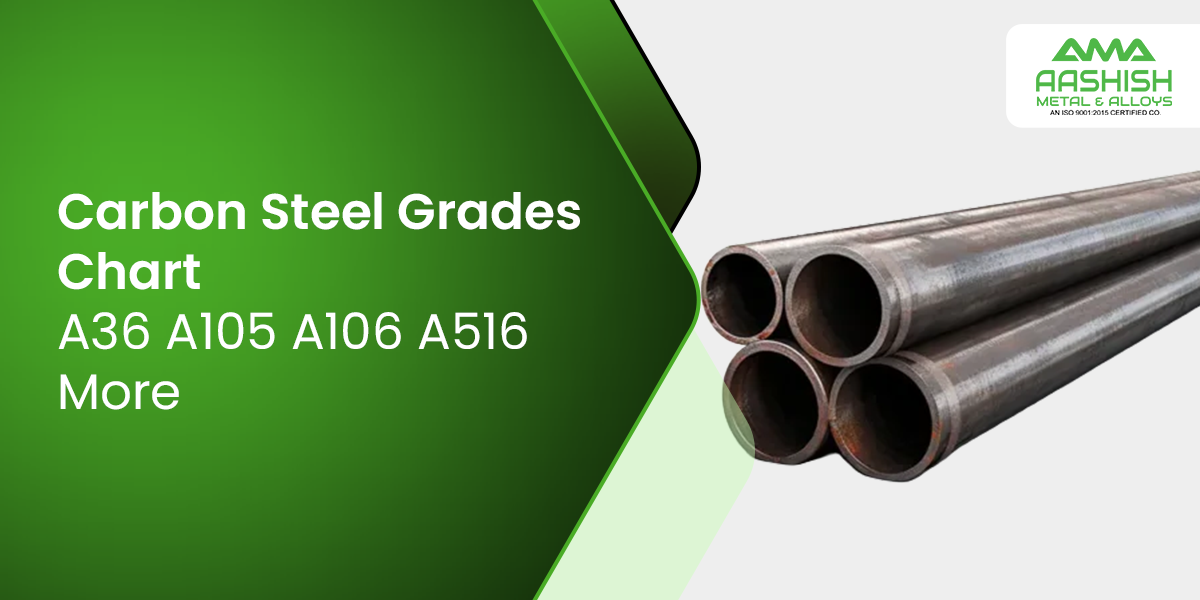
A carbon steel grades chart provides piping engineers, procurement and fabricators with a quick reference tool to compare a design specification to an actual product available for purchasing or fabrication before it advances to a fabrication or ordering state. These grades, such as A36, A105, A106 and A516 appear everywhere on drawings and purchase orders but represent products ranging from structural plate, forged flanges to seamless pressure pipe and if they are mixed up on a bill of material, the results are delays. This guide explains the differences between each grade, their use and which of these carbon steel grades are readily available or special order material.
What is Carbon Steel?
Carbon steel is totally different from stainless steel and nickel alloys, even the stainless steel and nickel alloys has some amount of chromium, nickel, or molybdenum. Unlike stainless steel and nickel alloys, which need small amounts of chromium, nickel or molybdenum, carbon steel needs small amounts of other metals. Behavior of the metal depends on the carbon content in the metal. Mild steel has low carbon content and has a maximum carbon content of about 0.3% which makes the steel soft, easier to weld and its formability is more significant than its strength. Medium carbon steel has a carbon content of 0.3 to 0.6% and is mostly used in structural and piping grades for a combination of both strength and ductility. High carbon steel has carbon content of above 0.6% and is harder, more wear-resistant and less weldable than other steel categories. Most of the steel grades mentioned in this guide belong to low carbon and medium carbon steel categories and that is why it is easy to weld and fabricate these steels.
Carbon Steel Grades Chart
The table below consolidates every grade covered in this guide, along with the standard it falls under, typical minimum mechanical properties, common uses and whether the grade is available as stocked product rather than reference material only.
Grade | Standard and Form | Min Yield / Tensile | Typical Use |
A36 | ASTM A36, structural plate, bar and shapes | 250 / 400 to 550 MPa | Structural fabrication, general construction, base plates |
A105 | ASTM A105, forged carbon steel | 250 / 485 MPa min | Flanges, forged fittings, valve bodies |
A106 Gr B | ASTM A106, seamless pipe | 240 / 415 MPa min | High temperature and high pressure piping, refineries, power plants |
A516 Gr 70 | ASTM A516, pressure vessel plate | 260 / 485 to 620 MPa | Pressure vessels, boilers, storage tanks, low temperature service |
A53 Gr B | ASTM A53, welded or seamless pipe | 240 / 415 MPa min | General service and structural piping, lower spec than A106 |
A234 WPB | ASTM A234, buttweld fittings | Matches A106 pipe | Elbows, tees, reducers welded into A106/A53 pipelines |
A350 LF2 | ASTM A350, forged low temperature | 250 / 485 MPa min | Flanges and fittings for low temperature service, down to about minus 46C |
A420 WPL6 | ASTM A420, low temperature buttweld | 240 / 415 MPa min | Buttweld fittings for low temperature piping systems |
A333 Gr 6 | ASTM A333, low temperature seamless pipe | 240 / 415 MPa min | Cryogenic and sub zero piping systems |
A36 and A516 are included because they are two of the most searched carbon steel grades worldwide and because the terms are commonly compared alongside piping grades, but they are not confirmed Aashish stock at this time. Treat both as reference information until availability is confirmed directly.
ASTM A36 Steel Explained
ASTM A36 is a low carbon structural steel used in plate, bar and structural shapes rather than pressure piping. It is not hardenable by heat treatment and derives its strength from composition and rolling rather than quenching, which keeps it easy to weld, cut and fabricate on site. Typical uses include structural framing, base plates, brackets and general fabrication where the material does not see significant internal pressure or high temperature service. A36 is one of the most widely specified structural steels globally, and it is included here for completeness, even though it sits outside the forged and pipe grades that make up the rest of this chart. Readers sourcing A36 plate should confirm current stock and lead time directly.
ASTM A105 Carbon Steel Explained
ASTM A105 is a forged carbon steel grade, and it is the standard material for flanges, forged fittings and valve bodies across the piping industry. Because it is forged rather than cast or rolled, A105 has a fine, consistent grain structure that holds up well under the combined stress of pressure, bolting and thermal cycling found in flanged piping connections. Minimum tensile strength sits at 485 MPa, with a minimum yield of 250 MPa, more than enough for most general and moderate temperature piping systems. A105 forgings are used for weld neck, slip on, blind and socket weld carbon steel flanges, along with threaded fittings, socket weld fittings and valve bodies. Aashish stocks A105 across several product lines, including carbon steel A105 threaded fittings, carbon steel A105 socket weld fittings and carbon steel A105 instrumentation ball valves.
ASTM A106 Carbon Steel Pipe Explained
ASTM A106 is a seamless carbon steel pipe grade, produced specifically for high temperature and high pressure service in refineries, power plants and process piping systems. The seamless manufacturing process avoids a longitudinal weld seam, which removes a potential point of weakness and makes A106 the preferred choice wherever a system will see sustained heat or pressure cycling. A106 Grade B carries a minimum yield of 240 MPa and a minimum tensile strength of 415 MPa, values it shares with the lower cost A53 Grade B pipe, though A53 can be furnished welded or seamless and is generally reserved for lower spec, general service piping rather than high temperature duty. Aashish supplies ASTM A106 Gr B and C pipes and tubes in standard schedules, and buyers unsure which wall thickness a project needs can cross check requirements against a pipe schedule chart before ordering.
ASTM A516 Pressure Vessel Plate Explained
ASTM A516, most commonly specified as Grade 70, is a carbon steel plate designed for pressure vessels, boilers and storage tanks, particularly where the equipment will operate at moderate to low temperatures. It offers better notch toughness at reduced temperatures than ordinary structural plate, which matters for vessels that see thermal cycling or cold climate exposure. A516 Grade 70 carries a minimum yield of 260 MPa and a tensile range of roughly 485 to 620 MPa. Like A36, A516 is included here as reference information rather than a confirmed Aashish stock item, since it sits in the plate category rather than the forged fitting and pipe products the company currently lists. Buyers with an A516 requirement should check current availability directly.
Other Common Carbon Steel Piping Grades
Beyond the four headline grades, several other carbon steel specifications show up regularly on piping bills of material, each tied to a specific function rather than general use.
ASTM A234 WPB is a carbon steel buttweld fitting grade, matched to A106 and A53 pipe, and covers elbows, tees and reducers welded directly into a pipeline. Aashish stocks a full range of carbon steel A234 WPB pipe fittings alongside its A106 pipe.
ASTM A53 Grade B, mentioned above as the lower spec alternative to A106, is available as ASTM A53 Gr B pipes and tubes and remains a common choice for general service and structural piping where high temperature service is not required.
For low temperature and cryogenic duty, three related grades work together as a family. ASTM A350 LF2, supplied as LTCS A350 LF2 threaded fittings, covers forged fittings and flanges rated down to about minus 46C. ASTM A420 WPL6, available as LTCS A420 WPL3 and WPL6 pipe fittings, is the buttweld fitting equivalent for the same low temperature range. ASTM A333 Grade 6, supplied as ASTM A333 Gr 3 and 6 pipes and tubes, is the seamless pipe used alongside both, purpose built for cryogenic and sub zero piping systems.
How to choose the Carbon Steel Grades?
There are only three questions to consider when selecting a carbon steel grade: temperature, pressure and product form. The majority of process piping systems are piping at standard temperature and moderate pressure that is covered by A106 pipe with A105 flanges and A234 WPB fittings. When the service temperature is below about -29C, the LTCS family, A350 LF2 fittings, A420 WPL6 buttweld fittings and A333 Gr 6 pipe are required as normal A105 and A106 material can lose toughness under impact at low temperature and become cracked. A53 Gr B is a lower cost pipe than A106 for general service piping in which there are no high temperature and/or pressure requirements. A516 is not used for pressure vessels or boilers and A36 is not used for structural applications. The most common errors in grade selection are prevented by selecting the product form first, then the plate, forged fitting or seamless pipe, and then matching the temperature and pressure range of the grade to the design requirements of the project.
Conclusion:
A carbon steel grades chart is only useful if it is checked against real stock and lead times, not just published specifications. Aashish Metal and Alloys supplies A105 fittings and flanges, A106 and A53 pipe, and the full LTCS family, A350 LF2, A420 WPL6 and A333 Gr 6, across the grades covered here. Browse the full carbon steel products range, or check the steel pipe types and buying guide for help matching pipe schedule and wall thickness to a project. For A105, A106, A53 or LTCS requirements, contact Aashish directly with the grade, size and quantity needed.
Frequently Asked Questions
A105 is a forged carbon steel grade used for flanges and fittings, while A106 is a seamless carbon steel pipe grade. They are used together in piping systems.
A516 Grade 70 is a carbon steel plate used for pressure vessels, boilers, and storage tanks, offering good toughness at lower temperatures.
A36 is a specific ASTM grade of mild, low-carbon structural steel. Mild steel is a general industry term.
A106 is a seamless pipe grade designed for high-temperature service, while A53 can be welded or seamless and is commonly used for general piping applications.
LTCS grades such as A350 LF2 are used for low-temperature service where standard A105 may not provide sufficient impact toughness. The required grade depends on the design temperature and applicable standards.
Carbon steel contains iron and carbon, while stainless steel contains chromium for improved corrosion resistance. Carbon steel suits general applications, while stainless steel is preferred for corrosive environments.