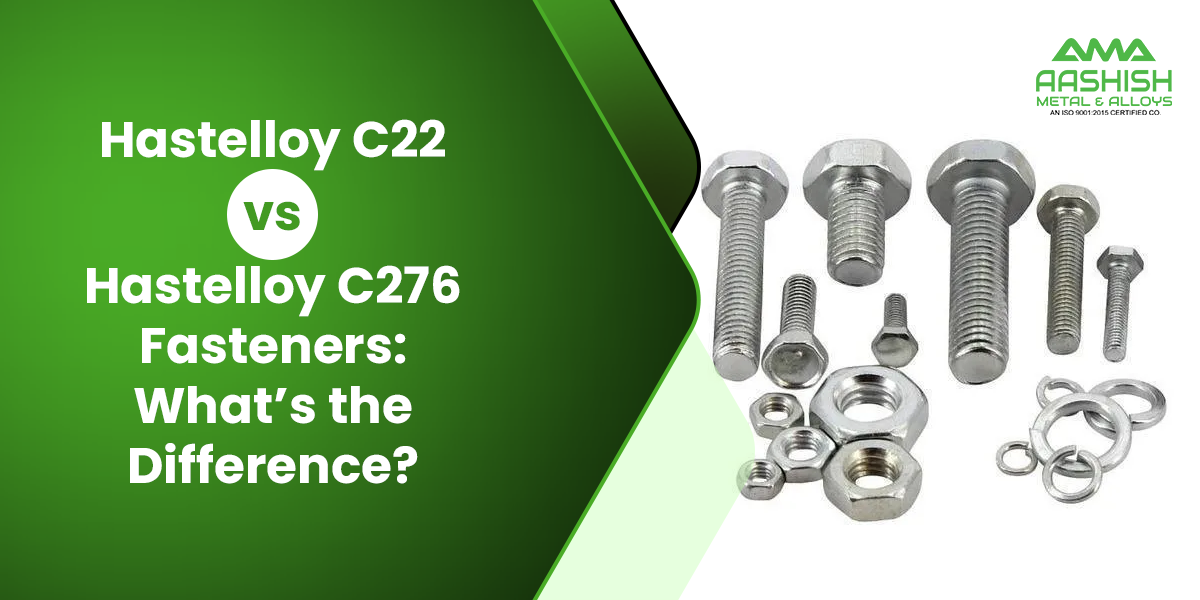
In the case of fasteners that are employed in the heavy-duty industries such as chemical processing and petrochemical refining, as well as in the exploration of oil and gas, the choice of material can either hurt or benefit the long-term performance of the fastener. Even the tiniest element should withstand the greatest pressures, violent chemicals, as well as temperature variations. Some of the most reliable alternatives in the market are Hastelloy C22 Fasteners and Hastelloy C276 Fasteners. Although they are both high-end nickel alloy fasteners designed to perform in high-performance conditions, the knowledge of their main differences can assist professionals in engineering and procurement to make the appropriate choice in a particular case.
What Are Hastelloy C22 and C276 Fasteners?
Hastelloy C22 Fasteners (UNS N06022) are Nickel-chromium-molybdenum-tungsten alloy fasteners designed with the express aim of operating in both oxidizing and reducing environments with excellent reliability. It is well known that they have a high level of structural and chemical integrity despite being in harshly corrosive conditions. Hastelloy C22 fasteners are a popular option for industries that are frequently exposed to mixed acidic environments.
However, the Hastelloy C276 Fasteners (UNS N10276) fall in a different category of high-performance nickel-based alloys, a blend of nickel, chromium, molybdenum, and tungsten to withhold a highly diversified group of aggressive chemical media. Hastelloy C276 fasteners are also very robust in oxidizing conditions and can often be found where exposure to sulfuric acid, hydrochloric acid and other harsh chemicals is likely to occur.
Hastelloy C22 vs C276 Chemical Composition
Hastelloy C22 and C276 are both nickel-chromium-molybdenum alloys which contain tungsten and cobalt additions. Their actual compositions however vary substantively concerning the general performance. The highest carbon content is 0.010% in Hastelloy C22, chromium is present in high amounts of about 22 percent and molybdenum is also present in 13 percent with tungsten being low at 3 percent. These ratios make it have a very fine balance of oxidizing and reducing resistance.
In contrast, Hastelloy C276 has a maximum level of carbon also at 0.010% but with slightly lower levels of chromium (16-18%) and molybdenum (12.5-14.5%), whereas tungsten is higher in it at 4-5%. The difference in elemental balance brings about different mechanical and chemical behavior especially in corrosion resistance, high-temperature performance and weldability.
Corrosion Resistance of Hastelloy Fasteners
Both alloys provide outstanding security in highly violent environments, such as wet chlorine gas, sulfuric and hydrochloric acid solution and exposure to seawater. With that said, certain differences can be observed in the way each of them performs in certain conditions.
Hastelloy C22 Fasteners have a better resistance against localized corrosion like pitting and crevice corrosion. This is due to the fact that they have a high level of chromium and molybdenum which leads to the stability of the passive film on the alloy surface. Because of this, they are extensively used in components like valves, pumps and manifolds that are used in the chemical processing and drug manufacturing factories.
Hastelloy C276, on the other hand, has a wider overall corrosion resistance- especially in combined reducing and oxidizing environments at high temperatures. This has rendered Hastelloy C276 Fasteners a solution of choice in the oil and gas industry whereby well fluids and production gases contain highly variable and aggressive chemical compositions.
Mechanical Properties of Hastelloy Fasteners
The two grades are excellent in mechanical properties, which include, high tensile strength, ductility and toughness over a broad temperature span- between ambient temperatures and high service temperatures. In spite of these common strengths, the two alloys perform differently at given mechanical situations.
The work-hardening rate of Hastelloy C22 is lower and hence translates to easier workability and machining of complex geometries. Although it has inferior yield strength and ultimate tensile strength to C276, it is more than made up for by superior impact toughness, a significant characteristic in vibratory loading conditions.
Hastelloy C276 has high yield and tensile strength values, which is why it is highly applicable in terms of high pressure and temperature. But, it increases in hardness at high temperatures, and it is therefore suited to equipment such as heat exchangers and chemical reactors in which mechanical strength and resiliency under thermal conditions is of paramount importance.
Hastelloy C22 vs C276 Price
A good consideration in selecting materials is always cost-wise. Generally, Hastelloy C276 should take a higher price range than C22 mainly due to its high tungsten content and the wide range of corrosion capability. With that said, the end price of either Hastelloy C22 Fasteners or Hastelloy C276 Fasteners will be based on numerous factors- such as form factor required, dimensions, quantity ordered and the price structure of the supplier. Whenever possible, one should seek quotations from two or more suppliers and compare their prices and material certificate before making a purchase.
Industrial Applications Hastelloy Fasteners
Hastelloy C22 Fasteners and Hastelloy C276 Fasteners find application in diverse industries with slight differences:
- Oil & Gas: When sour gas systems and desalination systems are involved and corrosion due to chlorides is a major problem, Hastelloy C22 Fasteners are suitable. Hastelloy C276 Fasteners will suit systems that are in direct contact with hydrochloric or sulfuric acids.
- Chemical Processing: Hastelloy C22 Fasteners is used successfully in conditions that have oxidizers and mixed acidic streams. Meanwhile, C276 fasteners are good in reducing acids, acid gas exposure, and bleed/vent.
- Marine & Desalination: Hastelloy C22 Fasteners have a greater resistance to pitting and crevice corrosion that takes place in saltwater and as such they are the material of choice in marine and desalination plants.
- Power Generation/Pollution Control: The Hastelloy C276 fasteners are most suitable in high temperature boilers and flue-gas desulfurization units, where thermal stability and a wide chemical resistance have to be maintained at the same time.
Source Hastelloy C22 Fasteners and C276 Fasteners from Aashish Metals
Both Hastelloy C22 and C276 are excellent fastener materials with respect to corrosive and various thermal demanding service environments. Although they have basic similarities, they offer different benefits in regards to their composition, corrosion protection, mechanical behaviour and cost profile. To make the correct choice of an alloy, it is very important to consider all these factors in addition to the design need, operation requirements, maintenance factor, and reliability of your supplier.
At Aashish Metals, we supply premium-grade Hastelloy C22 Fasteners and Hastelloy C276 Fasteners backed by full material traceability and industry compliance. Contact us today to discuss your project requirements and receive a competitive quotation for superior quality hastelloy fasteners.