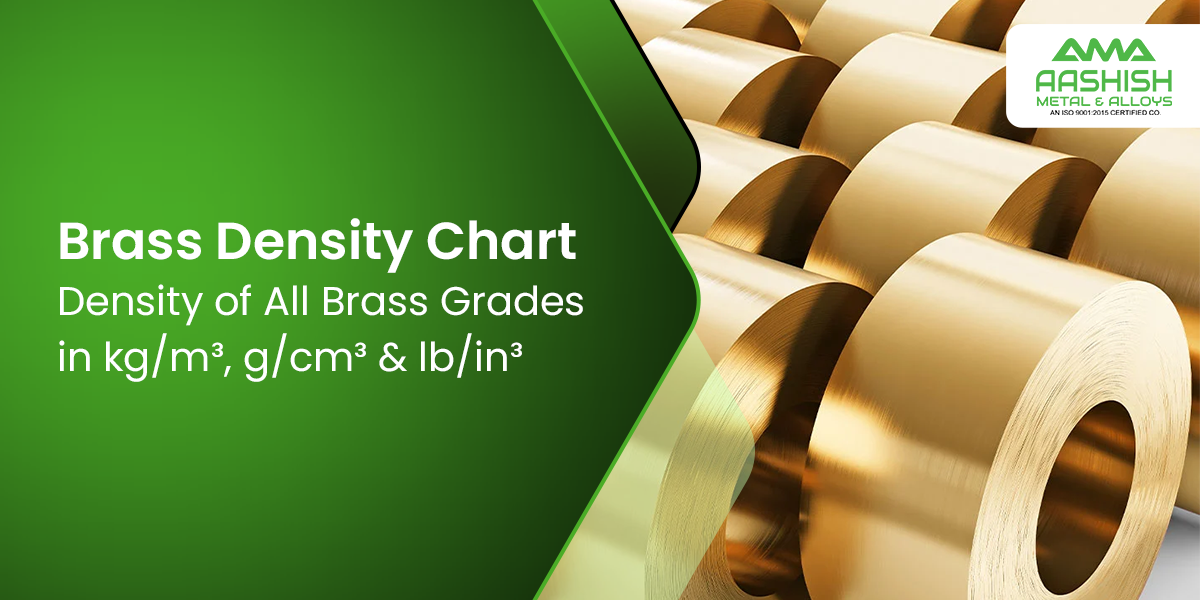
Brass density is different from grade to grade due to variation in proportions of copper, zinc and other alloying elements. The amount of Zinc present will not affect the density of brass metal, but an increase in the Zinc percentage will result in the brass being less dense than an increase in the amount of Copper. Densities of typical commercial Brass are around 8,400-8,730 kg/m3 (which can also be expressed as 8.40-8.73 g/cm3 or 0.303-0.315 lb/in3). The density of lead, tin, aluminium or silicon-containing grades may vary according to the precise composition of the grades. A brass density chart is available to compare individual UNS grade and get the required value to perform engineering calculations. The grade-specific density is critical in various applications, such as making estimates of component weight, material usage, shipping load, and project cost.
Brass Density Chart
The table below provides density values for standard brass alloys across metric and imperial measurement units. Hyperlinked grades indicate direct stock availability within our precision material inventory.
Alloy Name | UNS Designation | Density (g/cm³) | Density (kg/m³) | Density (lb/in³) |
Red Brass (85/15) | C23000 | 8.75 | 8,750 | 0.316 |
Cartridge Brass (70/30) | C26000 | 8.53 | 8,530 | 0.308 |
Yellow Brass | C27000 | 8.47 | 8,470 | 0.306 |
Muntz Metal (60/40) | C28000 | 8.39 | 8,390 | 0.303 |
Leaded Brass Tube | C33000 | 8.50 | 8,500 | 0.307 |
Free-Cutting Brass | C36000 | 8.50 | 8,500 | 0.307 |
Admiralty Brass | C44300 | 8.53 | 8,530 | 0.308 |
Naval Brass | C46400 | 8.41 | 8,410 | 0.304 |
Conversion table for Brass Density Chart
Measurement Unit | Typical Commercial Range | Conversion Factor from g/cm³ |
Grams per Cubic Centimeter (g/cm³) | 8.40 to 8.75 | 1.0 |
Kilograms per Cubic Meter (kg/m³) | 8,400 to 8,750 | Multiply g/cm³ by 1,000 |
Pounds per Cubic Inch (lb/in³) | 0.303 to 0.316 | Multiply g/cm³ by 0.036127 |
Pounds per Cubic Foot (lb/ft³) | 524.38 to 546.24 | Multiply g/cm³ by 62.428 |
Factor that Affect the Density of the Brass
Zinc Content:
Zinc floats on top of copper. The higher the percentage of zinc, the lower the density of the final alloy. For instance, C23000 (15% zinc) exhibits a density of 8.75 g/cm³, whereas C28000 (40% zinc) drops to 8.39 g/cm³.
Casting Porosity:
Micro-porosity can be a natural result of the solidification process in as-cast brass components. The density of cast brass can be up to 1.5% lower than theoretical due to internal void space.
Cold Working and Grain Structure:
The crystalline lattice is compressed and internal micro-voids are closed by mechanical cold-working processes (cold rolling, drawing). Items that are subjected to a high degree of cold working have a high degree of conformity with their maximum theoretical density, such as spring-temper sheet stock or precision shim stock.
Temperature Variations:
When heated, Brass expands, but its mass remains the same. Hence, the density for brass decreases by approximately 0.5% per 100 °C of operating temperature.
How to Calculate Brass Weight
Calculating material weight accurately is critical for estimating freight, material costs, and structural loads. The general equation for mass is:
Weight = Volume × Density
For flat stock like brass sheets, plates, and shims, the formula can be simplified:
Weight = Thickness × Width × Length × Density
Worked Example: Precision Brass Shim
To calculate the weight of a C26000 Cartridge Brass shim strip with the following dimensions:
- Thickness: 0.50 mm (0.05 cm)
- Width: 300 mm (30 cm)
- Length: 1000 mm (100 cm)
- Material Density (C26000): 8.53 g/cm³
Step-by-step Calculation:
- Determine Volume: 0.05 cm × 30 cm × 100 cm = 150 cm³
- Apply Density Formula: 150 cm³ × 8.53 g/cm³ = 1,279.5 grams
- Convert to Kilograms: 1,279.5 / 1,000 = 1.28 kg
This precision calculation ensures accurate material staging when working with stock items such as Brass Shims.
Frequently Asked Questions
Brass typically has a density of 8.4–8.7 g/cm³, or approximately 8,400–8,700 kg/m³, depending on its composition.
Generally, no. Copper has a density of about 8.96 g/cm³, while most brass grades are around 8.4–8.7 g/cm³.
It depends on the grade. Brass is generally similar to or slightly heavier than common carbon steel, which is about 7.85 g/cm³.
Density varies because brass suppliers may provide different copper-zinc ratios and alloy compositions. Added elements such as lead, tin, or aluminum can also affect density.
Calculate the volume and multiply it by the brass density: Weight = Length × Width × Thickness × Density. Use consistent units when calculating.
Brass materials generally fall under HSN Chapter 74 (Copper and articles thereof), but the exact HSN code depends on the product form, such as sheet, plate, tube, wire, rod, or fitting.