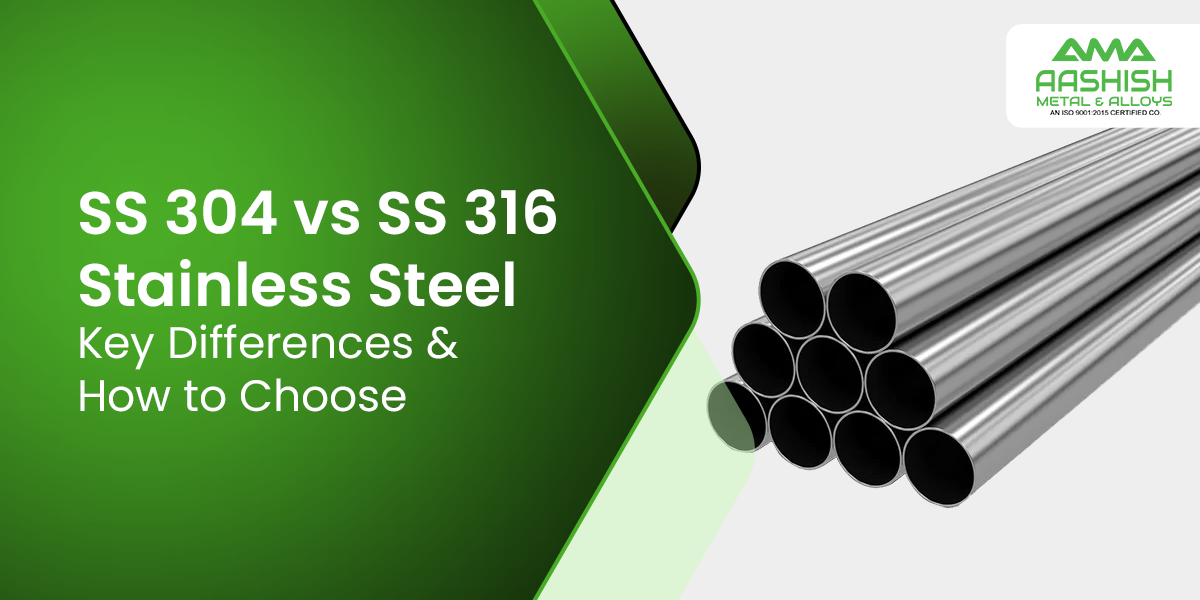
SS 304 and SS 316 stainless steels look identical, but their differing alloy composition gives them very different performance in harsh environments.The main distinction is that SS 316 usually has approximately 2–3% molybdenum while SS 304 has none. This addition enhances resistance to pitting and crevice corrosion particularly in chloride rich, marine and chemical environments. SS 304 is a corrosion resistant, strong, formable and weldable grade that is ideal for food processing, kitchen machinery, architecture and various industrial applications. SS 316 is more resistant to corrosion and the preferred options for marine equipment, chemical processing, pharmaceutical systems, and coastal installations. Both grades are readily available in sheet, plate, pipes, tubes, bars, fittings and fasteners. The right selection will depend on the environment in which it is to be used, the level of corrosion exposure, the level of performance needed and cost to the project.
What Is SS 304 Stainless Steel?
SS 304 is the most commonly manufactured austenitic chromium nickel stainless steel alloy across the world. This steel is commonly known as 18-8 stainless because of its composition which includes 18% chromium and 8% nickel. This is due to its excellent general corrosion resistance properties. There are two types of 304 stainless steel which include 304L and 304H.The carbon content in 304L is kept at less than 0.03%, which minimizes the possibility of carbide precipitation at weld joints that could pose a problem if the component is to be welded instead of fastened. At the other end, 304H has slightly more carbon content to get a little higher temp strength. For most industrial applications however, the two get specified interchangeably; 304 and 304L are both stocked as SS 304/304L shims by Aashish Metal & Alloys, and as SS 304 hex bolts, nuts and washers, all in the three grades 304, 304H and 304L under one product line.
What Is SS 316 Stainless Steel?
SS 316 is another austenitic chromium-nickel type, identical in basis to 304, but with one conscious ingredient added – the addition of 2-3% molybdenum. Molybdenum is used to stabilise the passive oxide film which is what makes stainless steel corrosion resistant in the first place – and it is used specifically against chloride ions, which are the species found in seawater, de-icing salt and many industrial chemical streams. That single addition is why 316 costs more and is reserved for chloride-heavy service, rather than specified as a blanket upgrade to 304.
As with 304, SS 316 comes in a low carbon variant, 316L, for use where the part will be welded, and a niche variant, 316Ti, stabilized with titanium for use at high temperatures. Aashish Metal & Alloys stocks SS 316/316L shims, SS 316 hex bolts, nuts and washers.
SS 304 vs SS 316: Chemical Composition Table
Composition figures for this comparison vary depending on where you look European (EN) sourced tables run slightly different ranges than the American ASTM standard, and some supplier sites round for simplicity. The table below is sourced to ASTM A240 / A240M, the governing specification for chromium and chromium-nickel stainless plate, sheet, and strip, so it’s the number set that will match what’s printed on an actual mill test certificate.
Grade | Chromium (Cr) | Nickel (Ni) | Molybdenum (Mo) | Carbon (C) max |
304 | 18.0 – 20.0 % | 8.0 – 10.5 % | — | 0.08 % |
316 | 16.0 – 18.0 % | 10.0 – 14.0 % | 2.00 – 3.00 % | 0.08 % |
Five Ways SS 304 and SS 316 Actually Differ
1. Corrosion Resistance
SS 304 and SS 316 have an oxide layer of Chromium that provides protection against surface corrosion. SS 316 is more effective against chlorides such as seawater, coastal atmosphere, anti-icing fluids and other chemicals. The material has molybdenum up to 2-3% and therefore provides more resistance against pitting and crevice corrosion. SS 304 on the other hand is used for indoors, fresh water, food industry, and where chloride levels are minimal. SS 316 is normally preferred for marine, coastal, chemical and chloride rich conditions.
2. Mechanical Strength & Temperature Performance
In the annealed condition, the mechanical properties of SS 304 and SS 316 are relatively similar. The minimum tensile strength for both grades is approximately 515 MPa and the minimum yield strength of both grades is approximately 205 MPa. They are practical in terms of corrosion durability rather than strength. SS 316 has a molybdenum content which decreases localized corrosion, making it more likely to provide better service reliability in aggressive environments. The form of the product, operating conditions, fabrication and material standard applied also influence temperature performance.
3. Magnetic Properties
SS 304 and SS 316 are both austenitic grades of stainless steel and are typically non-magnetic when in the annealed condition. But, during the processes like bending, rolling, drawing, or thread forming some magnetic response can be accomplished in the process of cold working. A low magnetisation value does not necessarily mean that the component is not SS 304 or SS 316. Likewise, the non-magnetic response won’t determine the exact grade. It is important to not use a magnet to differentiate between these two grades of stainless steel.
4. Cost & Price Differential
Overall, SS 304 is a more cost-effective material than SS 316, which is typically more expensive and has a slightly higher nickel content. The presence of these alloying elements leads to an increase in the cost of the material, and their prices may also change over time. Therefore, the price gap between SS 304 and SS 316 is not set and is dependent on market conditions, product form, size, quantities, and supplier. The improved chloride and corrosion resistance of SS 316 usually makes it more expensive; however, the increased performance is justified for any applications that require it.
5. Weldability & Fabrication
The weldability of SS 304 and SS 316 is good, and they can be easily fabricated by commonly used stainless steel welding methods such as TIG, MIG, and resistance welding. In welded parts, the low carbon versions (SS 304L and SS 316L) can be used to minimize the potential of carbide precipitation and sensitization in the HAZ. This helps to sustain corrosion resistance at the vicinity of welded regions. However, it is dependent on the fabrication process, application, welding process, specification of the product and operating conditions.
How to Identify SS 304 vs SS 316
Because these two grades are visually indistinguishable, identification has to be procedural, not visual:
- Mill Test Certificate (MTC): The reliable method. A certificate issued to EN 10204 3.1 traceability standards ties the material back to its heat number and confirms actual chemical composition as tested at the mill — this is what a procurement engineer should ask for on any critical order.
- PMI / XRF testing: Handheld Positive Material Identification (X-ray fluorescence) analyzers give a fast, non-destructive on-site composition read and are standard practice for verifying incoming material on regulated or safety-critical projects.
- Molybdenum spot test: A chemical drop test that reacts differently in the presence of molybdenum. It’s used in some quality-control settings, but it involves hazardous reagents and isn’t a practical or safe DIY method — it belongs in a lab, not in the field.
- Magnet test: As covered above, unreliable. Skip it.
If your supplier can’t produce a heat-numbered MTC on request, that’s the flag to watch for — not the color or finish of the material itself.
Which One Should You Choose?
Environment / Condition | Recommended Grade |
Indoor, dry, general fabrication or structural use | SS 304 |
Kitchen, food-processing, or architectural (no chloride exposure) | SS 304 |
Coastal, marine, or exposed to sea spray | SS 316 |
Chemical processing, pharmaceutical, or acidic/chloride process streams | SS 316 |
De-icing salt exposure (structural hardware, outdoor fasteners) | SS 316 |
Welded assembly in either environment | 304L or 316L (matching base grade) |
Requirement exceeds even 316’s resistance | SS 904L (or higher alloy) |
Conclusion
The 304-vs-316 decision comes down to one question: will this part see meaningful chloride exposure to marine air, de-icing salt, chemical processing, or coastal washdown, over its service life? If yes, the molybdenum in 316 is worth the premium. If not, 304 delivers the same baseline strength and general corrosion resistance at a lower cost, and there’s no practical benefit to over-specifying. Whichever grade your application calls for, always verify it against a Mill Test Certificate rather than appearance alone. Aashish Metal & Alloys supplies both grades across round bars, pipes and tubes, fasteners, tube fittings, flanges, and shims, with full EN 10204 3.1 traceability available on request. Request technical specifications or a quote for your exact requirement.
FAQs
No. SS 316 is better for chloride-rich and marine environments, while SS 304 is usually sufficient for indoor, dry, and low-chloride applications.
SS 316 generally costs more than SS 304 because it contains molybdenum and higher nickel content. The exact difference varies with market prices, size, form, and quantity.
Both are generally non-magnetic in the annealed condition. Cold working can make either grade slightly magnetic, so a magnet test cannot reliably distinguish SS 304 from SS 316.
Check the Mill Test Certificate (MTC) or use Positive Material Identification (PMI/XRF) testing. These methods can verify the chemical composition and grade.
Yes. Both grades have good weldability. For welded applications, 304L and 316L are commonly preferred because their lower carbon content reduces the risk of sensitization.
SS 316 is generally preferred for outdoor, coastal, marine, and chloride-exposed fasteners because it provides better resistance to pitting and crevice corrosion.
SS 316L has a lower carbon content than SS 316, which reduces the risk of carbide precipitation during welding. It is therefore commonly preferred for welded components.
SS 304 is highly corrosion resistant but can develop localized pitting in chloride-rich environments. Proper surface maintenance and suitable environmental conditions help maintain its corrosion resistance.