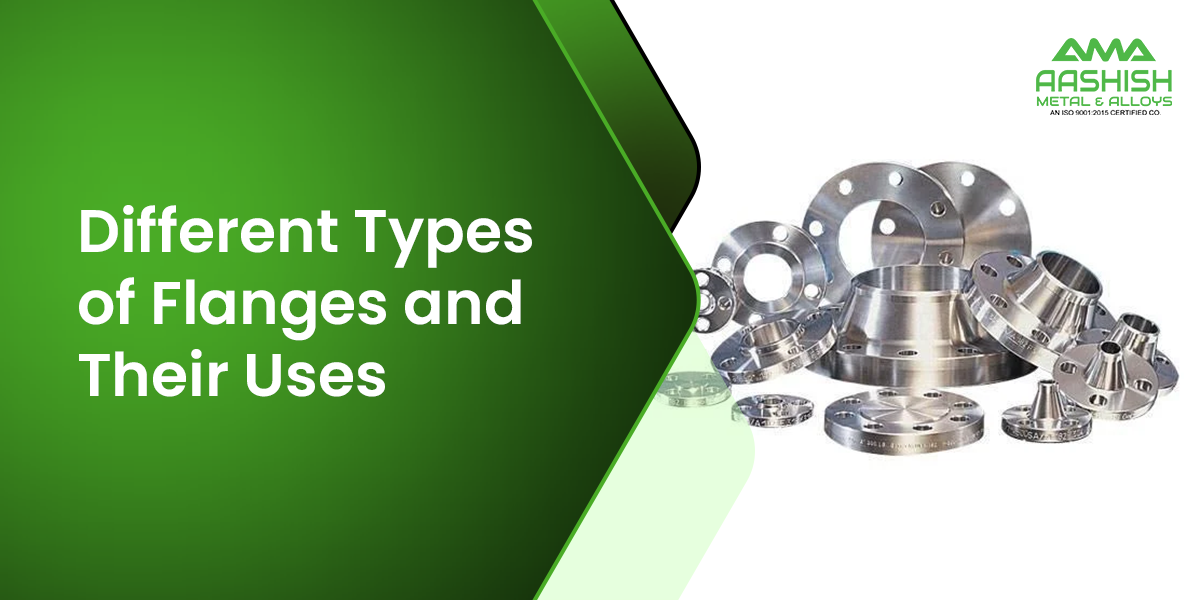
The flange, a small yet vital part, is essential for any pipe line system, from raw oil in a refinery to process chemicals in a pharmaceutical facility. A flange type is much more than a metal ring with holes punched in it. It is the point where pipes join valves, pumps, and other equipment, and is one of the first places in a system where failure occurs if the wrong type is selected. We can supply and manufacture flanges of various materials and pressure classes at Aashish Metals to the clients working in various industries including oil and gas, petrochemicals, power generation, and process industries. We’ve seen this first-hand over the years, and this guide aims to demystify each of the major flange types, how they function, and when and where they’re most applicable.
What is a Flange?
A flange is a forging or machining that is attached to two pipes or to a pipe to a valve, pump or pressure vessel. Rather than welding pipe ends to pipe ends, engineers employ flanged joints to allow components of a system to be bolted, unbolted, inspected, cleaned and replaced without cutting into the line.The three components of a complete flanged joint are the flange, the gasket and the bolts (or studs and nuts). One of the most common ways that a leak occurs in a process plant is by having improper flange rating, gasket material or bolt torque. Flanges are available to ASME B16.5 (NPS 1/2 thru 24) and ASME B16.47 (NPS 26 and above) standards and rated by pressure class (150 to 2500), as well as the face type and bore size that corresponds to the connecting pipe schedule.
Types of Flanges and Their Uses
Flanges are manufactured in different types to suit the requirements of different industries. Some of the most common flanges types are listed below.
1. Weld Neck Flange
The weld neck flange is the most commonly specified flange for high pressure and high temperature piping. It features a long tapered hub that is butt welded to the pipe, allowing stress to gradually pass from the pipe into the flange, instead of focusing at one point. Weld neck flanges are typically found on critical lines in refineries, chemical plants and offshore platforms, and for this reason that this tapered design is the preferred option for minimizing stress concentration at the base of the hub. The weld neck flange can withstand up to 5,000 psi as it is fully welded through the pipe wall thickness, and is available in all face types: raised face, flat face, and ring type joint (RTJ). The trade off is cost and installation time – it needs welders with a high level of skill and adds more axial space due to the hub length, than some other types of flanges.
2. Slip-On Flange
As the name implies, a slip-on flange is simply pushed onto the end of a pipe and then welds to the inside and outside of the pipe with a fillet weld. The bore is slightly larger than the pipe’s outside diameter which simplifies alignment, and it is also less expensive to fabricate than a weld neck flange, which is ideal when the budget is restricted and pressure requirements are not too high. So the compromise is strength. The fatigue strength of a slip-on flange is about one third to two thirds of that of a similar weld neck flange under cyclic loading, and is therefore not recommended for lines that are subject to frequent pressure and/or temperature changes.
3. Blind Flange
A blind flange is the only flange on this list without any bore. A solid disk with holes around the circumference for bolting to the end of a pipe run or to a valve opening or to the nozzle opening of a pressure vessel. Blind flanges are also used as manhole covers in vessels and tanks, providing maintenance personnel with a bolted access point which will not require metal cutting. Since there is no continuous flow path, blind flanges must be designed for the total internal pressure of the system which must be resisted by a flat unsupported surface, making them frequently the thickest flange in a particular size and pressure class.
4. Threaded Flange
A threaded flange (also referred to as a screwed flange) is a flange with pipe threads cut into the bore surface to permit it to be connected to a similar flange with the same internal threads by anything but welding. This allows for the fastest flange installation and removal, and is especially beneficial where welding is either dangerous, like flammable atmospheres, or isn’t possible, like certain non-weldable alloys. The downside is that threaded connections are not as strong with pressure cycling and are normally restricted to NPS 4 and smaller. Threaded flanges are usually only employed with Class 150 and 300 ratings.
5. Socket Weld Flange
A socket weld flange is a type of flange with a recessed socket that allows the pipe to be plugged into it, and is then sealed by a single fillet weld on the outside of the flange. According to ASME B31.1 and B31.3 practice, the pipe is pushed to the bottom of the socket and then pulled back about 1.6 mm prior to welding and then back during the weld and in service to allow for thermal expansion. Historically, socket weld flanges are commonly used in smaller bore, high pressure pipe lines, typically NPS 2 and below, and have a smoother interior flow with fewer turbulence points than a threaded flange, but they are not as common as threaded flanges.
6. Lap Joint Flange
Lap joint flange is a two piece assembly consisting of a stub end that is butt welded to the pipe, and a loose backing flange that slides over the stub end and is not welded to anything. The backing flange can rotate freely, so it can align the bolt holes in a short time without rotating the pipe, which is a significant advantage in pipelines that need to be disassembled frequently for inspection and cleaning. Lap joint flanges are also used when dissimilar metals are used; the backing flange may be a cheaper material than the stub end, which is the same alloy as the pipe. This can be practically a lower cost in the expensive alloy piping system.
7. Long Weld Neck Flange
A long weld neck flange is a weld neck flange that has a longer hub, or a nozzle flange, which can extend through a vessel wall or well beyond the length of a typical hub. This additional length also adds reinforcement in applications where the pipe wall thickness is high, and it also helps the assembly to handle expansion and contraction due to temperature changes.
8. Reducing Flange
A reducing flange is a flange with the same outside dimensions as a standard flange for one pipe size but the bore dimension is reduced to fit a smaller pipe size and permits a transition between two pipe sizes without the use of a separate reducer fitting. This saves a weld joint and installation space over a standard flange and concentric (or eccentric) reducer. The sudden change in the bore size causes more turbulence and a greater loss of pressure than a properly tapered reducer would, so it’s not used as often in practice, except where space limits the use of a reducer.
9. Expander Flange
Expander Flange is the opposite of Reducing Flange. Upgrades a pipe size by one or two standard sizes at the point of connection, which is helpful for connecting a smaller size pipe to a larger piece of equipment like a pump, compressor or valve. It is like the reducing flange in that it removes the necessity of having to weld a separate reducer.
10. Orifice Flange
An orifice flange is a special type of pair of flanges (or a flange used with an orifice fitting) in which there are pressure tap holes in both sides of an orifice plate. These flanges are an essential instrument on custody transfer metering skids and process flow monitoring stations as the pressure differential across the flange is used to calculate the flow rate.
11. Spectacle Blind and Spade Flanges
A spectacle blind (also known as a figure 8 blind) is one plate that is formed into two eye glasses with a solid end and an open end connected by a short web. With a line blocked between two companion flanges, or a completely blocked line, the plate can be rotated between two companion flanges without taking the plate off the bolt circle, thereby blocking the line or allowing full flow. A spade or paddle blind with its ring spacer is used for the same isolation as two separate pieces are used, not as a single unit.
12. Flangeolet (Weldoflange)
A flangeolet is the combination of a flange and an outlet fitting (weldolet or nipolet) in a single forged piece to form a branch connection using a bolted outlet to replace a second weld joint. It saves the number of welds required in making a branch connection and is often employed on high pressure branch lines where a small strong take off point is required.
Classifying Flanges by Face Type
Beyond the connection style, flanges types are also classified by the face that contacts the gasket:
- Flat Face (FF): the entire face is flat and makes full contact with the mating flange and gasket. Common on cast iron equipment and low pressure systems.
- Raised Face (RF): the most common facing, with a small raised area inside the bolt circle that concentrates gasket pressure for a tighter seal. Standard on most ASME B16.5 flanges.
- Ring Type Joint (RTJ): a grooved face designed to hold a solid metal ring gasket, used on the highest pressure and temperature applications such as wellhead and Christmas tree connections.
- Tongue and Groove / Male and Female: interlocking faces that prevent gasket blowout, often specified for hazardous or toxic services.
Classifying Flanges by Material
Flange material selection has just as much impact on service life as the connection type.At Aashish Metals, we stock and supply flanges across the full range of piping materials, including:
- Carbon steel flanges (ASTM A105) for general purpose piping where corrosion resistance is not the primary concern.
- Stainless steel flanges (ASTM A182, grades such as F304, F304L, F316, F316L) for corrosive, sanitary, and high temperature service.
- Alloy steel flanges (ASTM A182 F11, F22, F91) for high temperature power generation and refinery applications, available through our alloy steel products range.
- Duplex and super duplex flanges (UNS S31803, S32750) for offshore and high chloride environments where both strength and corrosion resistance are required.
- Nickel alloy flanges in Inconel, Hastelloy, Monel, and Incoloy grades for extreme temperature and highly corrosive chemical processing service.
Common Mistakes When Selecting Flanges
One of the costliest errors a project can make is the selection of the wrong flange type, rating and material as it can result in unplanned downtime, product loss, and a safety incident. In our guide to the most common mistakes in flange selection, we’ve gone over some of the more common issues like incorrect pressure ratings and compatibility issues with gaskets, etc., in depth. It’s worth reading before specifying any flange, especially on stainless and alloy systems where the cost of the flange is high if it’s not the appropriate material.
In general, make sure that the flange rating is the same as the pipe schedule and design pressure; check the face type against the gasket and mating flange; and never presume that a flange rated for one service temperature will have the same performance at a different temperature. The flange is not all that matters bolt torque and bolt sequence are equally important. No matter how well the flange is specified, one of the most common reasons for flange leaks in the field is from under-torqued or unevenly tightened bolts.
Conclusion:
Choosing the right flange isn’t simply a matter of picking a pipe size and bolt pattern. It depends on the knowledge of pressure, temperature, material compatibility, and accessibility for maintenance of the system you are constructing. When it comes to weld neck flanges or lap joint flanges, it’s all in the preparation and the knowledge of the application; it’s all in the supplier. We have been manufacturing and supplying flanges, pipe fittings, and forged fittings for industrial customers for many years, and our team is ready to help you specify the right flange for your next project.
FAQs
The weld neck flange is generally considered the strongest and most reliable option for high pressure and high temperature service because the tapered hub and full penetration weld distribute stress smoothly into the pipe.
A slip-on flange fits over the outside of the pipe and is welded on both the inside and outside, while a socket weld flange has the pipe inserted into a recessed socket and is welded only on the outside. Socket weld flanges are generally used on smaller, higher pressure lines.
The flange body itself can typically be reused if inspection shows no damage or corrosion, but the gasket must always be replaced with a new one at reassembly.
Pressure class selection depends on the design pressure and temperature of your system per ASME B16.5, and should always be confirmed against your piping class specification rather than assumed from pipe size alone.