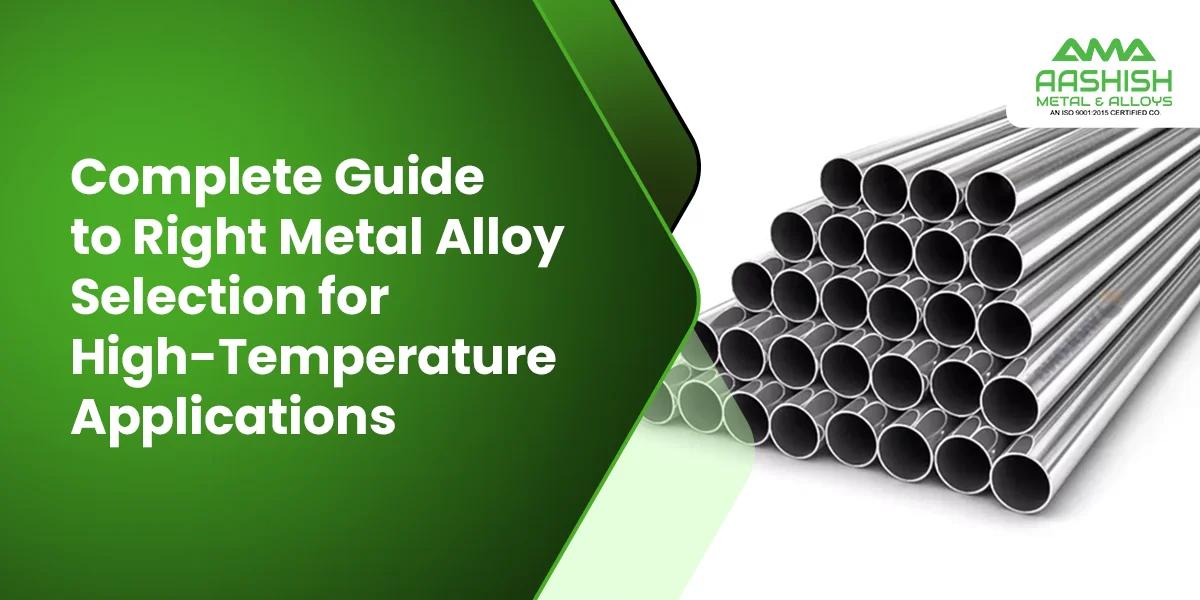
The wrong alloy selection of a high-temperature heat exchanger can be way too costly and six months of expensive downtime in the process. This is no longer a possible scenario. A specification error in the materials used in a single component can have implications that ripple through an industry, like in the petrochemicals, power generation or aerospace businesses. This guide will help you understand the specifications and save you from the costly specification mistakes.
“High-temperature service” is a general term used for any service that is conducted at temperatures ranging from 500 degrees Celsius to 1200 degrees Celsius or higher. In this range, the mechanical properties of standard carbon steels and low alloy steels decrease rapidly. The material should not be susceptible to oxidation, creep, thermal cycling and in many instances to attack from aggressive chemicals simultaneously.
The problem is that none of the alloys is capable of doing everything well. The ability to weld and higher costs generally go together with higher temperature capability. Corrosion resistance may be sacrificed for more strength in creep. The guide provides a step-by-step, decision-driven approach to selecting two or three grades that will match your application from a sea of dozens of candidates.
Key Material Selection Criteria
Before comparing individual alloy grades, engineers must define the operating envelope precisely. The six criteria below form the backbone of any rigorous metal alloy selection process for high-temperature service.
| Selection Criterion | Key Questions to Answer | Impact on Alloy Family |
| Operating Temperature Range | Peak vs continuous temperature? Any thermal cycling? | Defines the minimum alloy family required |
| Atmosphere Type | Oxidizing, reducing, sulfidizing, carburizing, or halogen? | Determines chromium and nickel content needed |
| Mechanical Stress | Static load, creep, pressure cycling, or thermal shock? | Governs creep strength requirements and grade within family |
| Corrosion Type | Oxidation, sulfidation, carburization, or pitting? | Rules out entire alloy families when severe |
| Fabrication Requirements | Welding, cold forming, machining, or tight tolerances? | Some high-performance alloys are difficult to fabricate |
| Cost vs Performance Tradeoff | Is budget fixed? What is the cost of failure? | Nickel superalloys cost 5 to 12 times stainless steel |
Using this matrix, an engineer can assign a weighting to each criterion based on the specific application and systematically eliminate unsuitable material families before spending time on detailed grade comparison.
Operating Temperature Range of the Alloy Material
The most practical starting point for metal alloy selection is the continuous operating temperature. The table below maps temperature ranges to the appropriate alloy family and highlights the recommended grades within each family.
| Temp Range | Alloy Family | Key Grades | Best For | Limitation |
| 500 to 700 deg C | Austenitic Stainless Steel | SS 304/304L, SS 321, SS 347/347H | Oxidizing environments, general purpose | Creep above 650 deg C; sensitization risk |
| 700 to 900 deg C | High-Chromium SS and Incoloy | SS 310/310S, SS 309, Incoloy 800/800H/800HT | Furnace components, heat exchangers | Higher cost than lower-grade SS |
| 900 to 1100 deg C | Nickel-Base Superalloys | Inconel 600/601, Inconel 625, Incoloy 825 | Critical high-temperature service | 5 to 10 times the cost of stainless steel |
| 1100 to 1200 deg C+ | Advanced Nickel Alloys | Hastelloy C-276/C-22, Hastelloy X, Inconel 718 | Extreme service with combined heat and corrosion | 8 to 12 times SS cost; complex fabrication |
500 to 700 deg C (Austenitic Stainless Steels)
Austenitic stainless steels are the cost-effective starting point for moderate high-temperature service. SS 304 and SS 304L are general purpose oxidation resistant but can creep at temperatures of over 650°C. SS 321 uses a titanium stabilizer which eliminates sensitization upon welding, and is suitable for cyclic service. For superior creep resistance, 347H is used for superheater headers and reformer tubes at the upper end of this temperature range, Stainless Steel 347H pipes are stabilized with niobium and C content is increased.
700 to 900 deg C (High-Chromium Stainless Steel and Incoloy)
With temperatures that exceed the safe limits of common austenitic grades, Stainless Steel 310 pipes represent a tremendous improvement. SS 310/310S has 25% chromium content, and forms a tight, self-protecting oxide film, resistant to oxidation at high temperatures up to about 1100 degrees Celsius in air. SS 309 provides intermediate properties and is frequently used to weld over other materials.
Incoloy 800 pipes and its controlled-carbon grades, 800H and 800HT, offer the optimum cost/creep properties in this range of service temperatures. The addition of aluminum and titanium in 800HT gives it superior creep-rupture strength for long-term service in pressure vessels designed to ASME Section VIII.
900 to 1100 deg C (Nickel-Base Superalloys)
When the temperature exceeds 900 degree C, nickel-base superalloys are required. Nickel has a stable FCC crystal structure from room temperature to its melting point of 1455°C, so that properties are consistent and predictable without any phase changes. Inconel products comprise Inconel 625, which provides nuclear qualified and outstanding creep strength products, Inconel 600 and 601 for oxidation and sulfidation resistance. Incoloy 825 offers excellent corrosion resistance in moderate-high temperature applications.
1100 to 1200 deg C and Above (Advanced Nickel Alloys)
When extreme service conditions combine high temperature service and severe corrosion, the performance of Hastelloy products is unsurpassed by any other family of alloys. Hastelloy C-276 and C-22 are solutions to aggressive chemical environments at high temperatures. Hastelloy X is designed specifically to resist oxidation at 1200 degrees Celsius in gas turbine and aerospace applications that require it. Inconel 718 is the most volume produced superalloy, which is produced by precipitation hardening and is used for the highest turbine and structural component.
Not Sure Which High-Temperature Alloy Fits Your Application?
Aashish Metals and Alloys provides free material selection consultation. Share your operating temperature, environment, and service requirements and our metallurgical team will recommend two or three optimal grades with full technical justification.
Contact Us TodayMetal Alloy Selection by Corrosive Environment
Operating temperature alone does not determine the correct alloy. The chemical environment running through or around the component often eliminates entire material families before temperature even becomes the deciding factor. The four categories below cover the most common high-temperature corrosive conditions.
| Environment | Corrosion Mechanism | Avoid | Recommended Alloys |
| Oxidizing (air, oxygen, steam) | Oxide scale formation; spalling under thermal cycling | Low-chromium grades | SS 310, Inconel 600, Incoloy 800 |
| Reducing (H2, NH3, CO) | Carburization and hydrogen embrittlement | SS 304, SS 316 (low nickel) | Inconel 600, Inconel 625 (high nickel resists carbon penetration) |
| Sulfur-Containing | Sulfidation attack; aggressive scaling | Low-Cr stainless grades | Inconel 601, Hastelloy C-276 |
| Chlorine and Halogens | Pitting, crevice corrosion, stress corrosion cracking | All standard stainless grades; Incoloy 825 | Hastelloy C-276, Inconel 625 |
Why Atmosphere Type Can Override Temperature as the Primary Driver
A chloride-containing environment at 400 degrees Celsius can be more destructive than a clean oxidizing atmosphere at 900 degrees Celsius. Stress corrosion cracking induced by chloride ions operates through an electrochemical mechanism that temperature alone does not predict. Hastelloy C-276, with its high molybdenum content of 16 percent, forms the industry baseline for chloride-containing process streams. Inconel 625 is the second-line choice when both chloride tolerance and high-temperature strength are required simultaneously.
In reducing atmospheres such as hydrogen, ammonia, or carbon monoxide, carburization is the primary failure mode for iron-based alloys. Nickel resists carbon penetration far more effectively than iron. This is why Inconel 600 and Inconel 625, both with nickel contents exceeding 58 percent, are the standard specification for carburizing furnace fixtures and reformer tubes.
Case Studies: Right versus Wrong Metal Alloy Selection
The following three real-world case studies illustrate how applying the selection framework prevents costly failures and how the wrong alloy chosen without systematic evaluation leads to premature component failure.
Petrochemical Furnace Tubes
SS 304 was originally selected based on its availability and relatively low cost.
SS 304 operates reliably up to approximately 650 degrees Celsius in oxidizing conditions. The furnace tubes operated at 720 degrees Celsius with significant creep loading from internal pressure. After 18 months, the tubes failed through creep rupture.
Incoloy 800HT pipes, with controlled carbon content between 0.06 and 0.10 percent and combined aluminum and titanium additions, were specified for the replacement installation.
Result: 10-year service life achieved versus 18-month failure cycle, eliminating five unplanned shutdowns.
Steam Superheater Headers
SS 321 was chosen for its titanium stabilization against sensitization during welding.
While SS 321 resists sensitization, it does not provide sufficient creep strength for continuous service above 650 degrees Celsius under internal pressure. Carbide precipitation at grain boundaries accelerated creep damage.
SS 347H pipes combine niobium stabilization with a higher carbon content in the H grade for superior creep-rupture strength at elevated temperatures.
Cost Impact: A 15 percent material cost premium for 347H avoided a 500,000 dollar failure event.
Chemical Reactor with Chlorides
Incoloy 825 was selected for its broad corrosion resistance and moderate high-temperature capability.
Incoloy 825, while excellent in many corrosive environments, does not contain sufficient molybdenum to resist stress corrosion cracking in concentrated chloride solutions at elevated temperatures. The reactor developed through-wall cracking within eight months.
Hastelloy C-276 with 16 percent molybdenum content provides the pitting resistance equivalent needed to prevent chloride-induced stress corrosion cracking.
Key Learning: Never compromise on corrosion resistance in chloride environments. The environment, not the temperature, is the governing criterion.
Practical Step-by-Step Selection Process
The six-step methodology outlined below converts the decision approach into a repeatable engineering process for any procurement and design team to use for any high-temperature application.
- Record Operating parameters: Maximum continuous temp, Peak excursion temp, Operating pressure, Number and Severity of thermal cycles per year.
- List out Corrosive Species: List all chemical species in the process stream and atmospheric chemical species. Add trace level contaminants like chlorides or sulfur compounds, these can be the controlling failure driver.
- Identify Mechanical Loading: Static stress, pressure cycling, vibration, creep-dominated. Alloys used in creep-dominated applications must have published creep-rupture data at the design temperature.
- Narrow to Two or Three Candidate Alloy Families: Use the temperature range table and the environment compatibility chart from this guide to narrow it down to two or three families that are acceptable. Most should have a short list of 2-3 families.
- Fabrication Feasibility & Cost: Determine that the candidate alloys can be obtained from a qualified supplier in the product form required (pipe, tube, fitting, flange or round bar). Aashish Metals and Alloys offer special alloy round bars and pipe products for all the major alloy groups, complete with material test certificates.
- Final Validation from a Material Supplier: Communicate your operating parameters with a material supplier that has metallurgical experience. A good supplier will take a look at your data and ensure that the grade selection is correct and alert you to any fabrication and/or testing needs you may not have thought of.
The Bottom Line
The choice of the correct alloy for use at high temperatures is not a one-dimensional problem. Operating temperature will be the bottom limit, and atmosphere type, mechanical loading, corrosion environment and fabrication constraints will determine the actual grade. A systematic process (defining the operating envelope first and then reducing to a couple of families of candidate materials and validating with a qualified material supplier) avoids specification errors that result in premature failures and unplanned shutdowns. There’s an alloy for your application at 680°C in a steam superheater or 900°C in a chloride-bearing chemical reactor. It’s much easier to get the selection right the first time than it is to correct it later.
Need High-Temperature Alloys? Contact Aashish Metals and Alloys
Aashish Metals and Alloys stocks Inconel, Hastelloy, Incoloy, and high-temperature stainless steel grades in pipes, tubes, fittings, flanges, and round bars. Every order ships with full material test certificates and dedicated technical support.