Key Differences and Applications
Super duplex S32750 is more expensive than duplex S32205 for offshore oil and gas piping. It’s not just an invoice. In the wrong application, the use of standard duplex as opposed to super duplex can result in catastrophic chloride stress corrosion cracking, failed systems and expenses that far outweigh any material savings. But, if the conditions are right, you don’t have to pay that premium. This guide provides engineers with the decision criteria they require to make the right choices.
Both duplex and super duplex stainless steels are a duplex (dual phase) microstructure comprised of approximately 50% ferrite and 50% austenite. This balanced dual-phase grade of stainless steel offers about twice the yield strength of traditional grades such as 304 or 316L, with excellent resistance to stress corrosion cracking and chloride pitting. There is a difference between duplex and super duplex, which is the level of alloy content and the conditions under which each grade can be relied upon. Explore the full range of Duplex and Super Duplex Steel Products from Aashish Metals and Alloys to understand what is available for your application.
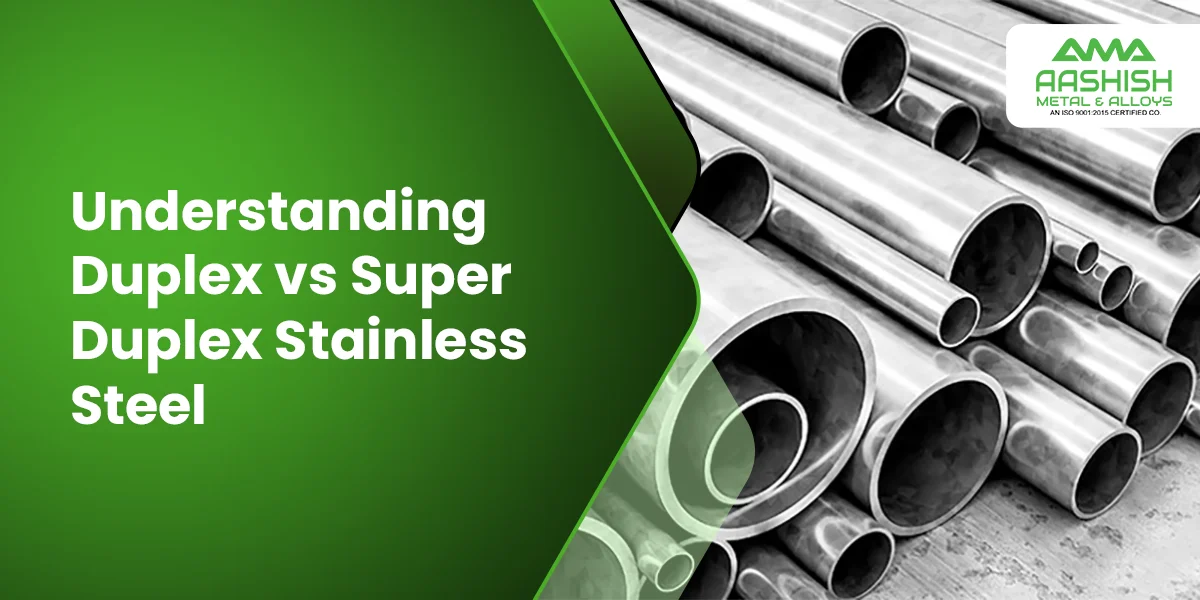
Duplex vs Super Duplex Stainless Steel
To overcome the deficiencies of fully austenitic stainless steels in chloride-containing environments, a duplex stainless steel has been developed, which is reasonably ductile and weldable. The most commonly used duplex grade is S32205, or 22/5/3/0.17 (22% chromium, 5% nickel, 3% molybdenum and 0.17% nitrogen). Super duplex stainless steel takes this idea further and increases the amount of alloying even more. The higher grades (S32750 and S32760) contain 25% chromium, 7% nickel, 4% molybdenum and 0.25% nitrogen, these make them a high chromium and high molybdenum grade. Every addition of the elements has a direct positive effect on both corrosion resistance and mechanical properties.
The table below shows the key differences at a glance between standard Duplex Steel S31803/S32205 Pipes and Super Duplex S32750/S32760 Pipes:
| Property | Standard Duplex (S31803/S32205) | Super Duplex (S32750/S32760) |
| Chromium (%) | 22% | 25% |
| Nickel (%) | 5% | 7% |
| Molybdenum (%) | 3% | 4% |
| Nitrogen (%) | 0.17% | 0.25% |
| PRE Number | ~35 | ~40 to 42 |
| Yield Strength | 450 MPa (65 ksi) | 550 MPa (80 ksi) |
| Critical Pitting Temp. | ~25 deg C in 6% FeCl3 | ~40 deg C+ in 6% FeCl3 |
| Cost Index | 1.0x (Baseline) | 1.4 to 1.6x (40 to 60% premium) |
Super duplex stainless steel (450/050) is a higher-grade version of duplex stainless steel that has higher levels of chromium, molybdenum and nitrogen, enhancing its strength and resistance to pitting and crevice corrosion. Super duplex will contain more alloy content and will be used in much more severe service conditions than both grades. Both grades have the same dual-phase microstructure. This additional performance comes at a higher cost and knowing where it is important is the important part of making the correct material selection.
What is PRE Number?
The Pitting Resistance Equivalent number, or PRE, is the single most important metric for specifying corrosion-resistant alloys in chloride environments. The formula is:
PRE = %Cr + 3.3 x %Mo + 16 x %N
This is a figure that indicates the resistance of a grade to pitting corrosion in a chloride containing environment. The higher PRE, the higher operating temperature of a grade that it can endure before pitting starts. The PRE for standard duplex S32205 is about 35. With a higher content of molybdenum (4%) and nitrogen (0.25%), the Super duplex S32750 has a higher rating of around 42.
The general guideline: When using seawater or aggressive chloride service, use a minimum PRE of 40. The lower grade has not enough safety factor in seawater temperature of 25-30°C and above. Also, it must be recognized that PRE does not predict resistance to stress corrosion cracking (SCC) and crevice corrosion, which must be evaluated separately.
| Grade | PRE Value | Recommended Service |
| SS 316L | ~24 | Low chloride indoor environments |
| Duplex S32205 | ~35 | Seawater below 30 deg C, <500 ppm Cl |
| Super Duplex S32750 | ~42 | Seawater above 30 deg C, subsea, brine |
| Super Duplex S32760 | ~40 to 41 | High-chloride chemical/offshore service |
Not sure if your application needs super duplex?
Aashish Metals and Alloys provides corrosion engineering consultation. Share your service conditions including temperature, chloride level, and design life requirements, and our team will recommend standard duplex or super duplex grades with technical justification and PRE calculations.
Evaluate operating temperature, chloride concentration, and corrosion exposure.
Get technically justified duplex or super duplex alloy recommendations.
Receive PRE calculations and guidance for long-term reliability.
Corrosion Resistance Comparison of Duplex vs Super Duplex
Pitting Corrosion
The main mode of failure in chloride environments is pitting corrosion. Typical duplex S32205 has a good service life in fresh seawater when the temperature is less than about 60 degrees C, but its safety margin decreases as the temperature increases. Super duplex S32750 and S32760 are also good in chlorides up to 80 to 90 degrees C, offering a significant amount of temperature tolerance and engineering safety factor. The critical pitting temperature of super duplex in a test solution of ferric chloride (6%) is greater than 40 degrees C, while the critical pitting temperature of standard duplex is around 25 degrees C. Super duplex grades practically resist localized attack at higher temperature and concentration of chloride solutions.
Crevice Corrosion
Geometrically restricted spaces, like flanged joints, gasket contact surfaces and tube-to-tubesheet connections, concentrate corrosive species resulting in crevice corrosion. In static sea water, above 30°C, standard duplex can be subject to crevice corrosion. The resistance of super duplex is up to 50 degrees C and above under similar conditions. This difference is important for engineers designing assemblies that will be used in seawater service and have flanged geometry, or any heat exchanger. Aashish Metals and Alloys offers precision fit duplex steel fittings for both standard duplex and super duplex.
Stress Corrosion Cracking (SCC)
The duplex and super duplex stainless steels are more resistant to chloride stress corrosion cracking than the austenitic stainless steels. One of the basic structural benefits of duplex over fully austenitic materials is that the ferritic phase present in the duplex structure inhibits crack propagation. Good SCC resistance, and much better performance in most chloride environment compared to SS 316. In most practical applications, super duplex is virtually immune to chloride SCC and is the material of choice for safety-critical applications under thermal cycling stress or residual fabrication stresses.
Reported industry data indicates that neither of the grades provides resistance to SCC in chloride solutions when the temperatures are below 150 degrees C. A significant benefit over the austenitic grade which may sustain SCC at much lower temperatures.
General Corrosion in Acids
They are not suitable for use in strong acids and should be avoided if using nickel-based alloys (e.g. Hastelloy) is more suitable. Super duplex is more efficient in dilute acid, however, because of its high levels of chromium and molybdenum. In a mixed environment, if the concentration of the acid and the chloride ion is in the medium range, Super duplex is the best option from the duplex family. When considering whether a particular grade shall be used for acid service, always refer to corrosion isocorrosion charts as resistance is dependent on temperature, aeration and presence of oxidising agents.
Duplex vs Super Duplex Mechanical Properties and Strength
The yield strength is around 20-25% higher for super duplex stainless steel (550 MPa or 80 ksi) than for standard duplex (450 MPa or 65 ksi). This design aspect is directly tied to this strength advantage. The higher yield strengths provide the engineering flexibility to reduce pipe wall thickness to achieve the same pressure rating, thereby reducing material weight, reducing installation costs and can help compensate for some of the material premium for difficult offshore and subsea structures. Super duplex 2507 has a 22% higher yield strength and 28% higher tensile strength than duplex 2205 to allow thinner wall thickness of pipe to carry the same pressure.
Both grades have excellent low temperature impact toughness and are suitable for service in cold climates or service in proximity to cryogenic temperatures. Additionally, superior fatigue performance under cyclic loading is found in super duplex which is appropriate for offshore structures exposed to wave and vibration loads.
Both families have been found to be susceptible to 475°C embrittlement. The sigma phase precipitates and the toughness decreases significantly at prolonged exposure at the temperature range of 300 – 500 degrees C. This range must be maintained in long term service for both grades. For Super Duplex Fasteners and structural components, Aashish Metals and Alloys provides full material certification and heat treatment records to confirm microstructural integrity.
Applications by Industry
- Oil and Gas (Offshore): Standard duplex S32205 is used for topside pipe and medium temperature applications. Components such as subsea manifolds, seawater injection systems and high pressure wellhead components where PRE>40 is critical require super duplex S32750/S32760. Super duplex isn’t a luxury, it’s a necessity when designing for the 30-year subsea life.
- Chemical Processing: Standard duplex is used for moderate-chloride process streams and storage tanks. When chemical aggressiveness and thermal load exceed those of the standard duplex, a higher grade of duplex, called ‘super duplex’, is required for heat exchanger, high chloride reactors and elevated temperature lines. For chemical plant service, Aashish Metals and Alloys provide both grades, in both pipe and fittings and flanges.
- Desalination Plant: Standard duplex can be used in Desalination Plant for cold seawater (below 25°C). For higher temperature brine heaters, flash evaporator tubes and heat recovery sections, super duplex is recommended. One failure mode of particular concern in this service is crevice corrosion at tube to tubesheet joints, which super duplex has the resistance to exceed 50°C.
- Pulp & Paper Bleach plant: The chloride bearing liquors are encountered in the Pulp & Paper Bleach plant at high temperature. Standard duplex is used for moderate-chloride service and super duplex is used when chloride concentration and temperature are high enough that they are used together, in high-temperature washers and evaporators.
Duplex vs Super Duplex Stainless Steel Material Selection
The selection criteria for duplex and super duplex customers for industrial service is outlined below. The decision of choosing super duplex steel for most industrial applications should be based on the actual corrosion data or design code requirements; otherwise, standard duplex should be the default choice.
Use Standard Duplex S31803/S32205 When:
- The continuous temperature of seawater service is below 30 degrees C.
- Chloride concentration < 500ppm when the temperature < 60 degrees C.
- Projects that require a low budget which can be designed with sufficient corrosion allowance.
- An upgrade from SS 316L with standard duplex providing a significant performance boost at a moderate extra expense.
- The geometry of the crevice is small or there is a system that will seal the crevice.
Use Super Duplex S32750/S32760 when:
- For seawater service, the operation temperature is over 30℃, or high-velocity erosion-corrosion exists.
- Crevice corrosion potential at gasket interface, tube-to-tubesheet connections and flanged joints of heat exchangers.
- Design life is specified to be greater than 30 years, even though the life may be less if there is no corrosion allowance.
- For safety-critical systems that would have dire consequences if they failed due to corrosion,
- A higher yield strength makes it worth the material premium or reduces the wall thickness.
- The process stream contains Sour gas (H2S) service and chlorides are present in the process stream.
The Bottom Line
Aashish Metals and Alloys is a trusted supplier of duplex and super duplex stainless steel products for demanding industrial applications. Whether you need standard duplex for topside piping or super duplex for subsea manifolds and heat exchangers, our team provides full technical documentation, PMI testing, and competitive lead times. Reach out to our team with your service conditions and we will provide a grade recommendation with technical justification.
Source Duplex and Super Duplex Steel from Aashish Metals and Alloys
We supply S31803, S32205, S32750, and S32760 in pipes, tubes, fittings, flanges, and fasteners. Full EN 10204 3.1 MTCs, PMI testing, and corrosion test reports available. Ready stock and fast custom fabrication.
S31803, S32205, S32750, and S32760 ready for supply.
Pipes, tubes, fittings, flanges, and industrial fasteners.
EN 10204 3.1 MTCs, PMI testing, and corrosion test reports available.
Ready stock with quick turnaround and custom fabrication support.
Frequently Asked Questions
Only if operating conditions are within S32205 limits: seawater <30°C, chlorides <500 ppm at <60°C, and no critical crevice corrosion risk. For seawater >30°C, subsea service, or 30+ year design life, super duplex prevents premature failure. Cost savings from material downgrade are lost 10x over if corrosion failure occurs.