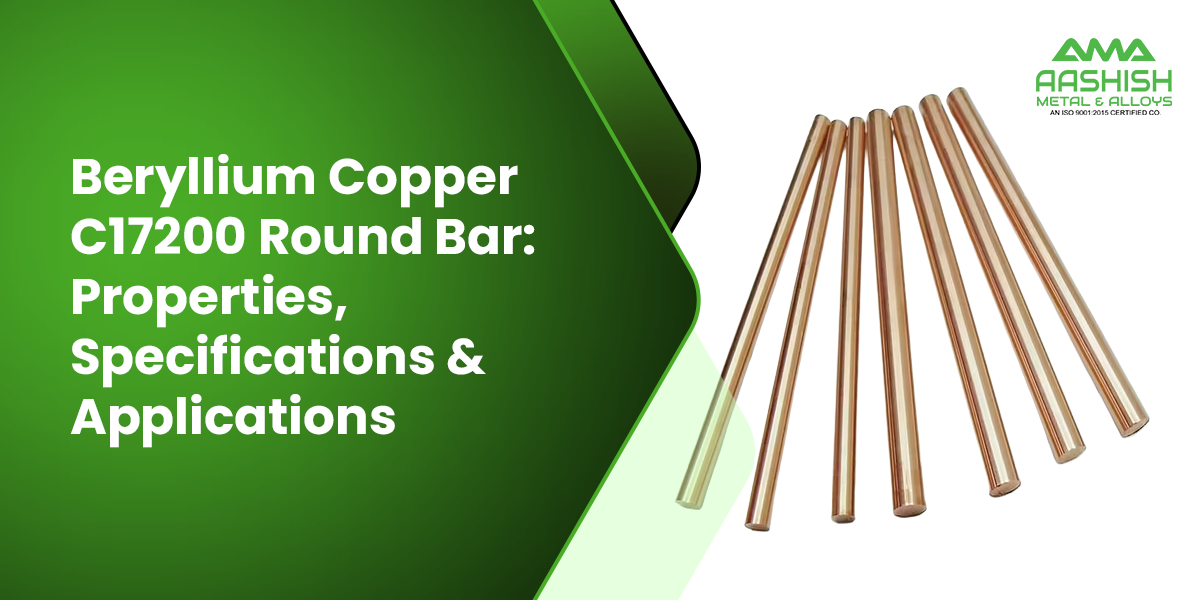
Beryllium Copper Round Bar is a high-strength copper alloy that is made with the compliance of C17200 grade (UNS C17200), which is a blend of the highest strength, conductivity and corrosion resistance with fatigue resistance. It is among the most popular beryllium copper alloy, and it is typically used in precision engineering. The Beryllium round bar shape is particularly applicable in machining high performance components which need durability, dimensional stability and consistent performance under harsh conditions. Beryllium Copper C17200 round bar used in situations where critical components are needed and the material must have both good electrical or thermal conductivity and mechanical strength.
The production of C17200 round bar is controlled and includes alloying copper to a very specific percentage of beryllium; the product is then cast, rolled/drawn into a bar shape and heat treated. Its hardness and strength are greatly increased in the process of precipitation hardening. Such properties as extremely high tensile strength, high wear resistance, good machinability after aging, non-magnetic properties, and high fatigue resistance are key. Its standard grade is C17200(or Alloy 25), and is commonly utilized in aerospace, oil and gas, electronics, automotive, tooling, marine, and electrical applications as springs, connectors, weld electrodes, molding and bushings and precision parts.
What is Beryllium Copper?
Beryllium copper is a high-end engineering alloy that is highly valued due to its superior mechanical strength, together with the stability of its electrical and thermal conductivity. It is stronger than normal copper and most of the other copper alloys and has excellent fatigue and wear resistance as well as long life in challenging applications. Beryllium copper offers high levels of hardness, dimensional stability, and service life compared to those of bronze and alloys of the same type and is therefore very appropriate to precision parts and other high-performance applications. The combination of strength and conductivity is a special feature of beryllium copper, which makes it one of the most favorite materials in industries that demand reliable performance, efficiency, and durability.
Key Properties of Beryllium Copper Round Bar
The key properties of Beryllium copper include many things that information is given below.
Exceptional Strength:
Beryllium copper of the C17200 beryllium copper (UNS C17200) series can have tensile strengths of tensile strength than 200,000 psi following suitable C17200 beryllium copper heat treatment, so it is one of the strongest copper-based alloys.
Electrical Conductivity:
The beryllium copper has remained the best choice to use in electrical and electronic parts despite the fact that it is highly strong but still conducts electricity about 70 percent of pure copper.
Superior Anti-corrosion Protection:
The alloy is also dependable under tough and chemically hostile conditions, and it is more durable than most typical copper alloys.
Unparalleled Fatigue Resistance:
C17200 made components can resist numerous stress cycles beyond breaking or failing, and therefore last long in demanding applications.
Excellent wear resistance:
Beryllium copper is a good abrasive and surface wear resistance, and it is used in high-contact mechanical components.
Precision Machinability:
C17200 beryllium copper is supplied in round bar form which may be machined to small tolerances and hence complex and high precision parts may be made.
Dimensional Stability:
The alloy is strong and retains its shape even when subjected to mechanical and thermal forces hence it is applicable in the critical engineering functions.
Optimal Strength and Conductivity Value:
Beryllium copper is a distinct blend of mechanical strength and high-quality conductivity that makes it popular in the aerospace, electronics, tooling and high-quality industry.
Applicational uses of Beryllium C17200 Round Bars
The beryllium C17200 round bars are commonly used in different industries due to its strength and corrosion resistance properties. Some of the common industries that use this material are given below.
Electricity and electronics:
Beryllium C17200 round bars in the size of 0.005 to 0.04 m are widely used as connectors, terminals, switch contacts and precision electrical parts because of a good combination of strength and conductivity.
Aerospace Components:
Applicable in high-performance aircraft components, fasteners and structural components in which high tensile strength, fatigue strength and reliability are prerequisites.
Automotive Applications:
Applied in sensor enclosures, valve springs, relay parts and other automotive parts that need high durability and service life.
Tooling & Mold Inserts:
This is commonly used in an injection molding insert, molds, due to their high wear resistance and thermal performance, which is beneficial for production efficiency.
Industrial Machinery Parts:
Used in pumps, valves, bushings, bearings, and machined components that are required to work under high load and in unfavorable conditions.
Non-Sparking Tools:
Appropriate when the tools are involved in an explosive or dangerous area where a lot of safety is essential.
Military & Defense Equipment:
Applied in special defense parts which need strength, reliability and operation under extreme conditions.
Comparison of Beryllium Copper Round Bar with Other Copper Alloys
| Parameter | Beryllium Copper Round Bar | Brass | Bronze |
|---|---|---|---|
| Strength | Very high; ideal for heavy-duty/high-stress | Moderate | Moderate to Good (grade dependent) |
| Corrosion Resistance | High (thrives in harsh environments). | Good (can degrade in specific conditions). | Generally good |
| Machinability | Excellent (best when heat-treated). |
Very good; very easy to work with. |
Varies; some grades are quite hard. |
| Wear Resistance | Superior; highly durable. | Moderate. | Good |
Advantages of Using the Right Refractory Anchors
Implementing correctly specified refractory anchors and appropriate refractory anchor types is a strategic investment that directly impacts system efficiency and longevity.
- Enhances Refractory Lining Life: The stabilization of the material will inhibit movement and spread of stress, which are two main causes of the premature degradation of refractories.
- Stops Detachment and Collapse: The anchor system is dependable to provide the lining mass to the shell so that the structural integrity of the refractory wall is achieved even during severe thermal and mechanical loads.
- Enhances Thermal Shock Resistance: Anchor designs are able to deal with thermal expansion and contraction. It is a flexible nature that reduces internal stress, and thus spalling and cracking that may occur during a fluctuation in temperature.
- Less Maintenance Down Time: The longer the system life, the greater the number of unplanned interruptions reduced and the lower the rate of costly maintenance and repair processes.
- Improves Structural Support of Castables: The anchors give a requisite supportive framework which reinforces monolithic linings in the course of initial curing and through decades of working service.
- Enhances Fuel Economy and even-distribution of Heating: The low-conductivity material and optimization of where the anchor is placed limits thermal bridging and ensures the overall system is as thermal efficient as can be and limits heat loss.
Applications of Refractory Anchors
Refractory anchors are indispensable components that support continuous operation across virtually every high-temperature heavy industry sector:
- Cement Industry: Kiln Lining is widely utilized as the anchor of rotary kilns and preheaters with conditions being of extreme temperatures and extremely abrasive natures.
- Petrochemical and Refining: Essential in obtaining linings in reactors, catalyst regenerators and cracking furnaces. These plants usually need special materials to stand up to any chemical corrosion present in the process gases.
- Steel Production: This is required in stabilizing refractory linings in blast furnace, hot metal ladles and reheating furnace in order to guard the equipment structure against corrosive molten metal and thermal shock.
- Boilers & Power Plants: The thermal transfer is maximized and the heat loss is reduced through the provision of the essential structural support of the combustion chamber and stacks.
- Waste Incineration: Castable refractory linings need very hardy anchor because of the variable temperatures and the highly corrosive exhaust gases which on their way quickly corrode unguarded metals.
How to Choose the Right Refractory Anchor
The choice of the anchoring system should be carried out on the basis of an extensive engineering study and correspond to the operating conditions of the material and design of the anchors. The important selection criteria are the maximum sustained operating temperature, which determines the grade of the refractory anchor material to use that is able to withstand oxidation and maintain mechanical strength, e.g. SS 316 used in chemical defense. The length of the anchor is a crucial aspect and should penetrate 75 percent to 85 percent of the lining thickness to provide structural support, and this is used to choose the proper refractory anchor types such as V, Y, and special ceramic anchors. Specific load and stress conditions that engineers have to consider include the mechanical vibration and the stationary components of weight of the refractory mass. Last but not the least is the location of the anchor (roof, wall, floor) and spacing, improper orientation or spacing may lead to localized stress and premature cracking of the structure. In the process of proper specification of the system, it is frequently required to collaborate with a specialized refractory anchor manufacturer.
Common Lining Failures Caused by Wrong Anchors
Failures within refractory lining support systems are often a result of mistakes in the original specification or installation of the refractory anchor design. The most frequent failures are cracking and spalling; they are usually brought about by the overly narrow interval between the anchors, which limits the required thermal expansion and creates too much internal stress in the refractory. Bulging and detachment can be caused by the inadequate length of the anchors that cannot provide the structural grip or the structural failure can be caused by the corrosion of the material or its mechanical creep. Finally, the lining collapse is usually catastrophic because of the under-specified materials or, more commonly, bad installation methodology such as incorrect spacing and depth.
Why Choose Aashish Metals
Aashish Metals is one of the major refractory anchor manufacturers, certified stainless steel refractory anchors designed to offer the maximum life and performance of the product under the harshest thermal conditions. There is strict quality control on all high-performance SS grades which include SS 304, 316 and the indispensable high-temperature SS 310.Our specialization in these high-tech materials ensures that we are able to satisfy the high-heat markets that are the most demanding.
In addition to conventional product lines, Aashish Metals has specialized in custom anchor fabrication, which provides customized V-type, UV-type, and L-type anchors that have been optimized to particular lining thickness and specific thermal profiles. Your operations risk and maintenance will be reduced by investing in better materials and accurate production. Contact our experienced engineering team today for expert consultation and system specification.Good (can degrade in specific conditions).MachinabilityVery good; very easy to work with.