Galvanic corrosion is regarded as the most prevalent and most expensive type of metal corrosion observed in construction, marine, oil and gas and industrial piping systems. Knowledge on the nature of galvanic corrosion, its initiation, and prevention is a must to engineers, procurement groups, and plant managers who deal with dissimilar metals on a day-to-day basis.
At Aashish Metal and Alloys, we supply corrosion-resistant alloys and precision components to clients across 52 countries. The initial and most effective measure in ensuring that your project does not suffer due to galvanic corrosion is to select the appropriate metals to use in your project.
What Is Galvanic Corrosion?
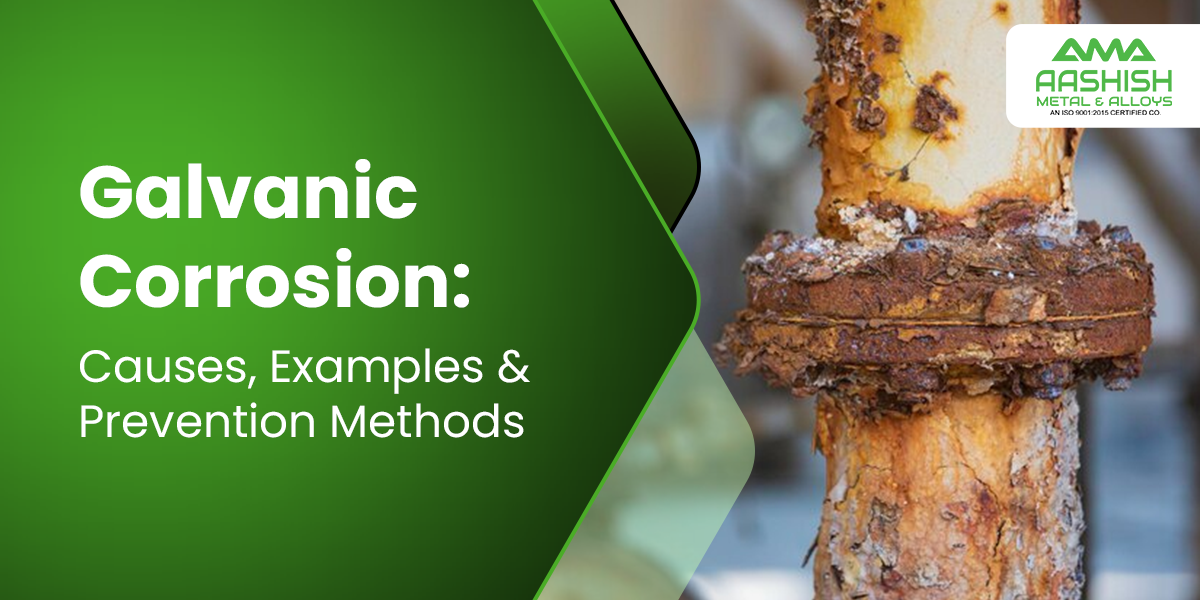
Galvanic corrosion (also known as bimetallic corrosion or dissimilar metal corrosion) is an electrochemical process that takes place between two metals with different electrode potentials when they are in direct physical contact and have an electrolyte present (e.g. saltwater, moisture or any electrically conductive liquid). The weaker metal (the anode) corrodes more rapidly in this reaction, whereas the more noble metal (the cathode) is not corroded.
Imagine it as an accidental battery, the possible difference in electric potential between the two metals impels an electric current, which dissolves the anodic metal in the electrolyte as time passes.
How Does Galvanic Corrosion Occur?
Three conditions must all be present simultaneously for galvanic corrosion to take place:
- Two dissimilar metals with different electrode potentials must be in contact. The greater the gap in their position on the galvanic series, the faster the corrosion rate.
- A direct electrical path must connect them, such as physical metal-to-metal contact or a shared fastener.
- An electrolyte must be present to carry ions between the metals. Common electrolytes include seawater, freshwater, humidity, acids, and soil.
Remove any one of these three elements and galvanic corrosion cannot occur. This principle forms the foundation of every prevention strategy discussed later in this article.
Galvanic Series Metals: Understanding the Scale
The galvanic series ranks metals and alloys from most anodic (active, corrodes fastest) to most cathodic (noble, most resistant to corrosion). When two metals from this list are coupled in an electrolyte, the one higher on the list (more anodic) will corrode preferentially.
Rank | Metal or Alloy | Corrosion Tendency |
1 (Most Anodic) | Magnesium | Corrodes fastest (Anode) |
2 | Zinc | Highly active, corrodes readily |
3 | Aluminium Alloys | Active, anodic in most couples |
4 | Carbon Steel / Cast Iron | Moderately active |
5 | Lead | Slightly active |
6 | Copper and Copper Alloys | Moderately noble |
7 | Stainless Steel 304 / 316 | Noble, corrosion resistant |
8 | Titanium | Very noble, highly resistant |
9 | Inconel / Hastelloy Alloys | Noble, excellent resistance |
10 (Most Cathodic) | Gold / Platinum | Corrodes least (Cathode) |
As shown in the table, materials like stainless steel 316, Inconel, Hastelloy, and Titanium sit near the cathodic end of the galvanic series. This is why they are preferred in aggressive environments. Explore our full range of Stainless Steel products and Hastelloy products for corrosion-critical applications.
Real-Life Galvanic Corrosion Examples
Galvanic corrosion examples appear across virtually every industry. Below are some of the most commonly encountered cases:
Marine and Offshore Applications
Aluminium hulls paired with stainless steel propeller shafts or bronze fittings in saltwater create classic galvanic cells. The aluminium, being more anodic, corrodes rapidly. Sacrificial zinc anodes are routinely attached to hulls to absorb this corrosive attack.
Plumbing Systems
In residential and commercial buildings, copper pipes connected to galvanised steel fittings are a frequent source of galvanic corrosion. Water acts as the electrolyte, and the zinc coating on the steel corrodes first, followed by the steel itself, leading to leaks and pipe failure over time.
The Statue of Liberty
One of the most famous galvanic corrosion examples in history: the Statue of Liberty suffered internal corrosion between its outer copper skin and the wrought iron support framework. The shellac insulation between the two metals had degraded over decades. Restoration work in the 1980s replaced the insulation with PTFE to prevent further bimetallic attack.
Industrial Piping and Flanges
In process plants, connecting carbon steel pipework to stainless steel flanges or fittings without insulation kits is a common trigger for galvanic corrosion, especially in wet or chemically active environments. Our 316 Stainless Steel products are specifically selected for their position on the galvanic series to minimise corrosion risk.
Structural Steel and Aluminium Connections
Steel and aluminium are far apart on the galvanic series. When bolted together in coastal environments, the aluminium degrades rapidly. This is routinely managed in aerospace and construction by using insulating washers or compatible fasteners.
How to Prevent Galvanic Corrosion
The good news is that galvanic corrosion prevention is well understood and practically achievable. Here are the most effective methods used across industries:
Select Compatible Metals
The simplest approach is to choose metals that are close together on the galvanic series. For example, pairing Duplex Steel fasteners with duplex steel pipework dramatically reduces the galvanic potential difference. Similarly, using Copper Nickel alloys throughout a marine system avoids dangerous pairings.
Use Electrical Insulation
Breaking the electrical path between dissimilar metals using non-conductive materials such as neoprene gaskets, plastic washers, PTFE tape, or dielectric fittings prevents the galvanic circuit from forming entirely. This is widely used in pipework and structural connections.
Apply Protective Coatings
Paint, epoxy, bituminous coatings, or electroplating prevent the electrolyte from contacting the metal surface. For maximum protection, coat both metals. Galvanising carbon steel with zinc, for instance, adds a sacrificial anodic layer that corrodes in place of the steel beneath.
Install Sacrificial Anodes
A sacrificial anode is a highly active metal (zinc, magnesium, or aluminium alloy) that is intentionally connected to the structure. It corrodes preferentially, protecting the main structure. This method is widely used on ship hulls, jetties, pipelines, and offshore platforms. Our Inconel products are frequently specified alongside cathodic protection systems in demanding subsea environments.
Control the Environment
Where possible, remove or reduce the electrolyte. This includes ensuring effective drainage at dissimilar metal joints, sealing against moisture ingress, and using dehumidification in enclosed spaces. In closed-loop systems such as HVAC, maintaining correct pH and inhibitor levels reduces galvanic activity.
Optimise Anode to Cathode Area Ratio
A large anode area combined with a small cathode area slows corrosion significantly. Avoid the opposite (small anode, large cathode) as this accelerates corrosive attack on the smaller anodic component. In practice this means using noble metal fasteners with a larger active-metal structure rather than the reverse.
The Bottom Line
Galvanic corrosion is a predictable, electrochemically-driven process. By understanding the galvanic series metals table, the three conditions required for corrosion, and the proven prevention methods outlined above, engineers and procurement specialists can design longer-lasting, lower-maintenance systems.
Material selection is the single most powerful control measure. Whether you need corrosion-resistant special instrumentation fittings, alloy fasteners, or complete piping systems, Aashish Metal and Alloys can support your specification with expert guidance and a comprehensive inventory of corrosion-resistant metals.
Frequently Asked Questions
Galvanic corrosion is the faster corrosion that develops when the two different metals are in contact with a liquid that has the ability to conduct electricity (an electrolyte). The less noble corrodes more rapidly than it would otherwise, whereas the more noble metal is shielded.
Those most susceptible are metals that are close to the anodic end of the galvanic series. They are magnesium, zinc, aluminium alloys, and carbon steel. They are quick to corrode when combined with noble metals such as stainless steel, copper or titanium as an electrolyte.
Galvanic corrosion needs an electrolyte to permit the movement of ions between the metals. Galvanic corrosion does not take place in dry air where there is no moisture. Nevertheless, the process can occur in even high humidity so this risk exists in most real-world outdoor conditions.
The best methods include methods such as using all stainless steel, installing dielectric unions or insulating gaskets at dissimilar metal connections, coating with protective coating, and ensuring that dissimilar joints are well drained to keep the accumulation of electrolytes to a minimum.
Stainless steel is noble and occupies high position on the cathodic end of the galvanic series thus is highly guarded and does not often fall prey to galvanic attack itself. But it has the ability to increase the rate of corrosion of less noble metals attached to it like carbon steel or aluminium. Another common cause of galvanic damage to aluminium is the use of stainless steel fasteners on aluminium structures which are not insulated.
The damage by galvanic corrosion cannot be reversed. Once the metal is corroded, it will never be able to be replaced or repaired. But when discovered, additional corrosion may be prevented by breaking the galvanic circuit or by using coating or installing sacrificial anodes.