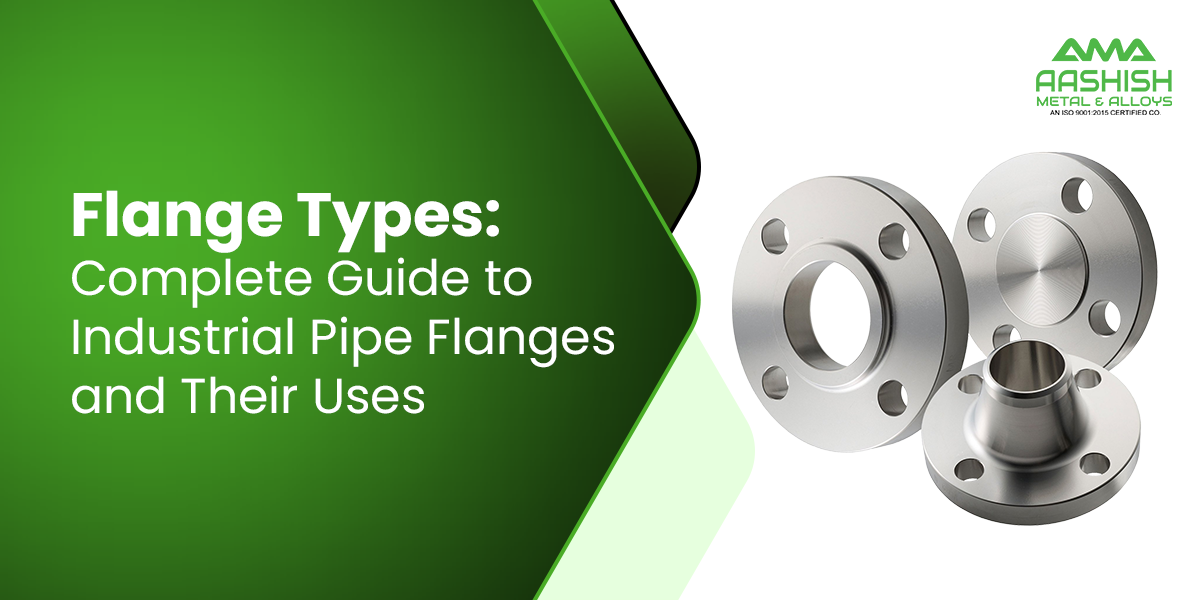
A flange is a ring-shaped fitting of steel, forged or cast and secured to two sections of pipe or pipe to a valve or vessel by bolting. A gasket is compressed between two matching faces and it is this compressed gasket which provides the pressure within the line. Flanges are what makes industrial piping serviceable and not a single sealed structure, due to the fact that they can be unbolted and put back together. The dimensions, bolt circle and pressure rating of various flange types and services are governed by various standards: ASME B16.5, ASME B16.47, API 6A, and AWWA C207.
There is no cosmetic choice when it comes to selecting the type of flange. It determines the manner in which pressure cycling, vibration and disassembly during maintenance is handled by the joint, and also the amount of stress the joint transmits from the bolt load to the pipe wall. The six basic flange types and the face types and pressure classes associated with each type are given below and are commonly found in most industrial piping.
Major Flange Types and Where Each One Fits
Weld Neck Flange
A weld neck flange has a long, tapered hub that is butt-welded to the pipe, spreading bolt-load stress gradually into the pipe wall instead of concentrating it at the weld. This makes it the standard choice for high-pressure, high-temperature, and cyclic service such as refineries and pressure vessels.
Slip-On Flange
A slip-on flange slides over the pipe end and is fillet-welded inside and out. It is easier to align and cheaper than a weld neck flange, but its pressure rating and fatigue resistance are lower, so it is common in lower-pressure piping and waterworks.
Blind Flange
A blind flange is a solid disc with no bore, used to seal off the end of a pipe run, a vessel nozzle, or an inspection port. It is the standard way to cap a line for testing or future expansion.
Socket Weld Flange
The pipe end fits into a recessed bore and is fillet-welded around the outside. Limited to smaller diameters and lower pressure classes, but it leaves a smooth interior bore that suits small-bore process and instrument lines. See our socket weld flange range for available sizes and classes.
Threaded Flange
Internal NPT threads screw directly onto threaded pipe with no welding required, which suits low-pressure, non-cyclic service or sites where welding is impractical. It is not suited to high-pressure or cyclic lines, since threads can loosen under repeated stress.
Lap Joint Flange
A two-piece design: a stub end welds to the pipe, and a separate backing flange sits loosely behind it, free to rotate for easy bolt-hole alignment. Since the backing flange never touches the process fluid, it can be plain carbon steel even when the pipe itself is an expensive alloy, see our lap joint flange options for various pressure classes.
Specialty Types
- Reducing flange. Joins two different pipe diameters in one fitting, skipping a separate reducer and weld.
- Spectacle blind / paddle blind. Isolates a section of line. A spectacle blind is a permanent figure-eight plate; a paddle blind is a removable version.
Not sure which flange class or material fits your project?
Our team matches flange type, face, and material to your exact pressure, temperature, and code requirements, so you're not guessing on a bolted joint that has to hold for years.
Get a quote, check stock availability, or speak with our team about grade selection for your application.
Flange Face Types
The sealing face geometry has to match between two mating flanges or the joint will not seal. Raised face (RF) is the most common, sitting slightly above the bolt circle to concentrate bolt load on the gasket. Flat face (FF) sits level with the bolt circle and is used against brittle materials like cast iron, which can crack under a raised face. Ring type joint (RTJ) uses a metal ring in a machined groove for a metal-to-metal seal, standard in high-pressure and wellhead service — see our API 6A Type 6B 2000 psi weld neck and blind flanges for a wellhead-grade example. Tongue and groove or male and female faces lock the gasket in place geometrically for demanding or hazardous applications.
Pressure Classes
Flange pressure class has to match the rest of the system exactly. ASME pressure classes run 150, 300, 600, 900, 1500, and 2500; these are pound classes, not literal pressures, since the actual allowable pressure depends on temperature and material per standard pressure-temperature tables. API 6A uses literal working pressures up to 20,000 psi for wellhead and Christmas tree equipment, and AWWA C207 uses its own classes for waterworks with bolt patterns that differ from ASME flanges of the same nominal size. Bolting two different classes together is not a safe shortcut even if the bolt holes line up, since wall thickness, bolt load, and gasket seating stress are all engineered around one specific class.
Materials
Most general flanges are forged carbon steel or forged stainless steel. Carbon steel covers standard process and utility service; stainless handles corrosive, food-grade, or pharmaceutical use. Chrome-moly alloys handle elevated temperatures, nickel alloys and duplex stainless handle aggressive corrosive or offshore service, and cast or ductile iron remains common in lower-pressure water utility piping.
How to Choose the Right Flange Type
- Operating pressure and temperature. High-severity service points toward weld neck and RTJ designs.
- Disassembly frequency. Frequent maintenance favors lap joint or slip-on designs.
- Pipe material. Exotic alloys often pair with a lap joint flange to control material cost.
- Governing code. ASME B31.3, API 6A, and AWWA each carry different requirements.
- Mating component. A valve, vessel nozzle, or fitting dictates the face type and bolt pattern you need to match.
Installation Note
Even the right flange will leak if installed poorly. Bolts must be tightened in a cross pattern across multiple passes, working up to full torque gradually rather than fully tightening one side before the other. This keeps gasket compression even around the face. A joint that leaks soon after startup is more often a torque sequencing problem than a bad gasket or wrong flange choice.
Final Thoughts
No single flange type covers every combination of pressure, temperature, material, and maintenance need. Weld neck flanges dominate severe service, slip-on and threaded designs cover lighter-duty piping, blind flanges close off lines, socket weld flanges handle small-bore process work, and lap joints solve alignment and cost problems on exotic alloy piping. Once you know what each type is built to do, matching one to your application is a short conversation.
Get the right flange the first time.
From weld neck to lap joint, in carbon steel, stainless, duplex, or nickel alloy, we stock and supply flanges across all major ASME, API 6A, and AWWA classes.
Get a quote, check stock availability, or speak with our team about grade selection for your application.
A flange creates a bolted, gasketed joint between two pipe ends, or between a pipe and a valve or vessel. Unlike a welded joint, it can be taken apart and put back together, which is what allows a piping system to be inspected, repaired, or modified over its working life.
A fitting is the broad category like elbows, tees, reducers, caps, anything that changes a line’s direction, splits it, or closes it off. A flange is one specific kind of connection: a bolted, gasketed joint. The two aren’t competing terms; a fitting can even come with a flanged end, combining both in one component.
Forged carbon steel and forged stainless steel cover the bulk of standard service. Beyond those, chrome-moly alloys step in for high-temperature lines, nickel alloys and duplex stainless handle aggressive corrosion or offshore environments, and cast or ductile iron is still widely used in lower-pressure water utility systems. Material choice tracks the pressure, temperature, and corrosivity of the service, not personal preference.
Under ASME B16.5, Class 2500 is the top of the line. Once a project needs more than that, the spec usually shifts to API 6A wellhead flanges, which are rated by literal working pressure rather than pound class and can go as high as 20,000 psi for wellhead and Christmas tree equipment.
No, the faces have to match. A raised-face flange concentrates bolt load onto a smaller gasket area, and bolting it against a flat-face component (commonly cast iron) can crack that component, since it isn’t designed to take a concentrated load. Always match face type to face type, or use a compatible transition piece.