To choose the appropriate anchor, the first step would be to determine its material design and the application requirements. All these anchors are available with varied strengths whether you want regular fasteners or special ones such as a refractory anchor. Durability and resistance to corrosion Stainless steel refractory anchors are typically utilized in high-temperature and in harsh environments. Types of refractory anchors are many in that they are of V-shape anchors, Y-shape anchors, and some of the custom made anchors that are designed based on the lining and the load needs. Some factors are to be taken into consideration in order to have the correct choice of the refractory anchors whereby the factors are considered such as temperature, load capacity and base material of the refractory anchors. To collaborate with a reputable producer of refractory anchors to assist you in receiving quality and durable anchors to be used in your system.
We will examine the critical designs and more developed materials required to be used in high performance with significant V-type, UV type, and L-type refractory anchor types. These factors are vital in understanding the right stainless steel refractory anchors to be used so that the thermal processing systems are as long lasting and reliable as possible.
What Are Refractory Anchors?
Refractory anchors are fasteners that are typically heat-resistant and are mechanically employed to fix refractory castables (monolithic castables, gunite or bricks) onto the outer steel casing of high-temperature equipment. Their fundamental refractory anchor design provides dynamic stability and is engineered to distribute both static weight loads and the severe thermal stresses caused by cycling temperatures across the refractory lining. Anchoring system is one of the main purposes that avoid the build up of localized stresses that may result in micro-cracks or spalling. The lining would begin to buckle, bulge or detach very quickly without this support system because of the constant expansion and contraction in high temperatures. The result is that the components will wear out and the equipment will break down.
Types of Refractory Anchors
The wide variety of refractory anchor types is designed to suit the unique needs of the requirements of various lining thicknesses, thermal gradients, and operating orientations.The design used here makes sure that the stability of dynamic stability is realized between the mechanical strength and the flexibility required to allow movement of the thermal.
V-Type Anchors (H3)
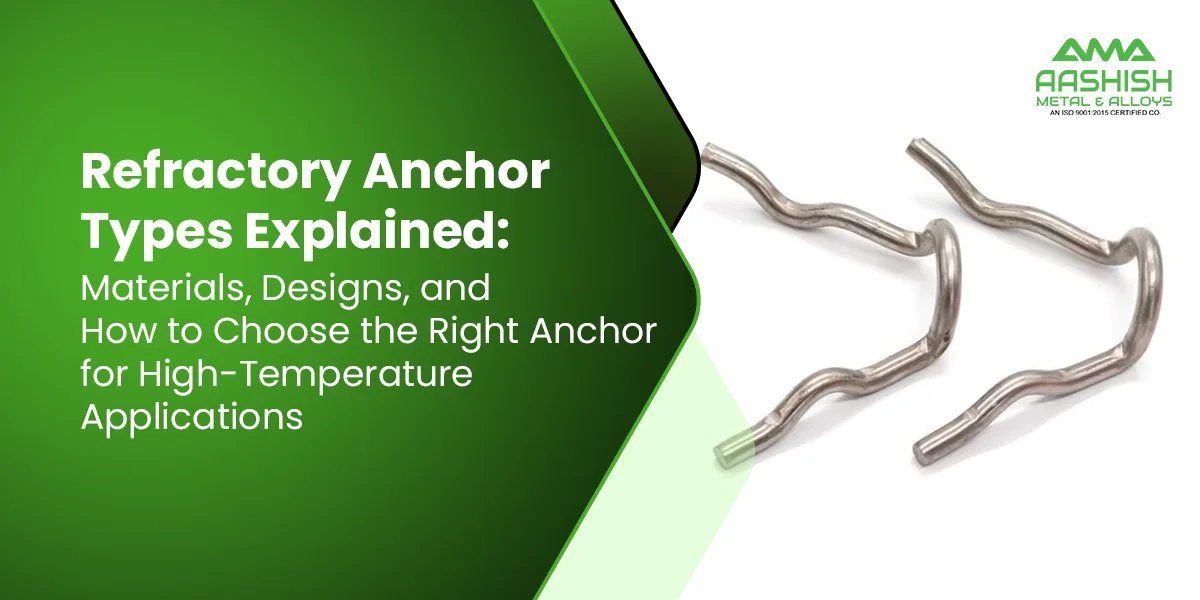
The V-shaped anchor, commonly known as refractory V anchors, is a widely utilized and classic design consisting of two legs that penetrate the refractory lining. This geometry delivers strong mechanical stability and is the standard choice for castable anchor linings in moderate-strength applications like kilns and ducts. Refractory Anchor V Types are effective at preventing the refractory material from sliding or falling off and are versatile for both vertical wall and horizontal floor installations.
UV-Type Anchors (H3)
UV-type anchors are critical for heavy-duty applications. They feature a hybrid configuration that synthesizes the benefits of U and V shapes, providing superior mechanical interlock and robust support, especially for thick refractory linings. This design is engineered to handle greater thermal expansion flexibility while simultaneously distributing heavy loads evenly. This capability is crucial in batch operations where rapid temperature cycling places significant dynamic stress on the lining. Refractory Anchor UV Types are typically employed in large industrial furnaces and heavy-duty kilns where both strength and movement tolerance are necessary.
L-Type Anchors (H3)
L-Type anchors are versatile support solutions often used to secure refractory linings in various structural orientations. L-anchors contribute to enhanced operational efficiency by helping optimize heat transfer. By ensuring the refractory lining remains continuous and sealed, they minimize heat loss, thereby improving the overall efficiency of the thermal system. Refractory Anchors L Types are valued for their high-temperature resilience and strong mechanical stability, remaining functional even under significant mechanical stress or vibration.
Materials Used for Refractory Anchors
The selection of the refractory anchor material is critical, as the anchor must resist oxidation, chemical attack, and creep (deformation under heat) to maintain mechanical integrity. The majority of SS refractory anchors are derived from the austenitic stainless steel family, offering robust performance in industrial heat environments.
Stainless Steel Grades
The foundation grades are SS 304 and SS 316. SS 304 provides the basic resistance to heat, and commonly is utilized where it is desired that the material withstands corrosion usually up to about 900 degree C and Molybdenum is added to SS 316 to make the material more resistant to corrosion and pitting corrosion in the severe acidic conditions of the petrochemical industry.
SS 310 is the standard that must be used when the applications demand the use of the true high temperature refractory anchors. The proportion of chromium (maximally 26) and nickel (maximally 22) in SS 310 is much greater in comparison with SS 304. This value added chemical structure enhances the development of a stable, inert oxide layer, which conveys remarkable oxidation strength. This enhanced stability will enable SS 310 to sustain its mechanical characteristics and be resistant to creep at temperatures up to 1200 degree C, necessary in furnace hot faces and cement kiln applications that cannot be done without.
Specialist Alloys
For extreme chemical resistance and temperatures that exceed 1200 degree C, specialist Nickel alloys, such as Inconel 601 and Incoloy 800, are utilized. These materials provide superior tensile strength and resilience against thermal cycling and complex chemical corrosion. Finally, in monolithic linings greater than nine inches thick, ceramic anchors are sometimes employed to limit thermal bridging, which can otherwise compromise the system’s thermal efficiency.
Refractory Anchor Material Selection Guide
| Material Grade | Key Characteristic | Max Recommended Application Temp | Primary Application Focus |
|---|---|---|---|
| SS 304 | Economical, General Purpose | Up to 900 °C (1650 °F) | Lower temperature zones, general structural support |
| SS 316 | Enhanced Corrosion Resistance (Mo content) | Up to 925 °C (1700 °F) | Acidic environments, chemical reactors |
| SS 310 | Superior Oxidation Resistance (High Cr/Ni) | Up to 1200 °C (2200 °F) | Furnace hot face, cement kilns, high heat zones |
| Nickel Alloys | Extreme Strength, Creep Resistance | 1200 °C+ (2200 °F+) | Highly stressed areas, intense chemical/thermal cycling |
Advantages of Using the Right Refractory Anchors
Implementing correctly specified refractory anchors and appropriate refractory anchor types is a strategic investment that directly impacts system efficiency and longevity.
- Enhances Refractory Lining Life: The stabilization of the material will inhibit movement and spread of stress, which are two main causes of the premature degradation of refractories.
- Stops Detachment and Collapse: The anchor system is dependable to provide the lining mass to the shell so that the structural integrity of the refractory wall is achieved even during severe thermal and mechanical loads.
- Enhances Thermal Shock Resistance: Anchor designs are able to deal with thermal expansion and contraction. It is a flexible nature that reduces internal stress, and thus spalling and cracking that may occur during a fluctuation in temperature.
- Less Maintenance Down Time: The longer the system life, the greater the number of unplanned interruptions reduced and the lower the rate of costly maintenance and repair processes.
- Improves Structural Support of Castables: The anchors give a requisite supportive framework which reinforces monolithic linings in the course of initial curing and through decades of working service.
- Enhances Fuel Economy and even-distribution of Heating: The low-conductivity material and optimization of where the anchor is placed limits thermal bridging and ensures the overall system is as thermal efficient as can be and limits heat loss.
Applications of Refractory Anchors
Refractory anchors are indispensable components that support continuous operation across virtually every high-temperature heavy industry sector:
- Cement Industry: Kiln Lining is widely utilized as the anchor of rotary kilns and preheaters with conditions being of extreme temperatures and extremely abrasive natures.
- Petrochemical and Refining: Essential in obtaining linings in reactors, catalyst regenerators and cracking furnaces. These plants usually need special materials to stand up to any chemical corrosion present in the process gases.
- Steel Production: This is required in stabilizing refractory linings in blast furnace, hot metal ladles and reheating furnace in order to guard the equipment structure against corrosive molten metal and thermal shock.
- Boilers & Power Plants: The thermal transfer is maximized and the heat loss is reduced through the provision of the essential structural support of the combustion chamber and stacks.
- Waste Incineration: Castable refractory linings need very hardy anchor because of the variable temperatures and the highly corrosive exhaust gases which on their way quickly corrode unguarded metals.
How to Choose the Right Refractory Anchor
The choice of the anchoring system should be carried out on the basis of an extensive engineering study and correspond to the operating conditions of the material and design of the anchors. The important selection criteria are the maximum sustained operating temperature, which determines the grade of the refractory anchor material to use that is able to withstand oxidation and maintain mechanical strength, e.g. SS 316 used in chemical defense. The length of the anchor is a crucial aspect and should penetrate 75 percent to 85 percent of the lining thickness to provide structural support, and this is used to choose the proper refractory anchor types such as V, Y, and special ceramic anchors. Specific load and stress conditions that engineers have to consider include the mechanical vibration and the stationary components of weight of the refractory mass. Last but not the least is the location of the anchor (roof, wall, floor) and spacing, improper orientation or spacing may lead to localized stress and premature cracking of the structure. In the process of proper specification of the system, it is frequently required to collaborate with a specialized refractory anchor manufacturer.
Common Lining Failures Caused by Wrong Anchors
Failures within refractory lining support systems are often a result of mistakes in the original specification or installation of the refractory anchor design. The most frequent failures are cracking and spalling; they are usually brought about by the overly narrow interval between the anchors, which limits the required thermal expansion and creates too much internal stress in the refractory. Bulging and detachment can be caused by the inadequate length of the anchors that cannot provide the structural grip or the structural failure can be caused by the corrosion of the material or its mechanical creep. Finally, the lining collapse is usually catastrophic because of the under-specified materials or, more commonly, bad installation methodology such as incorrect spacing and depth.
Why Choose Aashish Metals
Aashish Metals is one of the major refractory anchor manufacturers, certified stainless steel refractory anchors designed to offer the maximum life and performance of the product under the harshest thermal conditions. There is strict quality control on all high-performance SS grades which include SS 304, 316 and the indispensable high-temperature SS 310.Our specialization in these high-tech materials ensures that we are able to satisfy the high-heat markets that are the most demanding.
In addition to conventional product lines, Aashish Metals has specialized in custom anchor fabrication, which provides customized V-type, UV-type, and L-type anchors that have been optimized to particular lining thickness and specific thermal profiles. Your operations risk and maintenance will be reduced by investing in better materials and accurate production. Contact our experienced engineering team today for expert consultation and system specification.