Refractory Anchors: V-Type, UV-Type & L-Type for Furnace & Heater Linings
Home > Refractory Anchors
Types: V-Type · UV-Type · L-Type · Y-Type · Materials: 304 · 310 · 316 · 321 · Inconel · Cut to size · Mill certificate
Aashish Metals supplies refractory anchors, the metal fixings that hold refractory lining onto the steel shell of furnaces, boilers, heaters and reformers. We make them in the shapes contractors specify, V-type refractory anchors and UV-type refractory anchors as the most common, along with L-type and Y-type, in heat-resisting stainless and Inconel grades chosen for the lining temperature. Anchors are cut and formed to your drawing and hot-face length, with a mill test certificate on the grade.
Both the shape and the grade of the anchor are important since it is important to not crack the lining nor to pull the lining away from the shell during repeated heating and cooling of the refractory. The shape determines the way the anchor is attached to the refractory and expansion; the grade determines the temperature it will withstand. The tables below will show you the type you need and the grade for the hot face temperature.
Refractory Anchor Types
The type is the shape, and it is chosen by the lining thickness, the refractory and how the anchor grips.
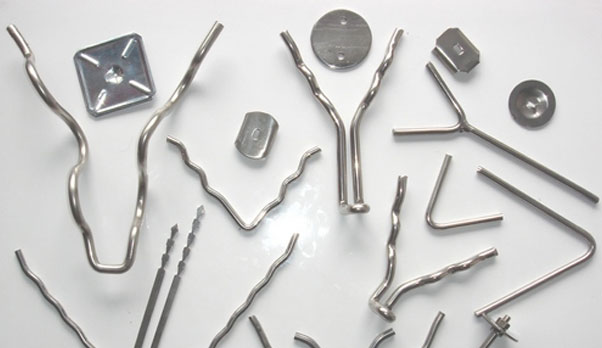
We supply V-type, UV-type and L-type refractory anchors as standard, and form other shapes to your drawing.
Anchor Materials by Temperature
| Grade | Suits up to (guide) | Notes |
|---|---|---|
| 304 / 304L | Around 850 C | General and lower-temperature linings |
| 316 | Around 870 C | Where some corrosion resistance is also needed |
| 321 | Around 900 C | Titanium-stabilised, resists scaling at higher heat |
| 310 / 310S | Around 1050 C | The common high-temperature anchor grade |
| Inconel (600/601) | Above 1100 C | The highest-temperature and most aggressive service |
How Refractory Anchors Work
Anchors are welded to the steel shell on a grid, typically a few inches apart, and the refractory, castable or gunned, is placed around and over them so it locks onto the anchor as it cures. Two things make a good anchor system: spacing and expansion. The spacing has to be dense enough to carry the lining weight and resist the pull of thermal cycling, and the anchor tips are usually tipped with a ceramic cap or a wax coat that burns out to leave an expansion gap, so the metal can grow on heating without cracking the refractory. Getting the shape, grade and spacing right is what keeps a lining in place for years rather than shedding.
Where Refractory Anchors Are Used
Refractory anchors go wherever a steel shell carries a refractory lining: fired heaters and furnaces in refineries and petrochemical plant, boilers and their ducting, reformers and cracking units, incinerators, kilns, and the flues and stacks that carry hot gas. In each the anchor holds a castable or ceramic-fibre lining onto the shell through continuous heating and cooling, which is why the grade is matched to the hot-face temperature and the shape to the lining.
Quality, Certification & Cutting
Anchors are cut and formed to your drawing, hot-face length and grade, and each order ships with an EN 10204 mill test certificate for the material, heat-number traceable, with positive material identification available. Ceramic tips or wax coating for the expansion allowance are supplied on request. Standard V and UV anchors in common grades and sizes ship quickly; special shapes, high grades and large quantities are confirmed on enquiry. Send the type, the material, the hot-face length and the quantity and the quote comes back with the certification built in.
Refractory Anchors: Frequently Asked Questions
V-type, UV-type and L-type anchors as standard, plus Y-type and specialist shapes formed to a drawing, in heat-resisting grades from 304 through 310 and 321 to Inconel. V-type is the general-purpose volume anchor and UV-type gives a longer grip for thicker linings. If a type or grade is not listed, ask, because we form to requirement.
By the hot-face temperature of the lining. As a guide, 304 suits up to around 850 C, 321 to around 900 C, 310 to around 1050 C and Inconel above 1100 C. The anchor must not soften or scale at the service temperature or it will let the refractory fall, so the grade is matched to the temperature and, where relevant, the atmosphere.
The shape and the grip. A V-type is a simple V welded to the shell at its open ends, the general-purpose anchor for most linings. A UV-type has a rounded or looped top that gives a longer, stronger grip into the refractory, used for thicker linings or where extra hold is needed. Both are chosen alongside the grade and the spacing.
To allow for expansion. The metal anchor grows more than the refractory when heated, so the tips are capped with a ceramic cover or a wax coat that burns out in service, leaving a small gap. That gap lets the anchor expand without pushing on and cracking the lining. It is a small detail that has a large effect on how long a lining lasts.
Yes. Every order ships with an EN 10204 mill test certificate for the anchor grade, heat-number traceable, with positive material identification available at order stage. This matters because the anchor grade is chosen for the service temperature, and the certificate confirms the grade supplied is the grade specified.
For More Information About Refractory Anchors please call +91-22-66362223 / 66394926 or send an email to export@aashishmetal.com
PRODUCT RANGE
Products
- Materials
- Stainless Steel
- Duplex & Super Duplex
- Nickel Alloy
- Monel
- Inconel
- Hastelloy
- Alloy 20
- Titanium
- Copper Nickel
- Alloy Steel
- Carbon Steel
- Beryllium Copper
- Bimetal
- API 6A Type 6B 2000 PSI Weld Neck & Blind Flanges
- API 6A Type 6B 2000 PSI Weld Neck & Blind Flanges
- Thank You For Connecting
- Duplex and Super Duplex Steel Pipes and Tubes
- Duplex and Super Duplex Steel Threaded Fittings Manufacturer and Supplier
- Duplex Steel S31803 S32205 and Super Duplex S32750 S32760 Pipe Fittings
- Duplex S31803 S32205 Socket Weld Fittings Manufacturer
- Duplex and Super Duplex Steel Socket Weld Fittings
- Duplex and Super Duplex Steel Tube Fittings
- Stainless Steel 316 / 316L Pipes & Tubes
- Stainless Steel 321 Pipes & Tubes
- Inconel Pipes and Tubes
- Stainless Steel Pipe Fittings Manufacturer and Supplier
- Stainless Steel Pipes and Tubes
- C17200 Beryllium Copper
- C17300 Beryllium Copper
- C17500 Beryllium Copper
- BERYLLIUM COPPER STRIP & COIL
- Beryllium Copper C17200 Wire
- Instrumentation Tube Fitting
- Inconel 718 Round Bars
- Monel K500 Round Bar
- Titanium Grade 2 Round Bar
- Titanium Grade 5 Round Bar
- Materials
Special Products
Please feel free to contact us. We will get back to you with 2 business days. Or just call us now.