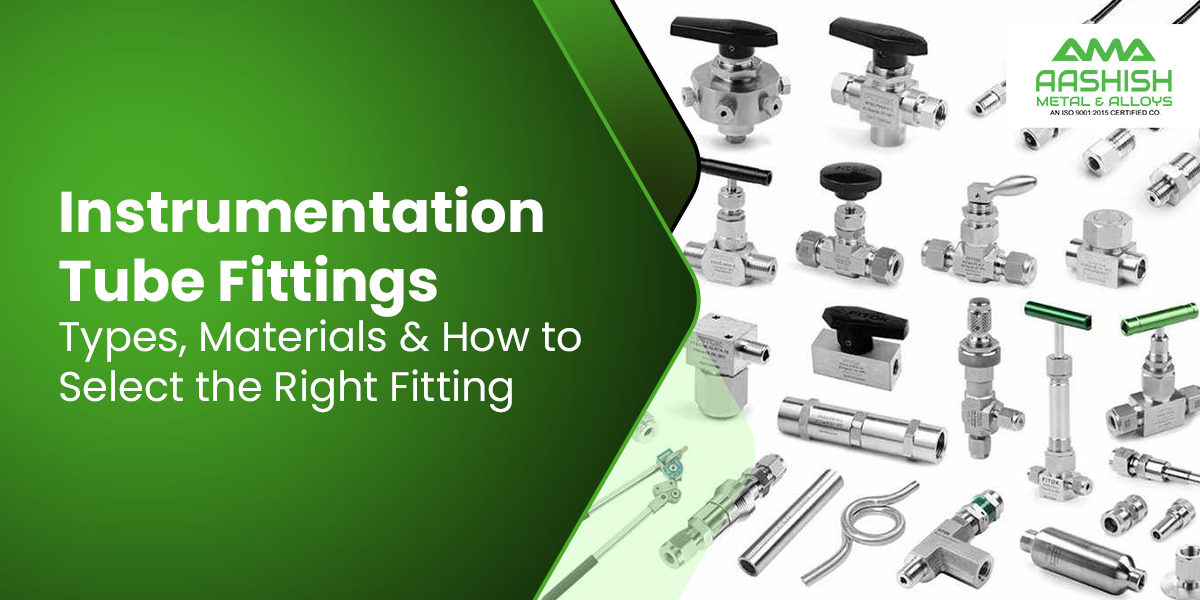
Be it the layout of a new line of high pressure process, or the replacement of existing connections in a chemical plant, one choice makes system reliability more than almost any other; that of instrumentation tube fitting. Get it wrong and you will have a leak free and maintenance-light connection, which may last decades. Get it wrong and you are about to incur planned closure, environmental liabilities, and even safety accidents.
This guide contains all the information that process engineers and procurement teams must have such as the operation of compression fittings at the ferrule level, which service to use SS 316L or Inconel 625, and even how to understand thread standards on the global projects.
For a full product overview and specifications, visit the Instrumentation Tube Fittings — Complete Range & Specifications.
What Are Instrumentation Tube Fittings?
Instrumentation tube fittings Instrumentation tube fittings are mechanical connectors that are used to connect small bore tubing, typically 1/8 to 2″ OD (or 3mm to 50mm metric) connectors, in instrumentation and process control system. They have three significant differences with standard pipe fittings:
- Precision tolerancing: The fittings of instrumentation are produced to more stringent dimensional standards than those of pipe fittings, which are guaranteed to assemble onto thin-walled tubing leak-free.
- Compression or bite-type sealing: Instead of using thread sealants, the vast majority of instrumentation fittings establish a mechanical seal into the tube OD by deforming a ferrule (or ferrules) into the tube. This is essential where process fluids should be maintained contained and thread compound contamination should not be condoned at all.
- Broad pressure capability: Instrumentation fittings regularly withstand working pressures up to 20,000 psi (69 to 1,379 bar) – much higher than standard compression plumbing fittings are designed to operate.
Its applications include oil and gas wellheads, oil and gas hydraulic control panels, oil and gas analytical sampling systems, power generation, pharmaceutical manufacturing and semiconductor process equipment. Where a small-bore fluid connection is required in a demanding way, anywhere, an instrumentation tube fitting is the answer.
Double Ferrule vs Single Ferrule Fittings: Key Difference
This is the most fundamental design distinction in the instrumentation fitting world, and it affects both performance and interchangeability.
Single Ferrule Fittings
One ferrule fitting consists of a single ferrule fitting but this ferrule fitting grips the tube and forms the sealing surface at the same time. The nut forces the ferrule forward crushing itself against a cone seat on the inside of the fitting body. Single ferrule design is the more basic and less costly, but this single design component is required to perform two functions simultaneously, holding and sealing, and this is a design trade-off in high vibration or high cycle applications.
Double Ferrule (Two-Ferrule) Fittings
Double Ferrule Compression Fittings — Types & Pressure Ratings use two separate ferrules with distinct functions:
- Front ferrule (forward ferrule): forms the main seal on the cone of the fitting body. It swages (bends) itself into the tube OD to make a gas-tight seal of the tube between two metal parts.
- Back ferrule (rear ferrule): This serves as the part that holds on to the tube, biting the tube wall to prevent the pull-out axial force and vibration.
The reason why double ferrule fittings always perform better than single ferrule designs is the separation of these two functions into two parts.
- Vibration resistance: the spring-loads on the rear ferrule suppress the loosening caused by vibration.
- Leak free performance: independent sealing and gripping does not weaken either of the functions.
- Tube pull-out resistance: grip forces are not fixed to compression of the seal; it is possible to torque-up to a grip spec without excessively stressing the seal.
These reasons had made the two-ferrule design the de facto in the world when used in critical instrumentation applications and brands such as Swagelok, Parker and Hoke all follow the two-ferrule principle.
Types of Instrumentation Tube Fittings
1. Compression Fittings (Ferrule-Type / Bite-Type)
The dominant fitting type in instrumentation. Compression Tube Fittings — Sizes, Ratings & Configurations require no special tube preparation — simply cut the tube square, insert it fully into the fitting, and tighten the nut. The ferrule(s) do all the work. Available in single and double ferrule variants, compression fittings cover tube sizes from 1/16” OD to 2” OD and pressure ratings to 20,000 psi depending on material and size.
General instrumentation, process lines, hydraulic control tubing, analytical systems, anywhere tube reassembly may be needed.
2. Flare Fittings (37° or 45°)
The tube end of the fittings is flared with a flaring tool into a conical shape and is usually cold-formed. The fitting body has a corresponding cone with which the flared tube face slides, and a flare nut drives the connection. The 37deg flare (SAE/JIC standard), is used in hydraulic and aerospace, 45deg flare is used in refrigeration and HVAC.
High-vibration conditions, hydraulic lines, ferrule bite is challenging due to the thickness of the tube wall, compatibility with legacy systems.
3. Browner (Brown / Socket Weld)
In cases where very high integrity, permanent connections are needed, which may not need any disassembly after the connection, the use of weld connectors is devoid of mechanical sealing. The tube is welded directly to the fitting end, butt welded ( tube OD to fitting OD, with a need of close alignment) or socket welded (tube inserted into a socket).
High-temperature/high-pressure service in which no mechanical joint can be tolerated, cryogenic service, aggressive chemical service in which corrosion of ferrules may be a problem.
4. Swagelok-Type (Equivalent / Interchangeable) Fittings
Swagelok type Swagelok type fittings are those fittings that mimic the dimensional standard, as established by the Swagelok Company – the most used instrumentation fitting specified in the world. Swagelok-Type Equivalent Fittings Interchangeable Double Ferrule Range Equivalent fittings of quality Swagelok body and nut dimensions are dimensionally compatible with actual Swagelok bodies and nuts (although a mixture of brands of ferrules is not advisable within the same connection). The equivalents are compatible with the same double-ferrule geometry and tube OD and are competitively priced, so they are the best option when large quantities of volumes are involved, or when MRO is required.
5. DIN 2353 (Metric Bite-Type) Fittings
The compression instrumentation fittings equivalent in Europe. DIN 2353 applies a single-ferrule bite principle, but is designed to accept metric tube ODs (6mm, 8mm, 10mm, 12mm, etc.) that are typical of process plants in the continental European continent and in Asia. It is offered in two principal series: the LL (extra-light) series where the equipment is used in low-pressure operation, and the L (light) and S (heavy) series where it is used in instrumentation and hydraulic service both operating at higher pressures. OD sizes that are frequently used include 6mm to 42mm. DIN 2353 cannot be dimensionally interchanged with inch-series Swagelok-type fittings.
Common Fitting Configurations
The five types above describe the connection mechanism. Within each type, fittings come in multiple configurations to handle routing and connection needs:
- Union / Straight Union — connects two equal-size tubes end-to-end. The most common fitting. Consists of body, two nuts, and two sets of ferrules.
- Reducing Union — connects two tubes of different OD. Essential for instrument impulse lines stepping down from 1/2” process tubing to 1/4” instrument tubing.
- Bulkhead Union — designed to pass through a panel, wall, or enclosure. The extended body includes a locknut and panel nut for through-panel mounting, creating a pressure boundary at the wall. See full bulkhead union configurations on our Instrumentation Tube Fittings product hub.
- Union Elbow (90°) — changes tube direction 90°, with tube connections on both ends. Used where bending the tube tightly would risk work-hardening or kinking.
- Union Tee — three-way fitting connecting three tubes in a T configuration. Common in sampling systems, instrument manifolds, and chemical injection lines.
- Union Cross — four-way fitting for panel manifold or distribution block applications.
- Male Connector — one end accepts tube via compression; the other end is a male NPT, BSPT, or BSPP threaded nipple for connecting to an instrument, valve, or process port. The most-used fitting on any instrumentation loop.
- Female Connector — tube on one end, female thread on the other, for connecting to a male-threaded process connection or transmitter nozzle.
- Male/Female Elbow — tube to threaded elbow, for right-angle connections to instrument ports.
- Cap / Plug / Tube End Closure — seals an open tube end for pressure testing, future connection points, or decommissioning a branch.
Pressure Ratings & Thread Standards (NPT / BSPT / BSPP)
Pressure Ratings
Pressure rating of instrumentation tube fittings varies with three factors which include tube OD, tube wall thickness, and material. Indicative working pressures of SS 316L and duplex double ferrule fittings are provided in the table below. Always ensure that manufacturer pressure-temperature ratings are of the particular tube OD, wall and material combination. At high temperatures, the deratement of ratings are reduced, usually 30-40 percent at 315degC compared to ambient of SS 316L.
Tube OD | Wall Thickness | SS 316L Working Pressure | Duplex Working Pressure |
1/4″ | 0.035″ | 5,000 psi (345 bar) | 7,200 psi (496 bar) |
3/8″ | 0.035″ | 3,200 psi (221 bar) | 4,600 psi (317 bar) |
1/2″ | 0.049″ | 3,300 psi (228 bar) | 4,700 psi (324 bar) |
1/2″ | 0.083″ | 5,800 psi (400 bar) | 8,400 psi (579 bar) |
1″ | 0.083″ | 3,700 psi (255 bar) | 5,300 psi (365 bar) |
Thread Standards
The thread of a male/female connector should be identical to the connection port of the instrument/process. Three types of thread are usually met with:
- NPT (Nationalpipe Taper): the Canadian standard. Tapered threads fasten by thread interference, and normally need PTFE tape or pipe thread compound. Angles are 60deg. The prevailing quality in US sourced equipment, offshore platforms in the Gulf of Mexico, and a large part of the Middle East.
- BSPT (British Standard Pipe Taper): The tapered thread has 55deg flank angle (Whitworth form). Likewise sealing principle to NPT but not substitutable. Widespread in equipment of the UK, old European plant, and Asian projects to British standards. In ISO 7 / 1, BSPT is also abbreviated as R (male) and Rc (female).
- BSPP (British Standard Pipe Parallel): parallel threads that are based on bonded seal, O-ring face seal (ORFS), or soft copper/aluminum washer sealing. Designated “G” threads in ISO 228. Usually used in Europe especially on hydraulic and pneumatic connections. BSPP provides a more controlled face seal than tapered threads and it is more desirable where the system needs to be disassembled frequently.
Ordering tip: It is necessary to specify fittings of connector-type and check thread standard and thread size. A 1/4 inches NPT and 1/4 inches BSPT appear to be the same but cannot be depended on to fit when they are put together.
Industries Using Instrumentation Fittings
Aashish metals also provides SS 316L and duplexally ferrued fittings regularly to offshore platform instrumentation and HF alkylation unit MRO purchase in Indian and Middle East refinery clients. The following material and industry applications indicate the entire range of applications that we support.
- Oil/Gas (Upstream, Midstream, Downstream)
Oil and gas facilities are everywhere covered with instrumentation fittings, such as wellhead chemical injection lines, HP/HT separator instrument taps, gas chromatograph sample conditioning panels, subsea control umbilicals, etc. Topside is dominated by SS 316L and duplex S31803 and super duplex S32750 are required in high-chloride service or sour service by NACE MR0175. - Petrochemical & Refining
The refineries require a diversity of materials in one plant, SS 316L tube fittings in cooling water, Monel 400 HF alkylation, Hastelloy C276 acid treating, and Inconel high-temperature furnace instrumentation lines. Process engineers do not define fittings by default of a facility, but by service stream. - Power Generation
The instrumentation fittings are widely used in steam power plants on boiler drum level gauges, turbine lube oil systems, hydrogen seal oil skids and turbine bypass control panels. Depending on the steam parameters, temperature service may require SS 316L or Inconel. - Pharmaceutical & Biotech
Instrumentation fittings in CIP/SIP lines, bioreactor instrumentation, and clean utility distribution are used in the pharmaceutical industry. The standard choice is SS 316L internal surface finish and electropolishing of Ra [?] 0.4 mm. Crevice-free designs and drainable ones are commonly given. - Semiconductor and Electronics Production
Instrumentation fittings on ultra- high-purity (UHP) gas and chemical delivery systems are used in semiconductor fabs. It is among the most stringent applications – fittings should possess very low particle generation rates, low outgassing as well as compatibility with hazardous process gases such as HF, HCl and chlorine-based etchants. - Marine & Offshore
Seawater environments, either on top offshore platforms or on naval ships, subject a person to persistent salt spray, humidity as well as vibration. Duplex and super duplex fittings are usually ordered; Monel 400 being used where the fitting can be immersed in sea water. - Analytical Instrumentation
Gas chromatographs, process mass spectrometers, and online analyzers are dependent on small-bore (1/16″ and 1/8″ OD) instrumentation fittings to make sample lines connection. Requirements of leak tightness are extreme – a 10-6 mbar*l/s helium leakage is even considered intolerable in GC carrier gas circuits.
Frequently Asked Questions
The flank angle of NPT is 60deg and this is the North American standard; the BSPT flank angle is 55deg (Whitworth form) and is the standard in Britain. They cannot be used interchangeably, i.e. an NPT male cannot be mated with a BSPT female.
Yes. Fittings using double ferrule compression can be broken and re-assembled on the same tube. When remaking, looseness When remaking, turn only 1/8 to 1/4 turn past finger-tight, do not use the full 11/4-turn make-up Because the ferrule is already swaged.
Fittings Standard double ferrule instrumentation are available between 1/16 inch OD to 2 inch OD in inch series, and between 3mm to 50mm in metric (DIN 2353) series.
SS 316 and SS 316L have identical corrosion resistance in most service conditions. The key difference is carbon content: 316L (≤0.03% C) is preferred for weld-adjacent connections because it avoids carbide precipitation (sensitisation) in the heat-affected zone.
Ready to Specify?
The choice of an appropriate instrumentation tube fitting is reduced to three variables, including connection type, material grade, and configuration. Get the three right in-point with your service conditions and you have a system, which cuts no oil over decades. The above sections provide you with the outline – the bottom links will bring you to the entire range of products.
Aashish Metals inventory of instrumentation tube fittings in all major configurations and materials, with complete traceability of materials, and competitive pricing of their project quantities and MRO supplies.
Explore the full range:
- Instrumentation Tube Fittings — Full Hub
- Double Ferrule Fittings
- Compression Fittings
- Swagelok-Type Equivalents
- SS 316L Tube Fittings
- SS 304 Tube Fittings
Have a specification or project inquiry? Contact the Aashish Metals team with your tube OD, material, pressure rating, and configuration, we’ll provide a technical recommendation and quote.