What Is Beryllium Copper?
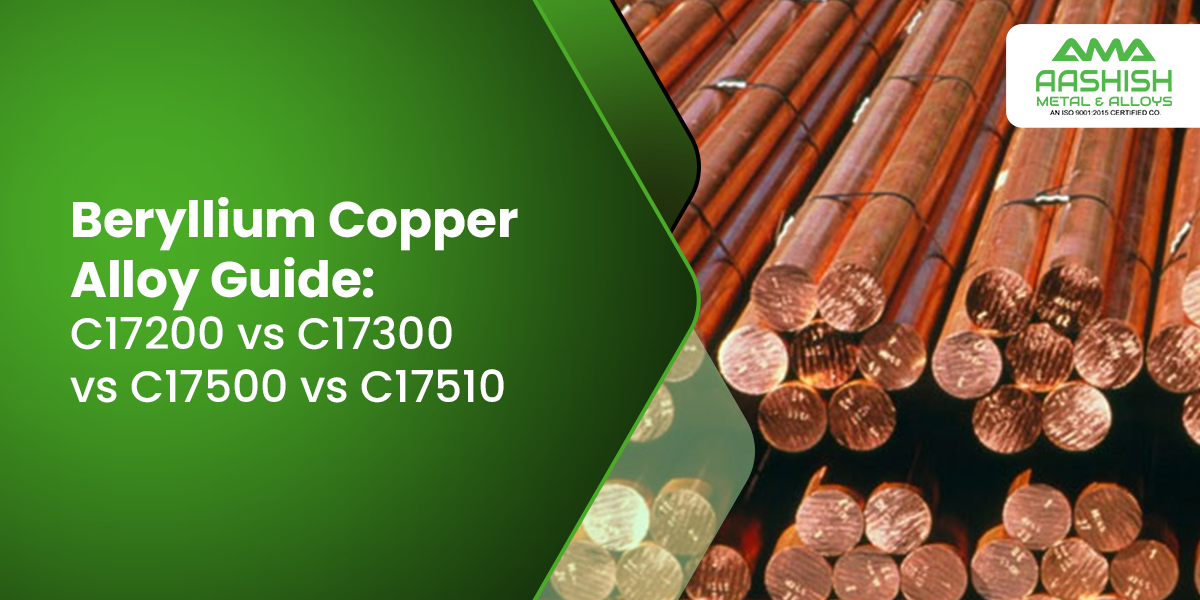
Beryllium copper (BeCu) Beryllium copper, copper beryllium, beryllium bronze, or spring copper is a copper alloy with a beryllium content of between 0.4 to 2.0 percent. This low content of beryllium to copper forms a family of high-copper alloys that can attain the strength levels of alloy steel, without sacrificing the electrical and thermal conductivity, corrosion resistance or non-sparking properties that make copper alloys so useful in challenging industrial service.
Out of all of the available commercial copper based alloys, beryllium copper has the highest strength, reaching as high as 1,400 MPa (200,000 psi) (per ASTM B196 / CDA material data). With a thermal conductivity of 62-70 Btu/fthrdegF (according to CDA material data), it is three to five times better than tool steel and is therefore an excellent material to use in applications where heat production is significant. It is ductile, welds, machinable and similar to pure copper is not affected by non-oxidizing acids, abrasive wear, and galling.
Beryllium copper is also non-sparking and non-magnetic in nature and in such explosive and magnetically sensitive areas it cannot be done without. It reacts unusually to precipitation-hardening (age-hardening) heat treatment, and it is by this process that its mortal powerfulness is set free.
|
Beryllium copper alloys can be safely manipulated in solid and non-abraded state. Beryllium copper machining, grinding, or welding produces fine particulate, which is a hazard to inhalation. Checking must be done in accordance with OSHA 29 CFR 1910.1024 (Beryllium Standard) such as engineering controls, respiratory protection, and monitoring of exposure. Always ask and consult the Safety Data Sheet (SDS) of the particular alloy to be processed. |
 Beryllium Safety Notice
The Two BeCu Alloy Families
The entire range of commercial beryllium copper alloys are divided into two distinctly families each being optimised towards a specific performance priority:
- High Strength Family: C17200 and C17300: 1.80- 2.00% beryllium. These are alloys that are the strongest and hardest of all of the copper-based alloys, having moderate electrical conductivity. These are structural and mechanical grades used as workhorse.
- High Conductivity Family: C17500 & C17510: 0.40-0.70% Beryllium. Their grades are less resistant to peak strength and are much more compatible with electrical and thermal conductivity, so they are used as electrical contacts, welding electrodes, and mold tooling.
The most important and the first task when beryllium copper alloy is selected is to understand which family your application belongs to. Each of the grades is discussed below.
C17200 Beryllium Copper: Properties, Hardness & Applications
The most popular beryllium copper alloy in the world is C17200 (commercially referred to as Alloy 25 and CDA 172). It is the highest strength of the family and becomes the first grade usually thought of whenever the main consideration is maximum mechanical performance.
Chemical Composition
C17200 has about 1.80-2.00 percent beryllium with the rest being copper. Small amounts of cobalt, nickel and iron are managed to guarantee the response of the precipitation hardening and stability. The rough content is 97.5 percent copper and 1.9 percent beryllium.
Mechanical & Physical Properties
- Final tensile strength ( Peak Aged): 200 ksi (1,380 MPa)
- Rockwell Hardness (Peak Aged): RC 45.
- Electrical Conductivity: minimum of 22% IACS.
- Thermal Conductivity: 62- 70 Btuft/ (hrft2degF) at 68degF.
- Density: 0.298 lb/in3 at 68degF
- Thermal Expansion Coefficient: 9.9 x 10⁻⁶/degF (68-572degF).
- Tension Modulus of Elasticity: 18, 500 ksi.
- Machinability Rating: of C36000 brass is approximately 20% of C36000 free-cutting brass (relative to C36000 machinability index of CDA)
These properties are attained by age hardening – a heat treatment by precipitation which is usually performed at temperatures of 500-750degF (260-400degC) and a minimum duration of one hour. This leads to the precipitation of a beryllide-rich gamma phase in the copper matrix and the effect that makes it dramatic in terms of strength and hardness. In this process, toughness, fatigue strength and corrosion resistance can further be refined by under-aging or over-aging the alloy.
Age Hardening Parameters for C17200 and C17300
C17200 is normally hardened at 600-625degF (315-330degC) in 2-3 hours. Aging at 500 deg F 1 hour gives a slightly softer, tougher form which can be shaped and then hardened. An over-aging of more than 750 degrees F lowers the hardness and tensile properties. In the case of C17300, the same temperature regime is relevant – the addition of lead has no influence on the response of the precipitation-hardening.
|
Condition |
Temperature |
Time |
Result / Use |
|
Under-aged |
500°F (260°C) |
1 hour |
Softer, tougher — form before final harden |
|
Peak aged |
600–625°F (315–330°C) |
2–3 hours |
Maximum hardness RC 45 / tensile 200 ksi |
|
Over-aged |
> 750°F (400°C) |
Varies |
Reduced hardness and tensile — avoid unless specified |
Corrosion Resistance
C17200 is quite corrosive resistant like pure copper. It resists contact with seawater, the majority of organic solutions, non-oxidizing acids and dilute alkalis. It will not be hydrogen embrittled and will resist stress corrosion cracking in sulphide and chloride solutions and the latter is the reason why it is very useful in downhole oil and gas environments.
Key Applications of C17200
- Oil and Gas: Instrument housings, flex shafts, MWD/LWD part, bearings, bushings, Valve part, pump shafts, non-sparking hand tools.
- Aerospace: Aerospace landing gear bushings, aerospace structural components, cryogenic equipment.
- Automotive: Springs, high performance, high reliability fasteners, connectors, precision connectors, high reliability connectors.
- Electrical: Switch/relays, fuse clips, spring connectors, contact bridges, Belleville washers.
- Mould inserts, injection mould parts, rolling mill parts, welding equipment, industrial.
Specifications
AMS 4650, AMS 4651, AMS 4530, AMS 4533, AMS 4534, AMS 4535, ASTM B196, QQ-C-530, MIL-C-46087.
→ See our full C17200 material guide, available forms, and technical datasheets
C17300: Leaded BeCu for Precision Machining
C17300 (CDA 173, or Alloy M25 or CuBe2Pb), is basically C17200 with a specified amount of 0.20-0.60% lead. This apparently trivial compositional modification has a far reaching practical consequence: it is much more machinable, with C17300 becoming the grade of choice whenever a complex, high-volume precision machining is needed.
How Lead Changes the Alloy
The additive of lead facilitates the production of fine chips, in the machining processes. Instead of creating long and stringy swarf, which can clog the tooling, C17300 forms short and manageable chips that increase the tool life and also allow it to work at high speeds. This is because it is the best choice in automatic screw machine operation and multi-axis CNC turning in which the cycle time and tool consumption directly impact the manufacturing economics.
C17300 has the same high mechanical performance of C17200 post age hardened. It has a tensile strength of 1,380 MPa (200 ksi) at optimum aged condition, as well as Rockwell hardness of RC 39-45.
Machinability Comparison
C17300 has a machinability rating of about 50 percent that of C36000 brass (compared to C36000 free-cutting brass according to CDA machinability index) – far better than C17200. This advancement has rendered it feasible to make very complicated parts with tight acceptances that would be too slow or costly to make with normal C17200.
Key Applications of C17300
- Electrical: RF coaxial connectors, switch and relay components, fuse connectors, contact bridges, components of navigational instruments.
- Fasteners: washers, roll pins, retaining rings, precision screws, bolts.
- Industrial Non-sparking safety tools, Bushings, Bourdon tubes, bellows, spline shafts, valve stems.
- Aerospace: Aircraft bellows, aircraft high precision instruments.
Specifications
ASTM B196, ASTM B197, QQ-C-530, MIL-C-21657, EN 12164 (CuBe2Pb), DIN 2.1248, CW102C.
→ Explore C17300 grade specifications, temper conditions, and machining guidance
C17500 and C17510: Conductivity
C17500 and C17510 are a part of high-conductivity family of beryllium copper alloys. They have a significantly lower beryllium content (0. 40-0. 70) and offset the lower beryllium with cobalt (C17500) or nickel (C17510) as the major alloying element. The outcome is an alloy family that loses part of the peak strength to have electrical and thermal conductivity values two to three times above those of C17200 and C17300.
C17500 Cobalt Beryllium Copper (Alloy 10)
C17500 is 0.40-0.70% beryllium and 2.40-2.70% cobalt. It offers a high electrical and thermal conductivity, and it is not weak in mechanical strength – features that put it far superior to most conventional copper alloys. C17500 is also specifically used to cast and mould tooling because it has improved hot and cold workability. It works especially well in a heavy-duty mechanical environment at high temperature where thermal fatigue resistance is an important asset.
C17510 Nickel Beryllium Copper (Alloy 3).
C17500 was used to fabricate C17510 that used nickel instead of cobalt as the alloying agent. The major motivator behind this development was cost – nickel is cheaper than cobalt and C17510 is a cheaper alternative to many applications and provides practically the same performance. C17510 states 0.20-0.60% beryllium and 1.40- 2.20% nickel.
C17510 with tensile strength of about 140 ksi (as per ASTM B441 / RWMA Class III specification) and electrical current conductivity of 45-60% IACS has wide application in terms of spot welding electrodes and seam welding electrodes, as its strength and current carrying ability are crucial. The US based distributors prefer it over its counterpart because of its cost and performance ratio.
C17500 vs C17510: Key Differences
The two alloys are viewed as being the same in terms of performance in practice. The major difference is the alloying element, cobalt in C17500 and nickel in C17510. C17510 is a bit more popular commercially, since it has a cost advantage, however, with most specifications both alloys are interchangeable with RWMA Class III electrode requirements. They both are precipitation-hardenable and offer high wear resistance and electric conductivity.
Key Applications of C17500 and C17510
- Electrodes used in welding: spot welding, seam welding, and resistance welding electrodes of joining high-resistance materials.
- Electrical contacts: Connectors of high reliability, Relays, and contacts with a high demand on current transmission.
- Mould tooling: Injection mould tooling, die-casting tooling, and plastics processing tooling.
- Springs and wire: Springs and wire that need to conduct or retain properties under high temperature that needs electricity.
- Bearings, Electrical machinery bearings: These bearings are of high conductivity.
Specifications
C17500: ASTM B441 (Rod), ASTM B534 (Plate), RWMA Class III, SAE J463, J461, MIL-C-81021. C17510: ASTM B441, RWMA Class III, MIL-C-81021.
Comparison Table: C17200 vs C17300 vs C17500 vs C17510
The table below provides a direct, side-by-side comparison of the four principal commercial beryllium copper grades across the properties most relevant to engineering and procurement decisions.
|
Property |
C17200 |
C17300 |
C17500 |
C17510 |
|
Family |
High Strength |
High Strength |
High Conductivity |
High Conductivity |
|
Also Known As |
Alloy 25 |
Leaded BeCu / M25 |
Alloy 10 |
Alloy 3 |
|
Beryllium Content |
1.80–2.00% |
1.80–2.00% |
0.40–0.70% |
0.20–0.60% |
|
Key Alloying Element |
— |
Lead (Pb 0.2–0.6%) |
Cobalt (2.4–2.7%) |
Nickel (1.4–2.2%) |
|
Tensile Strength (Peak Aged) |
200 ksi (1,380 MPa) |
200 ksi (1,380 MPa) |
~140 ksi |
~140 ksi |
|
Hardness (Peak Aged) |
RC 45 |
RC 39–45 |
HRB ~100 |
HRB ~100 |
|
Electrical Conductivity |
22% IACS min. |
22% IACS min. |
45–60% IACS |
45–60% IACS |
|
Density |
0.298 lb/in³ |
~0.298 lb/in³ |
0.316 lb/in³ |
0.316 lb/in³ |
|
Machinability |
Low (~20%) |
Improved (~50%) |
Moderate |
Moderate |
|
Non-Sparking |
✓ Yes |
✓ Yes |
✓ Yes |
✓ Yes |
|
Primary Use Case |
Max strength apps |
Precision machining |
Welding electrodes, molds |
Connectors, contacts |
|
Key Specs |
ASTM B196, AMS 4650/4651 |
ASTM B196, MIL-C-21657 |
ASTM B441/B534, RWMA Class III |
ASTM B441, RWMA Class III |
All four BeCu grades listed above are inherently non-sparking and non-magnetic, meeting ATEX Zone 0, 1, and 2 requirements for hazardous environments. For a full breakdown of non-sparking tool standards, see our guide to
All four BeCu grades listed above are inherently non-sparking and non-magnetic, meeting ATEX Zone 0, 1, and 2 requirements for hazardous environments.
How to Choose the Right BeCu Alloy for Your Application
Selecting the correct beryllium copper grade requires balancing four core factors: mechanical strength requirement, electrical or thermal conductivity requirement, machinability demands, and cost constraints. The following decision framework covers the most common scenarios:
When to Choose C17200:
- The major requirements are maximum tensile strength (up to 200 ksi) and hardness (RC 45).
- The application will have structural or load bearing parts- landing gear bushings, heavy bearings, flex shafts.
- Resistance to corrosion in severe conditions (chloride, sulphide, seawater) is essential.
- The element must have high-strength as well as non-sparking qualities.
- Examples of required forms are plate, strip, rod, bar, wire or forgings.
When to Choose C17300:
- The component has complex geometry or tight tolerances which demand high-volume precision machining, and you need the same strength as C17200.
- There is involvement of automatic screw machine or CNC turning operations and tool life is a manufacturing issue.
- It is used in applications in connectors, RF elements, Bourdon tubes, bellows or volume made fasteners.
When to Choose C17500:
- Maximum strength comes second in priority to electrical or thermal conductivity (45-60% IACS).
- It is used in mould tooling, die-casting, die welding electrodes or in high temperature service.
- The fabrication process requires improved workability in both hot and cold.
When to Choose C17510:
- Similar to C17500, conductivity requirements have a major constraint of cost.
- It is used in electrical contacts, spot/seam welding electrodes, connectors or heat sinks.
- The supply chain is significant to your supply chain due to US-sourced material and wide distributor network.
BeCu for Non-Sparking Tools in Oil & Gas
Copper alloys have traditionally been considered non-sparking conductors and beryllium copper – notably C17200 – can be used to add this characteristic to the mechanical strength required to make tools that can survive in the real-life industrial environment. This combination makes it the material of choice of hand tools that are not sparking and mechanical tools in explosive and flammable-gas environments.
Beryllium copper is non-sparking but physically tough and non-magnetic, fulfilling the standards of the ATEX directive of Zones 0, 1, and 2 which are the most dangerous categories. BeCu screwdrivers, pliers, wrenches, cold chisels, knives, and hammers are regularly used on oil rigs, on coal mines, on grain elevators and on gunpowder factories where an impact of a steel tool on a hard surface would result in an explosion or a fire.
C17200 also offers the added benefit of sulphide stress corrosion cracking resistance and hydrogen embrittlement -breakage types, which can prove disastrous in sour-gas conditions, in downhole oil and gas applications. The strength of the alloy also enables the alloy to support the mechanical load of MWD (Measurement While Drilling) and LWD (Logging While Drilling) components without bearing the weight penalty that steel does.
A non-sparking material, aluminium bronze non-sparking alloys, is sometimes used, though beryllium copper is much more strong and hard and is therefore used where integrity of the tool under load is an important consideratio.