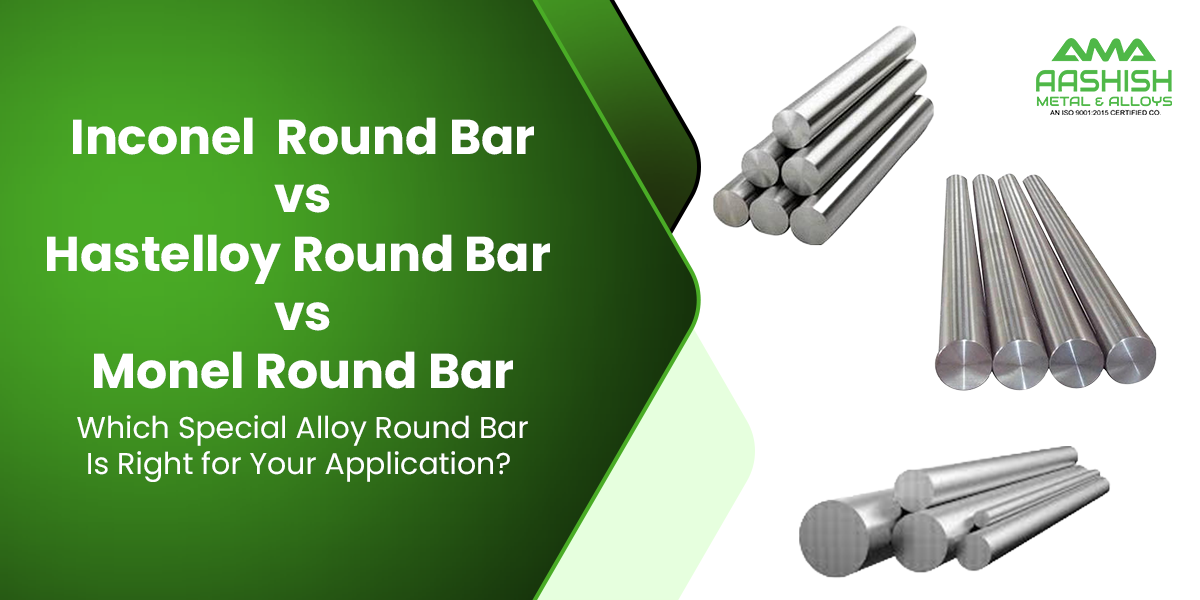
Inconel, Hastelloy, and Monel are the three names that come to mind when the engineers and procurement teams are in the hunt of the high-performing nickel alloy round bars. They are all nickel based superalloy. All the three are excellent in harsh conditions as compared to stainless steel. Yet both are best suited to a different set of issues – and either one improperly selected can lead to an early failure, or an unwarranted expense, or even risk.
The following guide includes the grades, properties and best application of each family of special alloy round bars and gives you a clear decision framework for Inconel vs Hastelloy vs Monel material selection.
Inconel Round Bar: Grades, Properties & Best Uses
The peculiarity of Inconel is that its strength and resistance to oxidation are high at high temperatures. Inconel on heating, forms a coherent oxide layer on the surface when heated which is tight and stable and serves to repel further attack making Inconel able to exhibit structural integrity under thermal cycling conditions, which destroys most metals.
- Inconel 600 (UNS N06600)
The general-purpose grade is the all-purpose Inconel 600. It has a nominal composition of 72% Ni, 14-17% Cr and 6-10% Fe that provides it with a high oxidation resistance up to 1093degC and against chloride-ion stress-corrosion cracking. It is designed on furnace materials, heat treating apparatus, chemical and food processing, and nuclear reactors. Aashish Metals maintains Inconel 600 round bars to the ASTM B166 and AMS 5665. - Inconel 625 (UNS N06625)
Inconel 625 is a nickel-chromium matrix that is enriched with molybdenum (8-10%) and niobium (3.15-4.15%). The outcome is a grade that has excellent fatigue resistance, pitting resistance, and seawater corrosion resistance, besides excellent high-temperature capability. Niobium helps the alloy to resist sensitisation during welding to eliminate intergranular cracking. This contributes to the fact that Inconel 625 round bars are used in offshore oil and gas equipment, marine risers, seawater piping, aerospace structures, and chemical plant components. - Inconel 718 (UNS N07718)
Inconel 718 is a precipitation-hardenable grade that has handy characteristics between −253°C to 704°C. Niobium and aluminium allow age-hardening to exceptionally high strength levels – it is now the most common alloy in aerospace turbine discs, fasteners, and rocket engines. ASTM B637 and AMS 5662/5663 receive Inconel 718 round bars. Inconel 718 is also a main material in LNG storage tanks and liquid hydrogen jobs as the cryogenic properties of this material render it a main material under [?]100degC which majority of steels are brittle.
Key Inconel Applications
Gas turbines, furnace fixtures, heat exchangers, aerospace engine components, chemical process reactors, nuclear steam generators, LNG equipment, and offshore wellhead equipment.
Hastelloy Round Bar: When Corrosion Resistance Matters Most
The main strength of Hastelloy is that it is resistant to aggressive corrosion induced by the action of chemicals in both oxidising and reducing reactions. The important distinguishing factor is high content of molybdenum (up to 28% in certain grades) – molybdenum is not susceptible to pitting and crevice corrosion in chlorides, and non-oxidising acids, by an amount that can only be resisted by chromium.
Hastelloy C-276 (UNS N10276)
The most common Hastelloy grade. C-276 contains 57 percent Ni, 15-17 percent mo and 14.5-16.5 percent Cr that provides it with excellent resistance against hydrochloric acid, sulphuric acid, chlorine, and wet chlorine gas. It is not susceptible to crevice corrosion as well as pitting even in hot seawater and brine solutions. Hastelloy C-276 round bars are a primary material for chemical reactors, acid recovery units, and pollution control equipment.
Hastelloy C-22 (UNS N06022)
C-22 is an improvement of C-276 in its ability to resist oxidising solvents such as wet chlorine and hypochlorite solutions and also its high resistance to reducing solvents. It is also less susceptible to pitting and crevices. Through our Hastelloy C-22 vs C-276 comparison, C-22 is preferred in the event that oxidising and reducing conditions are present together – in mixed acid streams and in pharmaceutical production. Inquire on Hastelloy C-22 round bars in these applications.
Hastelloy B-2 (UNS N10665)
Hastelloy B-2 is a nickel-molybdenum alloy containing extremely low amounts of chromium, which is designed to resist pure hydrochloric acid at all concentrations and temperatures, and reducing environments. It finds its application in the production of HCl synthesis plants, acetic acid production, and hydrobromic acid as service.
Key Hastelloy Applications
Chemical reactor, acid recovery units, FGD systems, pharmaceutical processing, offshore chemical equipment, pulp and paper digester and nuclear waste processing.
Monel Round Bar: Marine & Seawater Applications
The combination of nickel (63-70 percent) and copper is unique to Monel, which, in turn, makes it the standard material to use in the marine and seawater environment. Unlike Inconel or Hastelloy, Monel does not depend on a protective oxide film – its resistance to corrosion in sea water and in chlorides depends on its nickel-copper structure. It is also non-magnetic at room temperature, and this can be used to make some instrumentation.
Monel 400 (UNS N04400)
The standard Monel grade. Monel 400 round bars are very resistant to sea water, hydrofluoric acid, sulphuric acid (non-aerated, dilute), and caustic alkalines. Monel 400 can be used at a large range of temperature, down to sub-zero, up to about 480degC in oxidising conditions. It is however not applicable with strongly oxidising acids (nitric acid) or oxidising salt solutions.
Monel K-500 (UNS N05500)
Common Monel K-500 is an alloy with the same corrosion resistance as Monel 400 but is much stronger and harder after precipitation hardening by additions of aluminium and titanium. It is also not magnetic at low temperatures. Monel K-500 round bars are used where the part should not only be able to withstand seawater corrosion, but also experience heavy mechanical loads: marine pump shafts, propeller shafts, screws on offshore platforms, and underwater oil well instrumentation.
Key Monel Applications
Marine heat exchangers, seawater pumps and valves, desalination plants, offshore oil and gas fittings, hydrofluoric acid alkylation units, and chemical process equipment handling alkaline solutions. See also our blog on Monel valve vs stainless steel valve for a related material selection comparison.
Temperature, Corrosion Resistance & Properties Comparison Table
The table below compares Inconel, Hastelloy, and Monel round bar grades across the key selection criteria: temperature ceiling, corrosion resistance by media type, weldability, governing ASTM standard, and density for weight estimation.
Property | Inconel 600 | Inconel 625 | Inconel 718 | Hastelloy C-276 | Monel 400 / K-500 |
Primary Base | Ni-Cr-Fe | Ni-Cr-Mo-Nb | Ni-Cr-Fe-Nb | Ni-Mo-Cr | Ni-Cu |
Max Service Temp | ~1093°C | ~980°C | ~704°C | ~600°C (chem.) | ~480°C (oxid.) |
Seawater Resist. | Good | Excellent | Good | Excellent | Outstanding |
Oxidising Acid | Good | Good | Moderate | Excellent (C-22 better) | Poor — avoid |
Reducing Acid | Moderate | Good | Moderate | Excellent | Good (HF, H₂SO₄ dilute) |
High-Temp Str. | Good | Excellent | Outstanding | Good | Moderate |
Weldability | Excellent | Excellent | Good (controlled heat input) | Excellent | Good (clean surface required) |
Relative Cost | Moderate–High | High | High | Highest | Moderate–High |
ASTM Std (Bar) | B166 | B446 | B637 | B574 | B164 / B865 |
Density (g/cm³) | 8.47 | 8.44 | 8.19 | 8.89 | 8.80 / 8.46 |
density level helpful in estimating weight/mass of bar: density (g/cm 3 ) x volume (cm 3 ) = mass (g). To enable fast engineering analyses, Hastelloy C-276 is conspicuously denser than the Inconel grades, an element in weight sensitive aerospace or rotating equipment usage.
Inconel vs Hastelloy: When to Choose Which
They both use nickel and both resist corrosion, as well as both serve in high-temperature service. They are thought to be synonymous with one another, they cannot.
Select Inconel when the major difficulty is high temperature:
- Components of gas turbine, components of jet engine, exhaust.
- The furnace fixtures and retorts that work above 700degC.
- High temperature process streams Heat exchangers.
- Applications which need creep capability and thermal cycling stability.
Select Hastelloy where chemical corrosion is the major consideration:
- HCl, H 2 SO 4 or mixed acid feeds Chemical reactor.
- Conditions of alternating oxidising mediums and a reducing medium.
- Wet chlorine exposed flue gas desulphurisation systems.
- Pharmaceutical and food grade processes that need utmost purity.
Underground oil and gas, the decision depends on the conditions under the ground: Inconel is used when it is in the oxidising environment and Hastelloy is used when it was the reducing or sour-gas environment. Expressed roughly, Hastelloy C-276 round bar would usually be priced 10-25 per cent higher than Inconel 625 in the same diameter and length, contingent on the market price of molybdenum. Both grades are miles above 316L stainless steel that is the starting point of most procurement teams when comparing budgets. The difference in prices is normally lower than the cost of a specification error.
Monel vs Inconel: Key Differences
The Monel vs Inconel decision is clearer because their operating domains are more distinct:
Factor | Monel 400 / K-500 | Inconel 625 / 718 |
Best environment | Marine / seawater / HF acid | High temperature / oxidising |
Temperature ceiling | ~480°C (service) | Up to ~980°C |
Oxidising acids | Not suitable | Good to excellent |
Seawater resistance | Outstanding (intrinsic) | Excellent (passive layer) |
Machinability | Better (K-500: age-hardened) | Difficult — work-hardens |
Typical cost | Moderate–High | High |
Monel should not be used in strongly oxidising media such as nitric acid or oxidising salt solutions. If the process stream contains such agents, Hastelloy C-276 or Inconel 625 is the correct substitute.
Monel vs Hastelloy: Which is Better?
Both Monel and Hastelloy are used in seawater environments as well as in chloride environments, this provides real selection overlap in offshore and coastal processing usage. Temperature, the types of acid involved, as well as cost tolerance are the determining factors.
Factor | Monel 400 / K-500 | Hastelloy C-276 / C-22 |
Best environment | Pure seawater / marine / HF acid | Mixed chemical / marine / acid streams |
Temperature ceiling | ~480°C (service) | ~600°C (chemical service) |
Oxidising acid resistance | Poor — avoid | Excellent (C-22 superior) |
Reducing acid resistance | Good (HF, dilute H₂SO₄) | Excellent |
Seawater resistance | Outstanding | Excellent |
Typical cost | Lower of the two | Significant premium over Monel |
When to prefer | Pure seawater / no acid mixing | Mixed or alternating chemical streams |
In both cases where alloys may be considered technically, the rule of thumb is: Monel where the seawater is pure or pure single acid; Hastelloy where the streams are mixed or alternating chemical streams. Hastelloy C-276 is much more expensive than Monel 400, but can operate in both oxidising and reducing conditions, which means it does not require the design of dual service streams, which is a cost savings in large scale that usually surpasses the material cost difference.
How to Specify a Special Alloy Round Bar
Specifying a nickel alloy round bar correctly requires more than selecting the right grade. Buyers and engineers should define the following parameters in their enquiry:
- Grade and UNS Number: e.g. Inconel 625 / UNS N06625, Hastelloy C-276 / UNS N10276, Monel K-500 / UNS N05500
- Governing ASTM/ASME standard: e.g. ASTM B446 (Inconel 625 bar), ASTM B574 (Hastelloy C-276 bar), ASTM B164 (Monel 400 bar)
- Diameter and length: standard mill lengths are typically 2,000–6,000 mm; cut-to-length available on request
- Surface finish: hot rolled black, bright annealed, centreless ground, or rough turned
- Condition: annealed, solution annealed, or age-hardened (for K-500 and Inconel 718)
- Mill test certificates (MTC): EN 10204 3.1 or 3.2 as required by your project specification
- Additional testing: PMI (positive material identification), IGC testing, ultrasonic testing, as applicable
If you are unsure which grade meets your process requirements, the Aashish Metals technical team can cross-reference your service conditions against our stocked special alloy round bar range and recommend the most cost-effective solution.
Sourcing Special Alloy Round Bars: What to Ask Your Supplier
Prior to ordering an order of Inconel, Hastelloy, or Monel round bar, verify with your supplier the following: complete material traceability to melt, EN 10204 3.1 or 3.2 mill test certificates, availability of third-party inspection and stock in the grade and diameter you require, rather than the nearest one.
Aashish Metals holds ready stock across Inconel 625, Inconel 718, Inconel 600, Hastelloy C-276, and Monel K-500 round bars with full MTC documentation. If you need a material consultation or dimensional check before enquiring, our technical team is available via the special alloy round bar page, no obligation.
The Bottom Line
Inconel vs Hastelloy vs Monel Inconel plus Hastelloy both offer the highest heat limiting service, and Monel offers service in seawater and marine conditions. Every family has grades which have been proven to work in certain environments – and the surest method of minimizing lifecycle cost and unplanned downtime is to choose the right grade the first time around.
Whenever we supply nickel superalloys (over years of supplying nickel superalloys to the oil and gas, chemical processing and marine industry) we always hear about specification mistakes at the grade-selection level – not the procurement level. Preparation of the alloy prior to tender saving save both time and money as well as downstream re-work.
Source your Inconel round bars, Hastelloy round bars, and Monel round bars from Aashish Metals, stocked, certified, and ready to ship.
Frequently Asked Questions
Not reliably. Inconel is made with the high temperature strength and resistance to oxidation; Hastelloy is made with the chemical resistance to corrosion. Replacing one with the other without re-assessment of service environment is a risk to untimely failure. Literally, the seawater resistance between Inconel 625 and Hastelloy C-276 is similar but their differences steepen in cases of reducing acid (Hastelloy area) or long-term temperatures greater than 700degC (Inconel area).
At standard grades, the tensile strength of no. Monel 400 is about 480 Mpa in comparison with that of Inconel 625, about 830 Mpa. Nonetheless, Monel K-500 that has aged to hardness can attain about 900 Mpa tensile strength – equivalent to Inconel 625 – with better machinability. Monel K-500 compromises this quality by not being able to withstand high temperatures or highly oxidising conditions.
Both Inconel 625 and Hastelloy C-276 are also thought to be excellent welding, and the niobium content of Inconel 625 gives it a natural resistance to weld sensitisation.Inconel 718 should not be welded to strain-age crack because it needs to be heated in place and it is only welded through the qualified procedures. Monel 400 welds easily, but gets porous when the base metal surface is not removed clean before welding.
Inconel 625 is mostly an annealed, high-temperature-capable, corrosion-resistant alloy, which finds widespread applications in offshore and marine applications. Inconel 718 is a type of engine alloy that is a precipitation-hardenable alloy designed to be the strongest at high temperatures and is used predominantly in aerospace and gas turbine usage. Both are resistant to both oxidation and seawater, but 718 is the stronger, whereas 625 is the more easily welded.