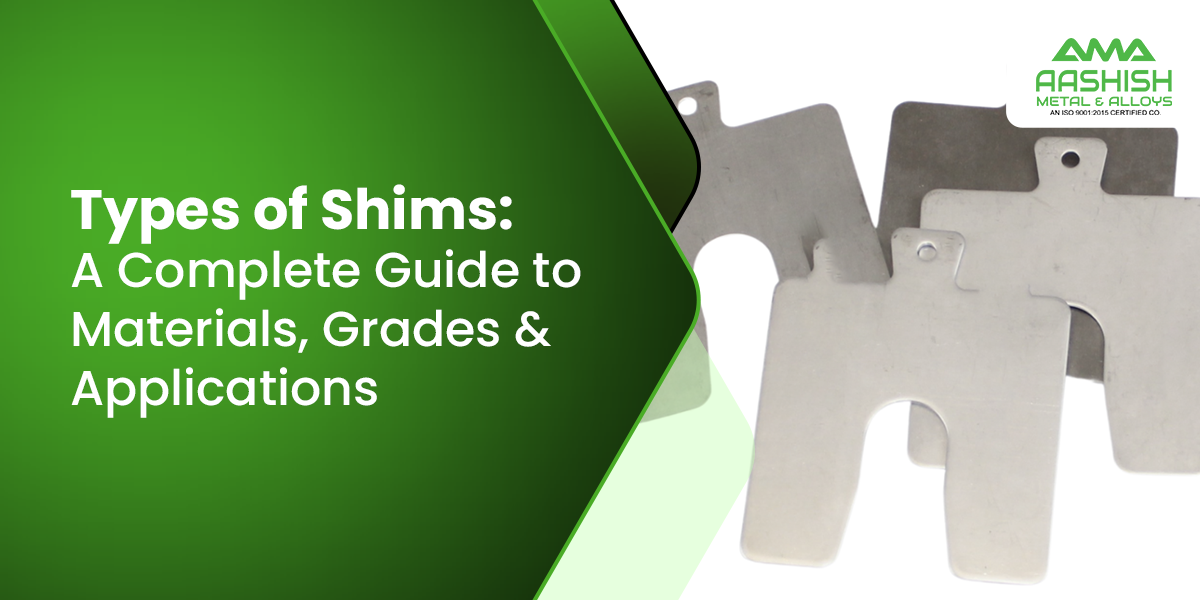
Even the correct kind of shims can be the difference between a machine that is running on precision and a machine that vibrates itself to death. Be it specifying materials to use in a chemical plant, or defining thicknesses of a turbine baseplate, this guide includes all shim materials, grades and design geometries, and provides direct advice as to the materials to use and when.
The selection of types of shims can not be reduced to the mere selection of a thickness. It involves the knowledge of metallurgy, environmental stressors and mechanical load. At Aashish Metals, we supply the technical know how and high quality materials that would see your equipment running in optimum performance.
What Are Shims and Why Are They Used?
A shim is a small tapered or wedged material that is placed to seal small spaces or gaps between objects. Although they may seem like mere metal or plastic scraps, industrial shims are made parts of an engineered structure that is meant to support or adjust positioning or to form a flat surface.
Shims have three important functions in the industrial environment:
- Precision Alignment: When joining two rotating pieces of equipment (i.e. a motor and a pump) any microscopic misalignment of the two parts will result in vibration, which will result in a breakage of the bearing. Research in industries identifies misalignment as the cause of up to 50 percent of the premature bearing failures (per rotating equipment maintenance research; see CDA / ASTM published guidelines). Shafts can be brought to a perfect collinear position with the help of alignment shims.
- Levelling and Stabilisation: In building and heavy machinery construction, floors are not always in the form of a straight plane. There are shims that are used in filling the gaps beneath baseplates so that the load is evenly spread on the foundation.
- Tolerance Compensation: There is a tolerance in manufacturing processes. When machined parts do not fit correctly because of cumulative errors (tolerance stack-up), a shim is used as the buffer, which is needed to reestablish the assembly to the desired specification.
Types of Shims by Material
A material of any shim is as significant as its thickness. When a shim of carbon steel is placed in a saltwater a corrosion takes place very rapidly whereas when a soft material is under heavy load, compression set occurs and the shim becomes flatter as time goes by, destroying your alignment.
- SS 304 Shims
The most common shim material that is specified is Grade 304 Stainless Steel used in general industry. Commonly known as 18/8 stainless (18% chromium, 8% nickel content), it is a good corrosion-resistant strength in the majority of non-marine settings.
Reasons to select it: Stable cost/performance ratio. Oxidation resistant and can be cut or stamped into shapes of the desired design.
Applications: General machine, food service and kitchen. - SS 321 Shims
Ordinary stainless steels are vulnerable to intergranular corrosion following long exposure to high temperatures. Titanium stabilisation of SS 321 enables it to have the capacity to preserve its structural integrity and corrosion resistance up to 800degC in a range that is far higher than that at which standard austenitic grades become sensitised (according to ASTM A240 / AMS 5510).
Rationality: It is good at high temperature up to 800degC.
Applications: Smoke stack, aircraft parts and furnace components.
- Brass Shims
The metal Brass is non-ferrous copper-zinc alloy. It is much softer than stainless steel and is therefore ideal in a situation where the shim is the sacrificial part – it is worn out before the costly machine components are.
Reasons to use it: Non-sparking, and therefore must be used in explosive atmospheres. Little friction properties are also natural.
Uses: Fuel system, ammunition parts, and architectural spacers used in decoration. - Copper Shims
Copper shims have the distinction of being highly thermal and electrical conductive. Copper is the appropriate specifications where a gap has to be filled and still electricity or heat has to pass through a joint.
Reasons: It is the most conductive shim material when compared to others in the common shim range; it is also very pliable and can fit into tight fittings.
Applications: Electric transformers, heat sinks, and high-performance gaskets. - Aluminium Shims
In other industries such as the aerospace industry, gram counts. Aluminium shims have a high strength to weight ratio and they are very resistant to corrosion in the atmosphere, so are the default specification where the weight is a key consideration.
Why use it: Light and very easy to cut in-site with low complexity tools.
Uses: Aircraft wing, automobile body parts, and window fittings.
- Inconel Shims
The Inconel is a nickel-chromium superalloy designed with use in high pressure applications where there are temperatures above 980degC, and where there is exposure to corrosive gases, which cannot be even with most of the standard stainless grades.
Reasons to use It: Does not melt at temperatures that would melt aluminium or stainless steel lose its structure.
Applications: Jet engines, nuclear reactors, high pressure chemical valves.
How to Select the Right Shim Thickness
The right choice of shim thickness is just as critical as is the choice of material. Any precision alignment or tolerance-compensation job can be carried out using the following four steps:
Step 1: Measure the Gap
Calibrated feeler gauges are to be used. Test at several locations around the joint to identify taper. Never trust design drawings, machining tolerances, and wear of components in reality usually have a different value than the nominal value.
Step 2: Calculate the Stack
Round to nearest available standard thickness (0.025 mm steps are standard). Maximum stacks are four stacks – further stacks add cumulative flatness error which increases with every new layer.
Step 3: Check with a Dial Indicator
Once installed, turn the shaft 360deg and ensure that the runout is not more than the tolerance that is stipulated by the machine. When a machine has been shimmed properly, the runout should be constant throughout the angular positions.
Step 4: Torque and Re-check
Shims are slightly compressed with the compressor of fasteners. Re-aligning Alignment Final torquing followed by a micro-correction in case the figure of the runout has moved above or below the tolerance.
Industry Standards Reference Precision shims are manufactured to tolerances per DIN 988 (metric), ASME B18.22.1 (imperial), and BS 3410 (UK). Standard commercial tolerance is ±10% of nominal thickness; precision grade is ±5% or tighter. Always confirm the tolerance grade with your supplier before ordering for critical alignment work. |
Which Shim Material Should You Choose?
Use this table as a quick-reference guide. All data referenced against CDA material index and ASTM published limits.
Material | Corrosion Resistance | Max Temp | Hardness | Best For |
SS 304 | High | 425°C | High | General machinery & food processing |
SS 316 | Excellent | 450°C | High | Offshore, marine & chemical plant |
SS 321 | High | 800°C | High | High-temp exhaust & furnace components |
Brass | Moderate | 200°C | Medium | Non-sparking applications & decorative |
Copper | Moderate | 200°C | Low | Electrical & thermal transfer joints |
Aluminium | Good | 150°C | Low–Medium | Lightweight / aerospace / on-site trim |
Inconel | Extreme | 980°C+ | Very High | Aerospace, nuclear & extreme-heat plant |
Non-Sparking & ATEX Compliance Brass and copper shims are inherently non-sparking and non-magnetic, meeting ATEX Zone 0, 1, and 2 requirements for use in explosive atmospheres. Stainless steel and nickel-alloy shims are non-magnetic but can generate sparks under impact. For hazardous-area applications, always specify a confirmed non-sparking alloy grade and verify compliance with the relevant ATEX zone classification. |
Industries That Use Shims
- Oil & Gas
On offshore platforms, vibration is the primary cause of premature equipment failure. Aashish Metals supplies SS 316 alignment shims to offshore operators where continuous platform motion creates micro-vibration that standard carbon steel shims cannot tolerate. Our shims are specified to within ±0.005 mm to maintain pump alignment across a full operational cycle. [Replace with a specific named project reference if available.] - Automotive
Shims are used in transmission assemblies to adjust gear mesh and in suspension systems to set precise wheel alignment for high-speed stability. - Aerospace
From shimmy dampers to wing-to-fuselage joins, aerospace shims must be ultra-light and meet the highest safety certifications. Aluminium and titanium grades are most commonly specified. - Power Generation
Turbines spinning at 3,600 RPM cannot tolerate even a slight shaft wobble. Precision alignment shims are critical to the continuous operation of the world’s energy grid.
Frequently Asked Questions About Shims
SS 304 stainless steel is the most widely specified shim material across general industrial applications, offering a reliable balance of corrosion resistance, hardness, and cost.
Yes. Pre-cut shim kits allow engineers to stack individual shims to achieve a precise target thickness. Limit stacks to four shims maximum to avoid cumulative flatness error. Ensure all shims in a stack share the same material grade to avoid galvanic corrosion between dissimilar metals.
A washer distributes fastener load across a surface; a shim positions a component in space. They serve different engineering functions and are not interchangeable in precision applications.
Measure the actual gap using a calibrated feeler gauge, then select the nearest standard thickness from your kit. Confirm alignment post-installation with a dial indicator, and re-check after final fastener torquing — torque loading compresses shims slightly.
SS 316 is the minimum specification for any environment with chloride exposure (coastal, offshore, or chemical plant). If the environment combines high salinity with elevated temperature, specify by PREN score. Target PREN > 32 for fully immersed seawater service.
No. Only non-ferrous alloys (brass, copper, aluminium) are reliably non-sparking. Stainless steel shims can generate sparks under impact. For explosive atmospheres (ATEX Zone 0/1/2), always specify a confirmed non-sparking alloy grade.
Need Help Selecting the Right Shim?
If your application needs a footprint or thickness not covered by standard sizes, Aashish Metals fabricates custom shims using laser cutting, waterjet cutting, and stamping across all materials in this guide — to your CAD drawing, with burr-free edges and tolerances certified to DIN 988 / ASME B18.22.1.
Our technical team works with engineers and procurement teams on both standard stocking requests and custom-cut specifications.