
Bimetal Strip Supplier India: Copper Aluminium Bimetallic Strips
Aashish Metal and Alloys is a major producer of bimetallic strip in India and an exporter, producing high quality copper aluminium bimetallic strips to serve two different families of use: thermostatic and thermal switching, and electrical transition joints. Our bimetal strips are precision-rolled, bonded, meeting international specifications, as well as having a broad selection of composition ratios and thickness and width selections to fit electrical, switchgear and industrial needs. We also supply Bimetal Sheets and Bimetal Washers. For the full product range, View all Bimetal Products.
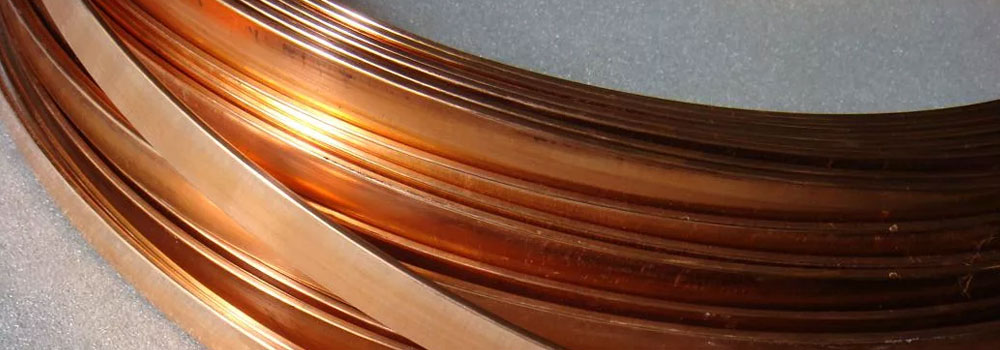
We have been a manufacturer of bimetal strips, copper aluminium bimetal strip, copper aluminum bimetal strip manufacturer of thermal control devices, circuit breakers, thermostats, automotive sensors, temperature switching and precision instruments.
- What is a Bimetal Strip?
- Types of Bimetal Strips
- Composition and Dimensions
- Manufacturing Process: Rolling and Cladding
- Why Bimetal Strip Prevents Galvanic Corrosion at Aluminium-Copper Joints
- Thermal Expansion Properties of Aluminium and Copper
- Industry Applications of Copper Aluminium Bimetal Strip
- Bimetal Strip vs Bimetal Sheet vs Bimetal Washer: Format Selection Guide
- Related Bimetal Products
- Frequently Asked Questions: Copper Aluminium Bimetal Strip
- Export Destinations
What is a Bimetal Strip?
A bimetal strip (also known as a bimetallic strip) is a mixed product in which two dissimilar metals are bonded together permanently into a single laminated strip. The copper-aluminium version has one aluminium-base layer and one copper-base layer, which are rolled together with high pressure to create an atomic-scale metallurgical bond.
The physical properties of the two metals in a bimetal strip are different, which allows the combination to be commercially significant:
- Different coefficients of thermal expansion: aluminium expands at 23.1 micrometres per metre per degree Celsius while copper expands at 16.5 micrometres per metre per degree Celsius. When the strip is heated, aluminium tries to grow faster than copper, causing the strip to bend toward the copper side. This predictable mechanical deflection is used to actuate switches and relays in thermal control devices.
- Different electrochemical properties: aluminium and copper occupy widely separated positions in the galvanic series. When they must be electrically connected, a direct metal-to-metal contact creates a galvanic cell that corrodes the aluminium rapidly. A bimetal strip with an aluminium face bonded to a copper face provides a safe, corrosion-free electrical transition from one metal to the other.
These two properties give the copper aluminium bimetal strip its two distinct commercial roles, which are described in detail in the following section.
Types of Bimetal Strips
The most important distinction in specifying a bimetal strip is understanding which of the two functional types is required. Competitors and aggregator listings often group these together or describe them interchangeably. They are not the same and must not be confused.
Type 1: Thermostatic Bimetal Strip (Thermal Switching)
An aluminium and copper thermostatic bimetal strip relies on the variation in thermal expansion between the two metals to create mechanical motion when temperature varies. As the strip gets heated, it is the aluminium layer that swells more than the copper layer. Since the two metals are permanently bonded, this variation in expansion will result in a curvature or bending motion. As the strip cools, it goes back to its original position.
It is a flexing motion to either open or close an electrical connection, to release a mechanical connection, or to indicate a temperature limit. The reaction is proportional, reproducible and does not need any electrical input. Thermostatic bimetal strips are produced as straight cantilever beams, helical coils, spirals and snap-disc elements as needed depending on the sensitivity and deflection range needed.
Typical applications for thermostatic bimetal strips include:
- Thermostats in home appliances, HVAC systems and industrial process control
- Miniature circuit breakers (MCBs) where the bimetal strip actuates the trip mechanism under sustained overcurrent
- Time-delay relays where the bending strip provides a calibrated delay before contact opening
- Lamp flashers where cyclical heating and cooling of the strip repeatedly opens and closes the lamp circuit
- Automotive temperature sensors and thermal cut-outs
Type 2: Transition Bimetal Strip (Electrical Al-Cu Joint)
A structural and electrical connector employed at a point where an aluminium conductor requires connection to a copper busbar, terminal or fitting is a transition bimetal strip. The strip is bonded on its face to aluminium conductor side and to copper component side by copper face. The final assembly does not involve direct contact between aluminium and copper since the two metals are only in contact at the internally bonded interface in the strip.
This is a bimetal strip, which does not take advantage of thermal bending. It is useful in its electrochemical and electrical properties as a safe transition medium between incompatible metals used in electrical systems.
Typical applications for transition bimetal strips include:
- Power distribution switchgear and MV/LV panels where aluminium cables terminate on copper busbars
- Transformer terminal connections
- Cable lugs and bus bar transition joints
- Government and PSU electrical infrastructure using aluminium cabling with copper switching equipment
Composition and Dimensions
Aashish Metals supplies copper aluminium bimetal strips in two standard composition ratios. The ratio is expressed as Al:Cu and denotes the proportion of aluminium to copper by volume in the bonded strip.
| Composition Ratio | Aluminium (%) | Copper (%) | Primary Use |
|---|---|---|---|
| 80:20 (Al:Cu) | 80% | 20% | Electrical transition joints, MCBs, switchgear |
| 85:15 (Al:Cu) | 85% | 15% | Thermostats, time-delay relays, lamp flashers |
Both ratios are produced by the same rolling and cladding process. The 80:20 ratio provides a slightly higher copper content for better electrical conductivity at the transition interface. The 85:15 ratio is standard for thermostatic applications where the aluminium-dominant layer drives a stronger bending response.
Standard dimensional range:
| Parameter | Standard Range | Special Arrangement | Supply Form |
|---|---|---|---|
| Thickness | 0.1 mm to 3.0 mm | Outside range available on request | Strip, coil, cut-to-length |
| Width | 1 mm to 72 mm | Custom widths available | Strip, coil, cut-to-length |
Strips are supplied as continuous coil, straight strip lengths or cut-to-length pieces. Custom widths and thicknesses outside the standard range are available by special arrangement. Minimum order quantities apply; contact us for details.
Manufacturing Process: Rolling and Cladding
Copper aluminium bimetal strips at Aashish Metals are produced using a solid-state rolling and cladding process. The two metal layers (aluminium and copper in the required ratio) are brought into face-to-face contact and passed through precision rolling mills under controlled pressure.
The process creates an atomic-level diffusion bond at the aluminium-copper interface without the use of adhesives, soldering or any intermediate material. The resulting bond is:
- Stronger than a mechanical joint and immune to delamination under thermal cycling
- Free from flux residues, intermetallic compounds or other interface contaminants that would compromise electrical conductivity
- Dimensionally consistent across the full length of the strip or coil, ensuring repeatable thermal deflection behaviour in thermostatic applications
The rolling process is carried out at room temperature or slightly elevated temperature depending on the strip specification. Post-rolling, strips are cleaned, inspected for dimensional tolerance and bond quality, and prepared for despatch.
Why Bimetal Strip Prevents Galvanic Corrosion at Aluminium-Copper Joints
Galvanic corrosion is a serious and often underestimated problem in electrical installations that mix aluminium and copper conductors. Understanding the mechanism explains why a bimetal transition strip is the correct engineering solution.
The Problem: Direct Aluminium-Copper Contact
There is a large electrochemical potential difference between aluminium and copper. When they are put in direct metal contact with moisture (even condensation by varying temperature in electrical panels) they form a galvanic cell. The anode in this cell is aluminium, which is oxidised. Copper is the cathode and promotes the corrosion.
Practically this implies that a direct bolted connection between an aluminium cable lug and a copper busbar will form a coating of aluminium oxide at the contact face over time. Aluminium oxide is not a good electrical conductor. The resistance to contact increases, the joint becomes hotter, the higher temperature speeds up further oxidation and the joint ultimately fails. This is one of the known causes of panel fires in electrical installations.
The Solution: Bimetal Transition Strip
An internally bonded transition between the two metals is offered by a copper aluminium bimetal strip. The aluminium face is either welded or bolted to the aluminium conductor. The copper face is connected to copper busbar or terminal. The aluminium and copper do not actually come together, but just inside the strip itself is the bonded internal interface, which is metallurgical, hermetically sealed and not in contact with atmospheric moisture.
The galvanic cell cannot be formed as there is no exposed aluminium-copper interface to the environment. The contact resistance on the faces of the strip is constant throughout the service life of the installation.
This is particularly significant in power distribution switchgear, metering cubicles, transformer terminals and any installation where the ingress of moisture cannot be completely controlled such as in humid, coastal or industrial locations.
Thermal Expansion Properties of Aluminium and Copper
| Metal | Coefficient of Thermal Expansion | Role in Bimetal Strip |
|---|---|---|
| Aluminium (Al) | 23.1 micrometres per metre per degree Celsius | High-expansion layer: expands more on heating, drives bending |
| Copper (Cu) | 16.5 micrometres per metre per degree Celsius | Low-expansion layer: resists expansion, creates curvature differential |
The difference of 6.6 micrometres per metre per degree Celsius between the two metals is the driving force behind the bending mechanism in thermostatic applications. For a bimetal strip with a fixed end, this differential expansion produces a deflection that is proportional to temperature change and to the square of the strip length. Longer strips produce greater deflection for the same temperature rise. This predictable relationship allows engineers to design bimetal strip actuators with precise switching temperatures.
Industry Applications of Copper Aluminium Bimetal Strip
- MCBs (Miniature Circuit Breakers)
The bimetal strip in an MCB carries the load current continuously and bends under sustained overload to release the trip mechanism, disconnecting the circuit before damage occurs. - Thermostats
In thermostat assemblies, the bimetal strip element bends as temperature rises, opening or closing an electrical contact at a calibrated setpoint to control heating or cooling systems. - Time-Delay Relays
Bimetal strips in time-delay relays produce a thermal lag between the application of current and the switching action, providing a built-in delay without electronic timers. - Lamp Flashers
In traditional lamp flasher units, current heats the bimetal strip, which bends to open the circuit, the strip cools and closes the circuit again, producing the repeated on-off cycle. - Switchgear and Electrical Panels
Transition bimetal strips are used at every point in a switchgear panel where aluminium busbars or cables must connect to copper terminals, preventing long-term galvanic degradation. - Transformer Terminals
Power transformers with aluminium windings use bimetal strip transition connectors at their terminal blocks to safely connect to copper distribution busbars. - HVAC and Climate Control Systems
Thermostatic bimetal elements are used in HVAC damper actuators, safety cut-outs and temperature limit switches in air handling and refrigeration equipment. - Automotive Temperature Sensors
Bimetal strip elements form the sensing element in automotive thermal fuses, oil temperature indicators and engine compartment overheat cut-outs. - Home Appliance Manufacturing
Toasters, coffee makers, irons and other domestic appliances use bimetal snap-disc or cantilever strip elements as safety thermostats and temperature regulators.
Supplier of Various Types of Bimetal Strips
Bimetal strips are available in different shapes and material combinations. The shape determines the deflection characteristic and the space envelope; the material combination determines the thermal sensitivity and the electrical properties.
| Classification Type | Category / Combination | Functionality and Characteristics | Typical Applications |
|---|---|---|---|
| Based on Shape | Helical Strips | High sensitivity; offers large deflection in a compact size. | Industrial thermometers. |
| Spiral Strips | Moderate sensitivity for standard monitoring. | Home thermometers, ovens. | |
| Cantilever / Simple Beams | Straight strips designed for direct mechanical switching. | Electric toasters, circuit breakers, thermal switches. | |
| Discs / Snap Elements | Engineered for positive, quick snap switching actions. | Coffee makers, snap-action thermostats. | |
| Based on Material | Brass-Steel | The standard choice for general-purpose thermal sensing. | General-purpose thermostats. |
| Copper-Steel | Combines high electrical conductivity with structural strength. | High-conductivity electrical components. | |
| Invar-based Nickel-Steel | High-precision operation at elevated temperatures using low-expansion Invar. | High-precision thermostats and thermometers. |
Bimetal Strip vs Bimetal Sheet vs Bimetal Washer: Format Selection Guide
Aashish Metals supplies copper aluminium bimetal products in three formats. The correct format depends on the geometry of the application and the assembly method.
| Product | Form Factor | Best Suited For | Typical Width / Thickness |
|---|---|---|---|
| Bimetal Strip | Long, narrow strip or coil | MCBs, thermostats, transition joints, relay contacts | 1 to 72 mm wide; 0.1 to 3.0 mm thick |
| Bimetal Sheet | Wide flat sheet | Fabrication, machining, larger contact surfaces | Wider, standard sheet dimensions |
| Bimetal Washer | Round disc with centre hole | Bolted Al-Cu connections, cable lugs, bus bar terminations | OD from small to large; per application |
For flat sheet applications, see our Bimetal Sheets. For bolted connection washers, see our Bimetal Washers. For the complete product range, View all Bimetal Products.
Related Bimetal Products
Bimetal Sheets: Bimetal Sheets are available in flat sheet format for fabrication, machining and larger contact surface applications. Available in the same copper aluminium compositions.
Bimetal Washers: Bimetal Washers are round disc washers with a centre hole, used at bolted aluminium-to-copper connections including cable lugs, bus bar joints and meter sealing terminals. Available in 80:20 (Al:Cu) composition and supplied to government and PSU projects.
Related Products: Copper Shims and Brass Shims are also available for precision gap-filling and alignment applications in electrical and mechanical assemblies.
Quality Assurance and Test Reports
We provide comprehensive quality documentation including Third-Party Inspection (TPI) certification, EN 10204/3.1B Mill Test Certificates, deflection testing reports, thickness measurement certificates and Raw Materials Certificates to verify bonding quality and material specifications. Our test reports ensure complete traceability and compliance with international standards, guaranteeing the highest quality bimetal strip for critical temperature control and electrical transition applications.
Frequently Asked Questions: Copper Aluminium Bimetal Strip
A thermostatic bimetal strip relies on the variability in thermal expansion between aluminium and copper to physically bend with temperature variation, and so activate a switch or relay. An electrical connector is a transition bimetal strip that is employed to connect the aluminium conductors to copper busbars to avoid galvanic corrosion at the contact point. They are both copper aluminium bimetal strips but they have completely contrasting functions in the field of engineering.
We offer copper aluminium bimetal strips with two standard ratios 80:20 (Al:Cu) and 85:15 (Al:Cu). The ratio represents the proportion of the volume of aluminium to copper in the bonded strip.
Normal thickness is 0.1 to 3.0 mm and width is 1 to 72 mm. Other sizes can be ordered specially. Coil, straight strip or cut-to-length strips are provided as required.
Applications of our bimetal strips in MCBs (miniature circuit breakers), thermostats, time-delay relays, lamp flashers, switchgear panels, transformer terminals, automotive sensors and industrial temperature control equipment.
The bond is built in a rolling/cladding technique where two metals layers are pressed together under pressure. This produces diffusion at the atomic level at the interface, which produces a stronger metallurgical bond than a mechanical or adhesive bond and holds together throughout the entire operating temperature spectrum.
Yes. The bimetal strips can be purchased in the form of continuous coil, straight cut strips or cut-to-length strips depending on your production process.
Yes. Get in touch with your desired composition ratio, thickness, width, supply form and quantity. We have bulk inventory and are able to verify price and lead time in real time.
Request a Quote for Bimetal Strip
We maintain bulk inventory of copper aluminium bimetal strips in both 80:20 and 85:15 composition ratios, ready for immediate despatch. Contact us with your required thickness, width, composition ratio and quantity for a competitive price and fast delivery.
Phone: +91-22-66362223 / 66394926
Email: export@aashishmetal.com
Monday to Saturday: 10:00 am to 7:00 pm IST
Export Destinations
Aashish Metal and Alloys exports copper aluminium bimetal strips to over 52 countries across the Middle East, Africa, North America, Europe, Asia, and South America including the UAE, Saudi Arabia, USA, UK, Germany, Singapore, Malaysia, Australia, South Africa and more.
Products
Special Products
PRODUCT RANGE
Please feel free to contact us. We will get back to you with 2 business days. Or just call us now.